Question
Two uniform solid spheres having unequal masses and unequal radii are released from rest from the same height on a rough incline. If the spheres roll without slipping:
  1. The heavier sphere reaches the bottom first.
  2. The bigger sphere reaches the bottom first.
  3. The two spheres reach the bottom together.
  4. The information given is not sufficient to tell which sphere will reach the bottom first.
Answer

  1. The two spheres reach the bottom together.

Explanation:

Acceleration of a sphere on the incline plane is given by:

$\text{a}=\frac{\text{g}\sin\theta}{1+\frac{\text{I}_{\text{COM}}}{\text{mr}^2}}$

ICOM for a solid sphere $=\frac{2}{5}\text{mr}^2$

So, $\text{a}=\frac{\text{g}\sin\theta}{1+\frac{2\text{mr}^2}{5\text{mr}^2}}=\frac{5}{7}\text{g}\sin\theta$

a is independent of mass and radii; therefore, the two spheres reach the bottom together.

Need a full question paper?

Generate a complete, print-ready paper with questions like this in minutes — across 16+ boards, with answer keys.

Start Generating Free

Similar questions

At room temperature, the $r.m.s.$ speed of the molecules of certain diatomic gas is found to be $1920\, m/s$. The gas is
Four particles each of mass $m$ are placed at the corners of a square of side length $l.$  The radius of gyration of the system about an axis perpendicular to the square and passing through its centre is   
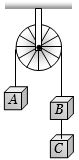
Three equal weights $A, B$ and $C$ of mass $2\, kg$ each are hanging on a string passing over a fixed frictionless pulley as shown in the figure The tension in the string connecting weights $B$ and $C$ is ........... $N$
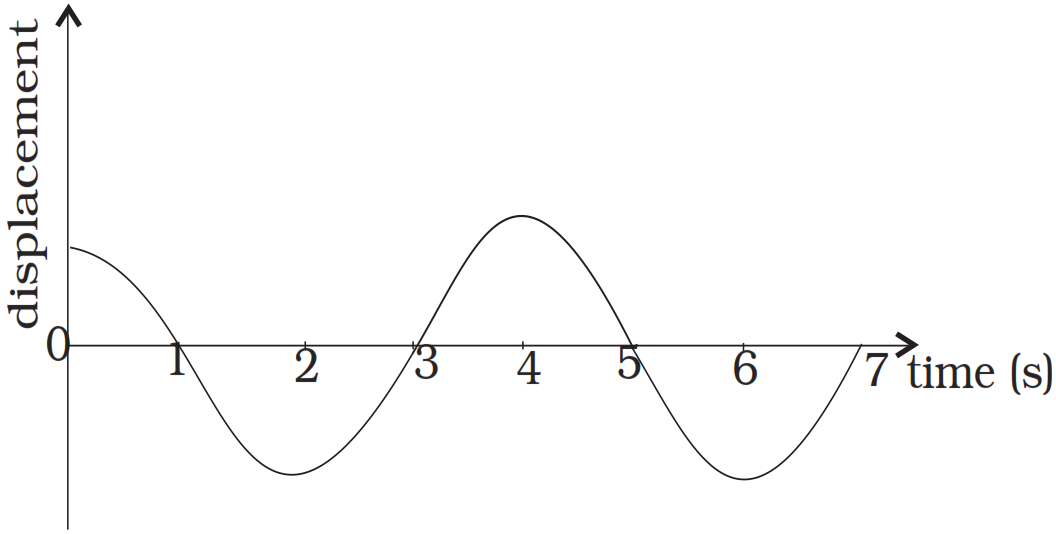
Displacement vs. time curve for a particle executing S.H.M. is shown in Fig. Choose the correct statements:

A black body at a temperature of $1640 K$  has the wavelength corresponding to maximum emission equal to $1.75$ $\mu $. Assuming the moon to be a perfectly black body, the temperature of the moon, if the wavelength corresponding to maximum emission is $ 14.35$ $\mu $ is ...... $K$
The motion of a body is given by the equation $\frac{{dv(t)}}{{dt}} = 6.0 - 3v(t)$. where $v(t)$ is speed in $m/s$ and $t$ in $\sec $. If body was at rest at $t = 0$
A balloon has $2 \,g$ of air. A small hole is pierced into it. The air comes out with a velocity of $4 \,m / s$. If the balloon shrinks completely in $2.5 \,s$. The average force acting on the balloon is ..........$N$
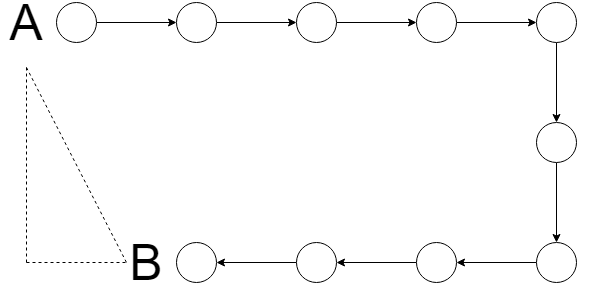
If, in the following diagram, distance between each circle is 1 unit, what is the displacement between A and B?

The vectors $\overrightarrow A $ and $\overrightarrow B$  lie in a plane. Another vector $\overrightarrow C $ lies outside this plane. The  resultant $\overrightarrow A + \overrightarrow B + \overrightarrow C$ of these three vectors
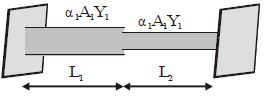
Two rods are joined between fixed supports as shown in the figure. Condition for no change in the lengths of individual rods with the increase of temperature will be

( ${\alpha _1},\,{\alpha _2},$ = linear expansion coefficient

$A_1, A_2$ = Area of rods

$Y_1, Y_2$ = Young modulus)