MCQ
Two waves have their amplitudes in the ratio $1: 9$. The maximum and minimum intensities when they interfere are in the ratio
  • $\frac{25}{16}$
  • B
    $\frac{16}{26}$
  • C
    $\frac{1}{9}$
  • D
    $\frac{9}{1}$

Answer

Correct option: A.
$\frac{25}{16}$
$\frac{I_{\max }}{I_{\min }}=\left(\frac{\frac{a_1}{a_2}+1}{\frac{a_1}{a_2}-1}\right)^2=\left(\frac{\frac{1}{9}+1}{\frac{1}{9}-1}\right)^2=\left(\frac{5}{4}\right)^2=\frac{25}{16}$.

Need a full question paper?

Generate a complete, print-ready paper with questions like this in minutes — across 16+ boards, with answer keys.
Start Generating Free

Similar questions

Temperature of a black body increases from $327^{\circ} \mathrm{C}$ to $927^{\circ} \mathrm{C}$, the initial energy possessed is $2 \mathrm{KJ}$, what is its final energy
A metal surface of work function $1.07 \ \mathrm{eV}$ is irradiated with light of wavelength $332 \mathrm{~nm}$. The retarding potential required to stop the escape of photo-electrons is
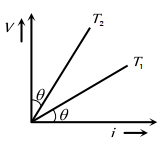
The $V$ - $i$ graph for a conductor at temperature $T_1$ and $T_2$ are as shown in the figure. $\left(T_2-T_1\right)$ is proportional to

Image

While using an electric bulb, the reflection for street lighting should be from
Pressure-temperature relationship for an ideal gas undergoing adiabatic change is $\left(\gamma=C_p / C_v\right)$
The kinetic energy possessed by a body of mass $m$ moving with a velocity $v$ is equal to $\frac{1}{2} m v^2$, provided
If the momentum of a body is increased by $100 \%$, then the percentage increase in the kinetic energy is
When a current of 1 ampere is passed through a conductor whose ends are maintained at temperature difference of $1^{\circ} C$, the amount of heat evolved or absorbed is called
Two bodies $M$ and $N$ of equal masses are suspended from two separate massless springs of force constants $k$ and $k$ respectively. If the two bodies oscillate vertically such that their maximum velocities are equal, the ratio of the amplitude $M$ to that of $N$ is
A ball is dropped on the floor from a height of $10 m$. lt rebounds to a height of $2.5 m$. If the ball is in contact with the floor for $0.01 sec$, the average acceleration during contact is