MCQ
Two waves having sinusoidal waveforms have different wavelengths and different amplitude. They will be having
  • Same pitch and different intensity
  • B
    Same quality and different intensity
  • C
    Different quality and different intensity
  • D
    Same quality and different pitch

Answer

Correct option: A.
Same pitch and different intensity
(a) The pitch depends upon the frequency of the source. As the twowaveshavedifferentamplitude therefore they having different intensity. While quality depends on numberofharmonicsovertone produced and their relative intensity. Assuming that their frequencies are the same.

Need a full question paper?

Generate a complete, print-ready paper with questions like this in minutes — across 16+ boards, with answer keys.

Start Generating Free

Similar questions

A $60 \mathrm{~kg}$ man runs up a staircase in 12 seconds while a $50 \mathrm{~kg}$ man runs up the same staircase in 11 , seconds, the ratio of the rate of doing their work is
The dimensional formula for r.m.s. (root mean square) velocity is
If $\vec{A}$ and $\vec{B}$ are perpendicular vectors and vector $\vec{A}=5 \hat{i}+7 \hat{j}-3 \hat{k}$ and $\vec{B}=2 \hat{i}+2 \hat{j}-a \hat{k}$. The value of $a$ is
The percentage error in the above problem is
An aeroplane is flying with a uniform speed of $100 m / s$ along a circular path of radius $100 m$. the angular speed of the aeroplane will be
A body of $10 \mathrm{~kg}$ is acted by a force of $129.4 \mathrm{~N}$ if $g=9.8 \mathrm{~m} / \mathrm{sec}^2$. The acceleration of the block is $10 \mathrm{~m} / \mathrm{s}^2$. What is the coefficient of kinetic friction
A magnet of magnetic moment $50 \hat i\, Am^2$ is placed along the $x-$ axis in a magnetic field $\vec B = (0.5\hat i + 3.0\hat j)\,T$. The torque acting on the magnet is
$\mu_0$ and $\varepsilon_0$ denote the permeability and permittivity of free space, the dimensions of $\mu_0 \varepsilon_0$ are
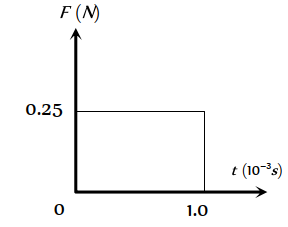
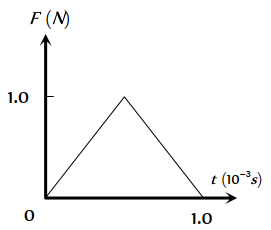
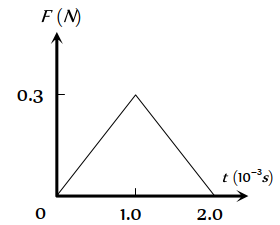
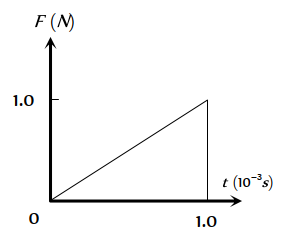
Figures $1,11,111$ and $IV$ depict variation of force with time

i

Image

ii

Image

iii

Image

iv

Image

The impulse is highest in the case of situations depicted. Figure

The masses and radii of the earth and moon are $M_1, R_1$ and $M_2, R_2$ respectively. Their centres are distance $d$ apart. The minimum velocity with which a particle of mass $m$ should be projected from a point midway between their centres so that it escapes to infinity is