MCQ
Two waves of same amplitude and same wavelength are superimposed in different phases. The amplitude of the resultant wave will be maximum when the phase difference between them is:
  • zero
  • B
    $\pi / 2$
  • C
    $\pi$
  • D
    $3 \pi / 2$

Answer

Correct option: A.
zero
(A) - zero

Need a full question paper?

Generate a complete, print-ready paper with questions like this in minutes — across 16+ boards, with answer keys.
Start Generating Free

Similar questions

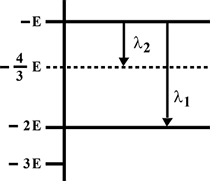
Some energy levels of a molecule are shown in the figure. The ratio of the wavelengths $r$ =$\frac{{{\lambda _1}}}{{{\lambda _2}}}$ is given by
A proton and an electron have the same de Broglie wavelength. If $K_p$ and $K_e$ be the kinetic energies of proton and electron respectively. Then choose the correct relation :
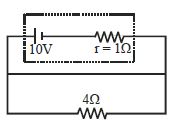
Potential difference across the terminals of the battery shown in figure is .................... $V$ ($r =$ internal resistance of battery)
Two wires ‘A’ and ‘B’ of the same material have their lengths in the ratio 1 : 2 and radii in the ratio 2 : 1. The two wires are connected in parallel across a battery. The ratio of the heat produced in ‘A’ to the heat produced in ‘B’ for the same time is
The pressure exerted by an electromagnetic wave of intensity I$\Big(\frac{\text{watt}}{\text{m}^2}\Big)$ on a non-reflecting surface is : $[c$ is the velocity of light$].$
The surface charge density of a thin charged disc of radius $R$ is $\sigma $. The value of the electric field at the centre of the disc is $\frac{\sigma }{{2\,{ \in _0}}}$. With respect to the field at the centre, the electric field along the axis at a distance $R$ from the centre of the disc
Capacitance of a parallel plate capacitor becomes $4/3$ times its original value if a dielectric slab of thickness $t = d/2$ is inserted between the plates ($d$ is the separation between the plates). The dielectric constant of the slab is
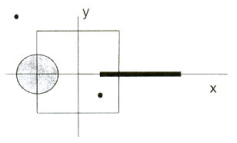
A disk of radius $a / 4$ having a uniformly distributed charge $6 \mathrm{C}$ is placed in the $x-y$ plane with its centre at $(-a / 2,0,0)$. A rod of length $a$ carrying a uniformly distributed charge $8 \mathrm{C}$ is placed on the $x$-axis from $x=a / 4$ to $x=5 a / 4$. Two point charges $-7 \mathrm{C}$ and $3 \mathrm{C}$ are placed at $(a / 4,-a / 4,0)$ and $(-3 a / 4,3 a / 4,0)$, respectively. Consider a cubical surface formed by six surfaces $x= \pm a / 2, y= \pm a / 2$, $z= \pm a / 2$. The electric flux through this cubical surface is
Two straight parallel wires, both carrying $10$ $ampere$ in the same direction attract each other with a force of $1 \times {10^{ - 3}}\,N$. If both currents are doubled, the force of attraction will be
Two $220\; V , 100 \;W$ bulbs are connected first in series and then in parallel. Each time the combination is connected to a $220 \;V \;AC$ supply line. The power drawn by the combination in each case respectively will be