MCQ
Two waves of same frequency and intensity superimpose with each other in opposite phases, then after superposition the
  • A
    Intensity increases by $4$ times
  • B
    Intensity increases by two times
  • C
    Frequency increases by $4$ times
  • None of these

Answer

Correct option: D.
None of these
d
(d) This is a case of destructive interference.

Need a full question paper?

Generate a complete, print-ready paper with questions like this in minutes — across 16+ boards, with answer keys.
Start Generating Free

Similar questions

If a body of mass $200\, g$ falls from a height $200 \,m$ and its total $P.E.$ is converted into $K.E.$ at the point of contact of the body with earth surface, then what is the decrease in $P.E.$ of the body at the contact $(g = 10\,m/{s^2})$ ............ $\mathrm{J}$
Hot water cools from ${60^o}C$ to ${50^o}C$ in the first $10$ minutes and to ${42^o}C$ in the next $10$ minutes. The temperature of the surrounding is ......... $^oC$
The moment of inertia of a uniform semicircular wire of mass M and radius r about a line perpendicular to the plane of the wire through the centre is:
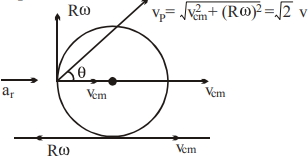
$A$ disc of radius $R$ is rolling purely on a flat horizontal surface, with a constant angular velocity. The angle between the velocity and acceleration vectors of point $P$ is
$Assertion :$ A hollow metallic closed container maintained at a uniform temperature can act as a source of black body radiation.
$Reason :$ All metals act as black bodies.
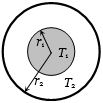
The figure shows a system of two concentric spheres of radii $r_1$ and $r_2$ and kept at temperatures $T_1$ and $T_2$, respectively. The radial rate of flow of heat in a substance between the two concentric spheres is proportional to
In a tonga, horse pulls a wagon. Which is the correct analysis of the situation?
An oscillator of mass $M$  is at rest in its equilibrium position in a potential $V\, = \,\frac{1}{2}\,k{(x - X)^2}.$ A particle of mass $m$  comes from right with speed $u$  and collides completely inelastically with $M$ and sticks to it . This process repeats every time the oscillator crosses its equilibrium position .The amplitude of oscillations after $13$  collisions is: $(M = 10,\, m = 5,\, u = 1,\, k = 1 ).$ 
Given below are two statements :

Statements $I$ : Astronomical unit $(Au)$. Parsec $(Pc)$ and Light year $(ly)$ are units for measuring astronomical distances.

Statements $II:$ $Au < Parsec ( Pc ) < ly$

In the light of the above statements. choose the most appropriate answer from the options given below:

An ideal gas follows a process described by the equation $PV ^2= C$ from the initial $\left( P _1, V _1, T _1\right)$ to final $\left(P_2, V_2, T_2\right)$ thermodynamics states, where $C$ is a constant. Then