Question
Two waves, travelling in the same direction through the same region, have equal frequencies, wavelengths and amplitudes. If the amplitude of each wave is 4mm and the phase difference between the waves is 90°, what is the resultant amplitude?
Answer

 Phase difference $\phi=\frac{\pi}{2}$

f and $\lambda$ are same. So, $\omega$ is same.

$\text{y}_1=\text{r}\sin\text{wt},\ \text{y}_2=\text{r}\sin\big(\text{wt}+\frac{\pi}{2}\big)$

From the principle of superposition

$\text{y}=\text{y}_1+\text{y}_2$

$=\text{r}\sin\text{wt}+\text{r}\sin\big(\text{wt}+\frac{\pi}{2}\big)$

$=\text{r}\Big[\sin\text{wt}+\text{r}\sin\big(\text{wt}+\frac{\pi}{2}\big)\Big]$

$=\text{r}\Bigg[2\sin\bigg\{\frac{\big(\text{wt}+\text{wt}+\frac{\pi}{2}\big)}{2}\bigg\}\cos\bigg\{\frac{\big(\text{wt}-\text{wt}-\frac{\pi}{2}\big)}{2}\bigg\}\Bigg]$

$\Rightarrow\text{y}=2\text{r}\sin\Big(\text{wt}+\frac{\pi}{4}\Big)\cos\Big(\frac{-\pi}{4}\Big)$

Resultant amplitude $=\sqrt{2}\text{r}=4\sqrt{2}\text{mm}$ (because r = 4mm)

Need a full question paper?

Generate a complete, print-ready paper with questions like this in minutes — across 16+ boards, with answer keys.

Start Generating Free

Similar questions

A straight wire carrying an electric current is placed along the axis of a uniformly charged ring. Will there be a magnetic force on the wire if the ring starts rotating about the wire? If yes, in which direction?
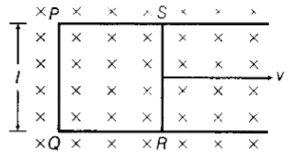
Figure shows a rectangular conducting loop PQRS in which arm RS of length I is movable. The loop is kept in a uniform magnetic field B directed downward perpendicular to the plane of the loop. The arm RS is moved with a uniform speed v.
Image

Deduce an expression for
i. the emf induced across the arm RS
ii. the external force required to move the arm and
iii. the power dissipated as heat.
  1. Derive Snell's law on the basis of Huygen's wave theory when light is travelling from a denser to a rarer medium.
  2. Draw the sketches to differentiate between plane wavefront and spherical wavefront.
Write the S.I. unit and dimensional formula for the permittivity of free space ?
In what way is Gauss’s law in magnetism different from that used in electrostatics? Explain briefly. The Earth’s magnetic field at the Equator is approximately 0.4 G. Estimate the Earth’s magnetic dipole moment. Given: Radius of the Earth = 6400 km.
In an experiment on photoelectric effect, the slope of the cut-off voltage versus frequency of incident light is found to be 4.12 × 10–15 Vs. Calculate the value of Planck’s constant.
A resistor R and an inductor L are connected in series to a source $\text{V}=\text{V}_0\sin\omega\text{t}.$
Find:
  1. Peak value of the voltage drops across R and across L,
  2. Phase difference between the applied voltage and current. Which of them is ahead?
Two particles, carrying charges -q and +q and having equal masses m each, are fixed at the ends of a light rod of length a to form a dipole. The rod is clamped at an end and is placed in a uniform electric field E with the axis of the dipole along the electric field. The rod is slightly tilted and then released. Neglecting gravity find the time period of small oscillations.
(II) (a) Define electric flux and write its SI unit.
(b) Use Gauss᾿s law to obtain the expression for the electric field due to a uniformly charged infinite plane sheet of charge.
Characteristic X-rays may be used to identify the element from which they are being emitted. Can continuous X-rays be used for this purpose?