MCQ
Two wires $A$ and $B$ of same length, same area of cross-section having the same Young's modulus are heated to the same range of temperature. If the coefficient of linear expansion of $A$ is $3/2$ times of that of wire $B$. The ratio of the forces produced in two wires will be
  • A
    $2/3$
  • B
    $9/4$
  • C
    $4/9$
  • $3/2$

Answer

Correct option: D.
$3/2$
d
(d) $F = YA\alpha \Delta \theta $

If $Y, A$ and $\Delta \theta$ are constant then $\frac{{{F_A}}}{{{F_B}}} = \frac{{{\alpha _A}}}{{{\alpha _B}}} = \frac{3}{2}$

Need a full question paper?

Generate a complete, print-ready paper with questions like this in minutes — across 16+ boards, with answer keys.

Start Generating Free

Similar questions

A potter's wheel has ______ motion:
A body of mass $5 \times 10^{3} \,kg$ moving with speed $2\, m / s$ collides with a body of mass $15 \times 10^{3} \,kg$ in elastically and sticks to it. Then loss in $K. E.$ of the system will be (in $KJ$)
A force of $200\, N$ is applied at one end of a wire of length $2\, m$ and having area of cross-section ${10^{ - 2}}\,c{m^2}$. The other end of the wire is rigidly fixed. If coefficient of linear expansion of the wire $\alpha = 8 \times 10{^{-6}}°C^{-1}$ and Young's modulus $Y = 2.2 \times {10^{11}}\,N/{m^2}$ and its temperature is increased by $5°C$, then the increase in the tension of the wire will be ........ $N$
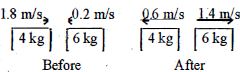
In figure, determine the type of the collision The masses of the blocks, and the velocities before and after the collision are given. The collision is
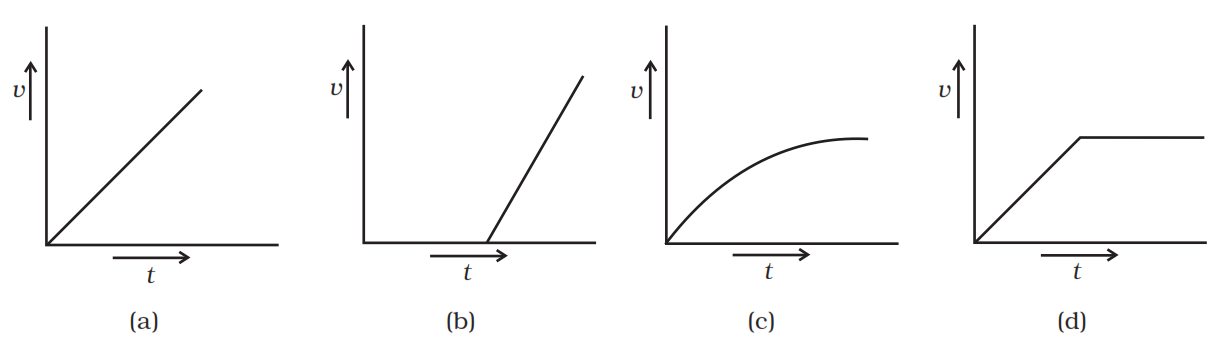
A tall cylinder is filled with viscous oil. A round pebble is dropped from the top with zero initial velocity. From the plot shown in indicate the one that represents the velocity (v) of the pebble as a function of time (t):

A rubber ball is dropped from a height of $5 \,m$ on a planet where the acceleration due to gravity is not known. On bouncing, it rises to $1.8\, m$. The ball loses its velocity on bouncing by a factor of
A rocket is fired vertically up from the ground with a resultant vertical acceleration of $10\  m/s^2$. The fuel is finished in $1\  minute$ and it continues to move up.$(a)$ the maximum height reached.$(b)$ After how much time from then will the maximum height be reached (Take $g = 10\  m/s^2$)
An optical bench has $1.5 m$ long scale having four equal divisions in each $cm$. While measuring the focal length of a convex lens, the lens is kept at $75 cm$ mark of the scale and the object pin is kept at $45 cm$ mark. The image of the object pin on the other side of the lens overlaps with image pin that is kept at $135 cm$ mark. In this experiment, the percentage error in the measurement of the focal length of the lens is. . . . .
The ratio of the numerical values of the average velocity and average speed of a body is always
Streamline flow is more likely for liquids with:
  1. High density.
  2. High viscosity.
  3. Low density.
  4. Low viscosity.