Question
Under certain circumstances, a nucleus can decay by emitting a particle more massive than an $\alpha$particle. Consider the following decay processes:
$^{223}_{88}\text{Ra}\rightarrow^{209}_{82}\text{Pb}+^{14}_{6}\text{C}$
$^{223}_{88}\text{Ra}\rightarrow^{219}_{86}\text{Rn}+^{4}_{2}\text{He}$
Calculate the Q-values for these decays and determine that both are energetically allowed.
Answer

Take a $^{14}_{6}\text{C}$ emission nuclear reaction:
$^{223}_{88}\text{Ra}\rightarrow^{209}_{82}\text{Pb}+^{14}_{6}\text{C}$
We know that:
Mass of $^{223}_{88}\text{Ra},\ \text{m}_1=223.01850\text{ u}$
Mass of $^{209}_{82}\text{Pb},\ \text{m}_2=208.98107\text{ u}$
Mass of $^{14}_{6}\text{C },\text{m}_3=14.00324\text{ u}$
Hence, the Q-value of the reaction is given as:
$\text{Q}=(\text{m}_1-\text{m}_2-\text{m}_3)\text{c}^2$
= (223.01850 - 208.98107 - 14.00324)c2
= (0.03419 c2) u
But 1 u = 931.5 MeV/c2
$\therefore\ \text{Q}=0.03419\times931.5$
= 31.848 MeV
Hence, the Q-value of the nuclear reaction is 31.848 MeV. Since the value is positive, the reaction is energetically allowed.
Now take a $^{4}_{2}\text{He}$ emission nuclear reaction:
$^{223}_{88}\text{Ra}\rightarrow^{219}_{86}\text{Rn}+^{4}_{2}\text{He}$
We know that:
Mass of $^{223}_{88}\text{Ra},\ \text{m}_1=223.01850$
Mass of $^{219}_{82}\text{Rn},\ \text{m}_2=219.00948$
Mass of $^{4}_{2}\text{He },\text{m}_3=4.00260$
Q-value of this nuclear reaction is given as:
$\text{Q}=(\text{m}_1-\text{m}_2-\text{m}_3)\text{c}^2$
= (223.01850 - 219.00948 - 4.00260)C2
= (0.00642 c2) u
= 0.00642 × 931.5 = 5.98 MeV
Hence, the Q value of the second nuclear reaction is 5.98 MeV. Since the value is positive, the reaction is energetically allowed.

Need a full question paper?

Generate a complete, print-ready paper with questions like this in minutes — across 16+ boards, with answer keys.

Start Generating Free

Similar questions

A plane electromagnetic wave travels in vacuum along z - direction. What can you say about the directions of its electric and magnetic field vectors? If the frequency of the wave is 30 MHz, what is its wavelength?
A metal ball of mass 1kg is heated by means of a 20W heater in a room at 20°C. The temperature of the ball becomes steady at 50°C.
  1. Find the rate of loss of heat to the surrounding when the ball is at 50°C.
  2. Assuming Newton's law of cooling, calculate the rate of loss of heat to the surrounding when the ball is at 30°C.
  3. Assume that the temperature of the ball rises uniformly from 20°c to 30°C in 5 minutes. Find the total loss of heat to the surrounding during this period.
  4. Calculate the specific heat capacity of the metal.
Two particles A and B, each having a charge Q, are placed a distance d apart. Where should a particle of charge q be placed on the perpendicular bisector of AB so that it experiences maximum force What is the magnitude of this maximum force?
A particle of mass m is kept on the top of a smooth sphere of radius R. It is given a sharp impulse which imparts it a horizontal speed v.
  1. Find the normal force between the sphere and the particle just after the impulse.
  2. What should be the minimum value of v for which the particle does not slip on the sphere?
  3. Assuming the velocity v to be half the minimum calculated in part.
  4. Find the angle made by the radius through the particle with the vertical when it leaves the sphere.

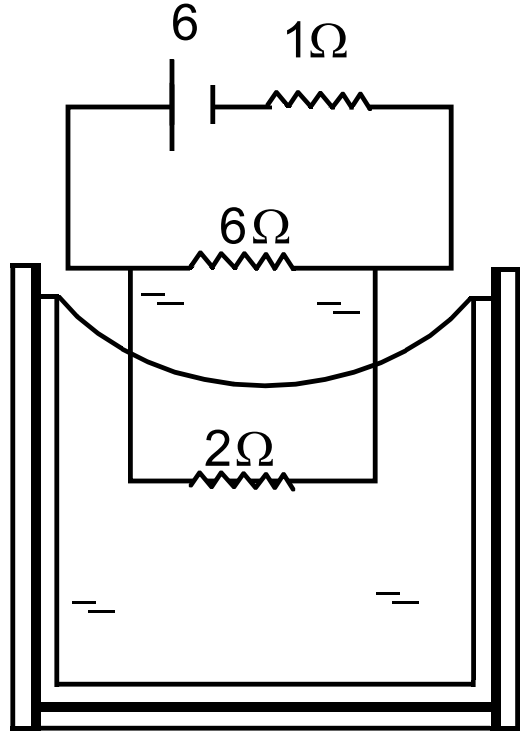
The 2.0Ω resistor shown in the figure is dipped into a calorimeter containing water. The heat capacity of the calorimeter together with water is 2000JK-1.
  1. If the circuit is active for 15 minutes, what would be the rise in the temperature of the water?
  2. Suppose the 6.0Ω resistor gets burnt. What would be the rise in the temperature of the water in the next 15 minutes?

  1. Using Gauss Theorem show mathematically that for any point outside the shell, the field due to a uniformly charged spherical shell is same as the entire charge on the shell, is concentrated at the centre.
  2. Why do you expect the electric field inside the shell to be zero according to this theorem?

OR

A thin conducting spherical shell of radius R has charge Q spread uniformly over its surface. Using Gauss’s theorem, derive an expression for the electric field at a point outside the shell.

Draw a graph of electric field E(r) with distance r from the centre of the shell for $0\leq\text{r}\le\infty.$

OR

Find the electric field intensity due to a uniformly charged spherical shell at a point (i) outside the shell and (ii) inside the shell. Plot the graph of electric field with distance from the centre of the shell.

OR

Using Gauss’s law obtain the expression for the electric field due to a uniformly charged thin spherical shell of radius R at a point outside the shell. Draw a graph showing the variation of electric field with r, for r > R and r < R.

A person is standing on a truck moving with a constant velocity of 14.7m/s on a horizontal road. The man throws a ball in such a way that it returns to the truck after the truck has moved 58.8m. Find the speed and the angle of projection:
  1. As seen from the truck.
  2. As seen from the road.
Suppose the entire system of the previous question is kept inside an elevator which is coming down with an acceleration a < g. Repeat parts (a) and (b).
Natural water contains a small amount of tritium $\big(\text{ }^3_1\text{H}\big).$ This isotope beta-decays with a half-life of 12.5 years. A mountaineer while climbing towards a difficult peak finds debris of some earlier unsuccessful attempt. Among other things he finds a sealed bottled of whisky. On returning, he analyses the whisky and finds that it contains only 1.5 per cent of the $\text{}^3_1\text{H}$ radioactivity as compared to a recently purchased bottle marked '8 years old'. Estimate the time of that unsuccessful attempt.
  1. Two insulated charged copper spheres A and B have their centres separated by a distance of 50 cm. What is the mutual force of electrostatic repulsion if the charge on each is 6.5 × 10⁻⁷ C? The radii of A and B are negligible compared to the distance of separation.
  2. What is the force of repulsion if each sphere is charged double the above amount, and the distance between them is halved?