MCQ
Under steady state, the temperature of a body
  • A
    Increases with time
  • B
    Decreases with time
  • C
    Does not change with time and is same at all the points of the body
  • Does not change with time but is different at different points of the body

Answer

Correct option: D.
Does not change with time but is different at different points of the body
(d) In steady state there is no absorption of heat in any position. Heat passes on or is radiated from it's surface. Therefore, in steady state the temperature of the body does not change with time but can be different at different points of the body.

Need a full question paper?

Generate a complete, print-ready paper with questions like this in minutes — across 16+ boards, with answer keys.
Start Generating Free

Similar questions

A convex lens produces a real image $m$ times the size of the object. What will be the distance of the object from the lens
In human eye the focussing is done by
Two identical thin bar magnets each of length $/$ and pole strength $m$ are placed at right angle to each other with north pole of one touching south pole of the other. Magnetic moment of the system is
A silver ball of radius $4.8 \mathrm{~cm}$ is suspended by a thread in the vacuum chamber. $L / V$ light of wavelength $200 \mathrm{~nm}$ is incident on the ball for some times during which a total energy of $1 \times 10$. falls on the surface. Assuming on an average one out of $10$ photons incident is able to eject electron. The potential on sphere will be
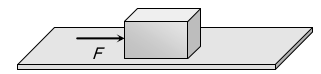
A block of mass $2 \mathrm{~kg}$ is kept on the floor. The coefficient of static friction is $0.4$. If a force $F$ of $2.5$ Newtons is applied on the block as shown in the figure, the frictional force between the block and the floor will beImage
The idea of the quantum nature of light has emerged in an attempt to explain
The focal length of a convex mirror is $20 \mathrm{~cm}$ its radius of curvature will be
If the value of ' $g$ ' acceleration due to gravity, at earth surface is $10 \mathrm{~m} / \mathrm{s}^2$, its value in $\mathrm{m} / \mathrm{s}^2$ at the centre of the earth, which is assumed to be a sphere of radius ' $R$ ' metre and uniform mass density is
The amount of work, which can be obtained by supplying $200 \mathrm{cal}$ of heat, is
A black body is at a temperature $300 \mathrm{~K}$. It emits energy at a rate, which is proportional to