MCQ
$\underset{\raise0.3em\hbox{$\smash{\scriptscriptstyle-}$}}{A} \xrightarrow{{4\,KO{H_1}{O_2}}}\mathop {2\underset{\raise0.3em\hbox{$\smash{\scriptscriptstyle-}$}}{B} }\limits_{(Green)}  + 2{H_2}O$

$3\underset{\raise0.3em\hbox{$\smash{\scriptscriptstyle-}$}}{B} \xrightarrow{{4\,HCl}}\mathop {2C}\limits_{(Purple)}  + Mn{O_2} + 2{H_2}O$

$3\underset{\raise0.3em\hbox{$\smash{\scriptscriptstyle-}$}}{C} \xrightarrow{{{H_2}O,KI}}2\underset{\raise0.3em\hbox{$\smash{\scriptscriptstyle-}$}}{A}  + 2KOH + \underset{\raise0.3em\hbox{$\smash{\scriptscriptstyle-}$}}{D} $

In the above sequence of reactions, $\underset{\raise0.3em\hbox{$\smash{\scriptscriptstyle-}$}}{A}$ and $\underset{\raise0.3em\hbox{$\smash{\scriptscriptstyle-}$}}{D} $ ,  respectively are

  • A
    $KI$ and $KMnO_4$
  • $MnO_2$ and $KIO_3$
  • C
    $KIO_3$ and $MnO_2$
  • D
    $KI$ and $K_2MnO_4$

Answer

Correct option: B.
$MnO_2$ and $KIO_3$
b
$Mn{O_2}\,\xrightarrow{{4KOH,\,{O_2}}}\mathop {2{K_2}Mn{O_4}}\limits_{(Green)} \, + \,2{H_2}O$

$3{K_2}Mn{O_4}\,\xrightarrow{{4\,HCl}}\mathop {2KMn{O_4}}\limits_{(purple)} \, + \,Mn{O_2}\, + \,2{H_2}O$

$2KMn{O_4}\,\xrightarrow{{{H_2}O,\,KI}}2Mn{O_2}\, + \,2KOH\, + \,KI{O_3}$

Need a full question paper?

Generate a complete, print-ready paper with questions like this in minutes — across 16+ boards, with answer keys.

Start Generating Free

Similar questions

$\begin{array}{*{20}{c}}
  {\,\,\,\,\,\,\,\,\,\,\,\,\,O} \\ 
  {\,\,\,\,\,\,\,\,\,\,\,\,\,||} \\ 
  {\mathop {C{H_3}MgBr}\limits_{(excess)}  + Et - O - C - O - Et\xrightarrow[{(2){H^ \oplus }}]{}(A)} 
\end{array}$ ; Product $A$ is
Which of the following is the example of $S{N^2}$ reaction
In the nitrogen family the $H -M -H$ bond angle in the hydrides $MH_3$ gradually becomes closer to $90^o$ on going from $N$ to $Sb$. This shows that gradually
Which of the following silver compounds finds maximum use in photography
Find out the major product formed from the following reaction. $\left[\mathrm{Me}:-\mathrm{CH}_3\right]$
A solution contains $1.2046 \times {10^{24}}$ hydrochloric acid molecules in one $d{m^3}$ of the solution. The strength of the solution is .......... $N$
To carry out above conversion, arrange the following reagents in correct order

$\begin{matrix}
   {{O}_{3}}/Zn  \\
   (1)  \\
\end{matrix}\,\,\,\,\,\,\,\,\,\,\begin{matrix}
   EtONa/EtOH/\Delta   \\
   (2)  \\
\end{matrix}\,\,\,\,\,\,\,\,\,\,\,\begin{matrix}
   NaOCl  \\
   (3)  \\
\end{matrix}\,\,\,\,\,\,\,\,\,\begin{matrix}
   {{H}^{+}}  \\
   (4)  \\
\end{matrix}$

Chlorobenzene is formed by reaction of chlorine with benzene in the presence of $\ce{AlCl_3}.$ Which of the following species attacks the benzene ring in this reaction?
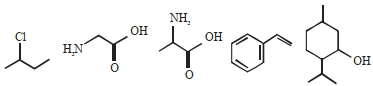
Observe structures of the following compounds

$[Image]$

The total number of structures/compounds which possess asymmetric carbon atoms is $....$

The maximum number of $ - N{O_2}$ groups that can be introduced by nitration in benzene is usually