Question
Unicellular organisms differ from multicellular ones. How?

Answer

Unicellular Organisms
Multicellular Organisms
The body of the unicellular organism is composed of a single cell.
The body of the multicellular organism is composed of numerous cells.
Irregular in shape.
Have a definite shape.
Simple body organization.
Complex body organization.
A single cell is responsible to carry the life processes.
Different cells are specialized to perform different functions.
The total cell body is exposed to the environment.
Only the outer cells are exposed to the environment.
Division of labour is at the organelle level.
Division of labour is at cellular, tissue, organs and organ system level.
Includes both eukaryotes and prokaryotes.
Includes only eukaryotes.
A lifespan of a unicellular organism is usually short.
These multicellular organisms have a longer lifespan.
Injury to the cell leads to the death of the organism.
Injury to a cell does not cause the cell to die in a multicellular organism.
Reproduce by asexual reproduction.
Reproduce by sexual reproduction.
Cell differentiation is absent.
Cell differentiation is obvious.
They can be autotrophs or heterotrophs.
They include both autotrophs and heterotrophs.
They are microscopic in nature.
They are macroscopic in nature.
All forms of bacteria, amoeba, paramecium yeast, are examples of unicellular organisms.
Human beings, animals, plants, birds, insects, are a few examples of multicellular organisms.
 

Need a full question paper?

Generate a complete, print-ready paper with questions like this in minutes — across 16+ boards, with answer keys.

Start Generating Free

Similar questions

A liquid compound X of molecular mass 18u can be obtained from a number of natural sources. All the animals and plants need liquid X for their survival. When an electric current is passed through 200 grams of pure liquid X under suitable conditions, then 178 grams of gas Y and 22 grams of gas Z are produced. Gas Y is produced at the positive electrode whereas gas Z is obtained at the negative electrode. Moreover, gas Y supports combustion whereas gas Z burns itself causing explosions.
  1. Name (i) liquid X (ii) gas Y, and (iii) gas Z
  2. What is the ratio to the mass of element Z to the mass of element Y in the liquid X?
  3. Which law of chemical combination is illustrated by this example?
  4. Name two sources of liquid X.
  5. Gate an important use of Y in our life.
Name the following compounds. Also write the symbols/ formulae of the ions present in them:
  1. CuSO4
  2. (NH4)2SO4
  3. Na2O
  4. Na2CO3
  5. CaCl2
Describe the process to show that the dye used in blue/black ink is a mixture of two or more components with diagram.
What is organic farming? What are its advantages?
Show by using the graphical method that:
$\text{s}=\text{ut}+\frac{1}{2}\text{at}^2$
where the symbols have their usual meanings.
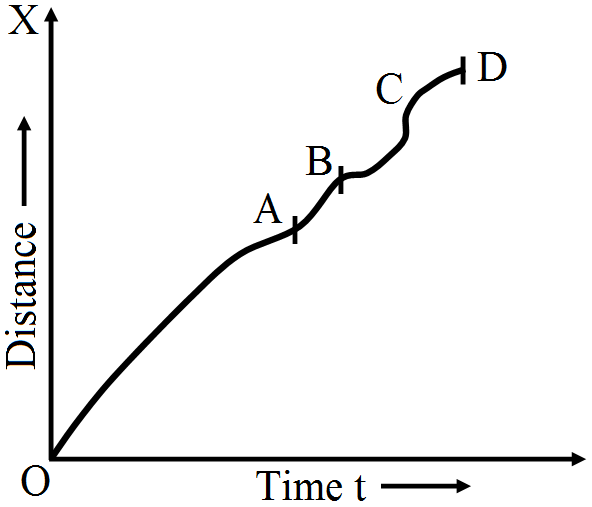
The figure shows an x-t graph of a particle moving along a straight line. What is the sign of the acceleration during the intervals OA, AB, BC, and CD?

Describe the composition of human blood.
Which has more atoms, 50g of aluminium or 50g of iron? Illustrate your answer with the help of calculations.
(Atomic masses: Al = 27u; Fe = 56u)
How long will it take a force of 10N to stop a mass of 2.5kg which is moving at 20m/s?
The following data was obtained for a body of mass 1kg dropped from a height of 5 metres:
 
Distance above ground
Velocity
i.
5m
0m/s
ii.
3.2m
6m/s
iii.
0m
10m/s
Show by calculations that the above data verifies the law of conservation of energy (Neglect air resistance). (g = 10m/s2).