MCQ
Unit of self inductance is
  • A
    $\frac{{Newton - second}}{{Coulomb \times Ampere}}$
  • $\frac{{Joule/Coulomb \times Second}}{{Ampere}}$
  • C
    $\frac{{Volt \times metre}}{{Coulomb}}$
  • D
    $\frac{{Newton \times metre}}{{Ampere}}$

Answer

Correct option: B.
$\frac{{Joule/Coulomb \times Second}}{{Ampere}}$
b
(b)

Need a full question paper?

Generate a complete, print-ready paper with questions like this in minutes — across 16+ boards, with answer keys.
Start Generating Free

Similar questions

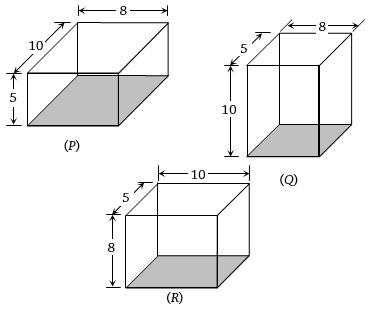
A rectangular block of size $10\,cm \times 8\,cm \times 5\,cm$ is kept in three different positions $P, Q$ and $R$ in turn as shown in the figure. In each case, the shaded area is rigidly fixed and a definite force $F$ is applied tangentially to the opposite face to deform the block. The displacement of the upper face will be
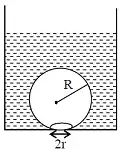
On heating water, bubbles being formed at the bottom of the vessel detach and rise. Take the bubbles to be spheres of radius $R$ and making a circular contact of radius $r$ with the bottom of the vessel. If $r < < R$, and the surface tension of water is $T$, value of $r$ just before bubbles detach is (density of water is $\rho_{w}$)
One end of a $2.35\,\,m$ long and $2.0\,\,cm$ radius aluminium rod$(K = 235 \,\,W.m^{-1}K^{-1})$ is held at $20^0\,\,C$. The other end of the rod is in contact with a block of ice at its melting point. The rate in $kg.s^{-1}$ at which ice melts is

[Take latent heat of fusion for ice as $\frac{{10}}{3} ×10^5 J.kg^{-1} $]

Which of the following is a one dimensional motion
Remote sensing satellites move in an orbit that is at an average height of about $500 \,km$ from the surface of the earth. The camera onboard one such satellite has a screen of area $A$ on which the images captured by it are formed. If the focal length of the camera lens is $50 \,cm$, then the terrestrial area that can be observed from the satellite is close to ............... $A$
A Newtonian fluid fills the clearance between a shaft and a sleeve. When a force of $800$ $N$ is applied to the shaft, parallel to the sleeve, the shaft attains a speed of $1.5$ $cm/sec$. If a force of $2.4$ $kN$ is applied instead, the shaft would move with a speed of ......... $ cm/sec$
A particle of mass $m$ is located in a one dimensional potential field where potential energy is given by : $V(x) = A(1 -cos\, px)$ ,

where $A$ and $p$ are constant.

The period of small oscillations of the particle is

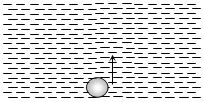
A table tennis ball has radius $(3 / 2) \times 10^{-2} m$ and mass $(22 / 7) \times 10^{-3} kg$. It is slowly pushed down into a swimming pool to a depth of $d=0.7 m$ below the water surface and then released from rest. It emerges from the water surface at speed $v$, without getting wet, and rises up to a height $H$. Which of the following option(s) is (are) correct?

[Given: $\pi=22 / 7, g=10 ms ^{-2}$, density of water $=1 \times 10^3 kg m ^{-3}$, viscosity of water $=1 \times 10^{-3} Pa$-s.]

$(A)$ The work done in pushing the ball to the depth $d$ is $0.077 J$.

$(B)$ If we neglect the viscous force in water, then the speed $v=7 m / s$.

$(C)$ If we neglect the viscous force in water, then the height $H=1.4 m$.

$(D)$ The ratio of the magnitudes of the net force excluding the viscous force to the maximum viscous force in water is $500 / 9$.
Two projectiles, one fired from surface of earth with velocity $10 \,m/s$ and other fired  from the surface of another planet with initial speed $5\, m/s$ trace identical trajectories.  The value of acceleration due to the gravity on the planet is   ......... $m/s^2$
An air bubble doubles its radius on raising from the bottom of water reservoir to be the surface of water in it. If the atmospheric pressure is equal to $10\, m$ of water, the height of water in the reservoir is ..... $m$