MCQ
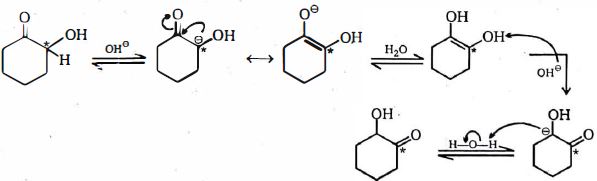
Unknown compound $(A)$ is
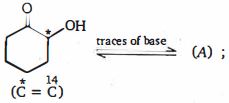
- A

- ✓

- C

- D

Generate a complete, print-ready paper with questions like this in minutes — across 16+ boards, with answer keys.
$(a)\,\,{N_2}(g) + {O_2}(g) \rightleftharpoons \,\,2NO(g); $ $\Delta {H^o}\, = \,181\,\,kJ$
$(b)\,\,2C{O_2}(g)\,\,\,\, \rightleftharpoons \,2CO(g)\, + \,{O_2}(g);$ $\Delta {H^o}\, = \,566\,\,kJ$
$(c)\,\,{H_2}(g) + {I_2}(g) \rightleftharpoons \,2HI(g) ;$ $\Delta {H^o}\, = \,-9.4\,\,kJ$
$(d)\,\,{H_2}(g) + {F_2}(g) \rightleftharpoons \,2HF(g) ;$ $\Delta {H^o}\, = \,-541\,\,kJ$
$(a)$ They might be configurational isomers $(b)$ They might be diastereomers
$(c)$ They might be constitutional isomers $(d)$ They might be tautomers
$(e)$ They might be conformational isomers $(f)$ They might be enantiomers
$(g)$ They might be positional isomers