Question
Use a pair of compasses and construct the following angles:
150°

Answer


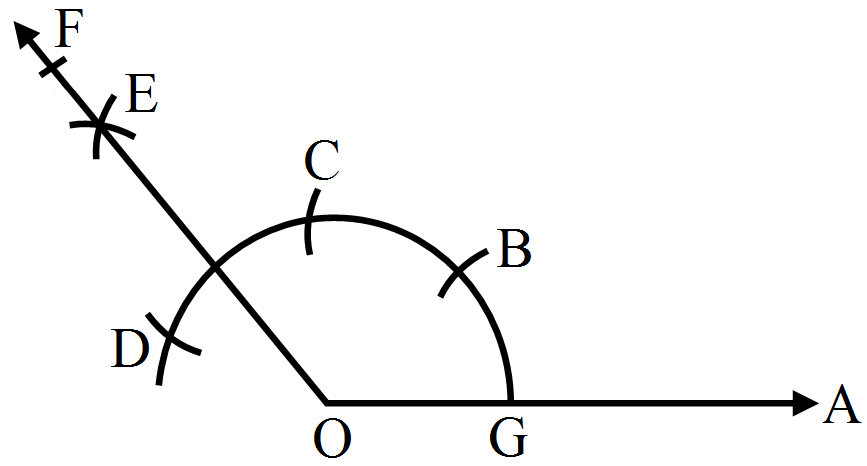
Steps of Construction:
  1. Draw a ray OA.
  2. With O as centre and any suitable radius draw an arc cutting OA at G.
  3. With G as centre and same radius cut the arc at B and then B as centre and same radius cut the arc at C. Again, with C as centre and same radius cut the arc at D.
  4. With C as centre and radius more than half CD draw an arc.
  5. With D as centre and same radius draw another arc to cut the previous arc at E.
  6. Join OE and produce it to F.
Then, $\angle\text{AOF}=150^\circ.$

Need a full question paper?

Generate a complete, print-ready paper with questions like this in minutes — across 16+ boards, with answer keys.
Start Generating Free

Similar questions

Draw a line AB. Take a point P on it. Draw a line passing through P and perpendicular to AB.
Draw a line segment AB = 5.6cm. Draw the perpendicular bisector of AB.
Draw an angle of 45°, using a pair of compasses.
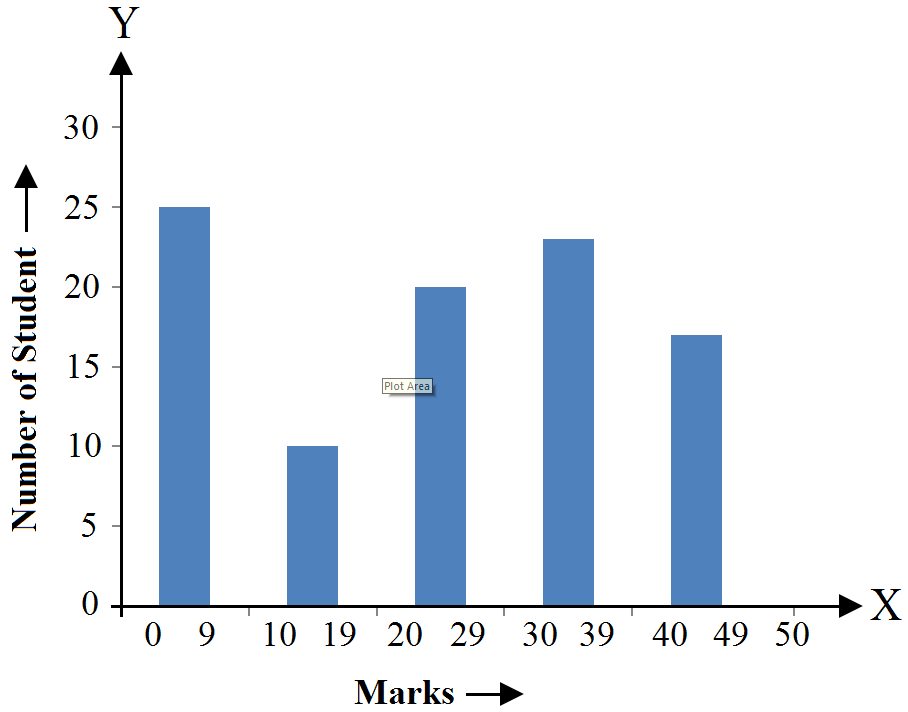
Given below is the bar graph indicating the marks obtained out of 50 in mathematics paper by 100 students. Read the bar graph and answer the following questions:
  1. It is decidec to distribute work books on mathematics to the students obtaining less than 20 marks, giving one workbook to each of such students. If a work book costs ₹ 5, what sum is required to buy the work books?
  2. Every student belonging to the highest mark group is entitled to get a prize of ₹ 10. How much amount of money is required for distributing the prize money?
  3. Every student belonging to the lowest mark-group has to solve 5 problems per day. How many problems, in all, will be solved by the students of this group per day?
  4. State whether true or false.
  1. 17% students have obtained marks ranging from 40 to 49.
  2. 59 students have obtained marks ranging from 10 to 29.
  1. What is the number of students getting less than 20 marks?
  2. What is the number of students getting more than 29 marks?
  3. What is the number of students getting marks between 9 and 40?
  4. What is the number, of students belonging to the highest mark group?
  5. What is the number of students obtaining more than 19 marks?
Using your protractor, draw an angle of measure 108°. With this angle as given, draw an angle of 54°.
There are 527 apples, 646 pears and 748 oranges. These are to be arranged in heaps containing the same number of fruits. Find the greatest number of fruits. Find the greatest number of fruits possible in each heap. How many heaps are formed?
The following table shows the daily production of T.V. sets in an industry for 7 days of a week:
Day
Mon
Tue
Wed
Thurs
Fri
Sat
Sun
Number of T.V. Sets
300
400
150
250
100
350
200
Represent the above information by a pictograph.
The number of students of Std 6th and Std 7th who went to visit the Tadoba Tiger Project at Chandrapur was 140 and 196 respectively. The students of each class are to be divided into groups of the same number of students. Each group can have a paid guide. What is the maximum number of students that can be there in each group? Why do you think each group should have the maximum possible number of students?
Arrange the following decimal numbers in the ascending order:
0.52314, 0.52313, 0.53201, 0.52321
Match the following columns on whole numbers:
S.No.
Column A
S.No.
Column B
(a)
137 + 63 = 63 + 137
(i)
Associativity of multiplication
(b)
(16 × 25) is a number
(ii)
Commutativity of multiplication
(c)
365 × 18 = 18 × 365
(iii)
Distributive law of multiplication over addition.
(d)
(d) (86 × 14) × 25 = 86 × (14 × 25)
(iv)
Commutativity of addition
(e)
23 × (80 + 5) = (23 × 80) + (23 × 5)
(v)
Closure property for multiplication