Question
Use factor theorem to factorise $6 x^3+17 x^2+4 x-12$ completely.

Answer

Self

Need a full question paper?

Generate a complete, print-ready paper with questions like this in minutes — across 16+ boards, with answer keys.

Start Generating Free

Similar questions

Mr. Menon deposit Rs 1,200 per month in a cumulative deposit account for a period of 5 years. After the end of the period, he will receive Rs 88,470. (a) Find the rate of the interest per annum. (b) Find the total interest that Mr. Menon will earn.
A frequency distribution of the life times of $400 T.V.,$ picture tubes leased in tube company is given below. Find the average life of tube:
Life time (in hrs) Number of tubes
$300 - 399$ $14$
$400 - 499$ $46$
$500 - 599$ $58$
$600 - 699$ $76$
$700 - 799$ $68$
$800 - 899$ $62$
$900 - 999$ $48$
$1000 - 1099$ $22$
$1100 - 1199$ $6$
Using Remainder Theorem, factorise:
$x^3 + 10x^2 – 37x + 26$ completely
The radius of a sphere is $10\ cm.$ If we increase the radius $5\%$ then how many % will increase in volume?
Rs. 6500 is divided equally among a certain number of persons. Had there been 15 more persons, each would have got Rs. 30 less. Find the original number of persons.
A fruitseller bought $x$ apples for ₹ $ 1200$.
(a) Write the cost price of each apple in terms of $x$.
(b) If 10 of the apples were rotten and he sold rest at ₹3 more than the cost price of each, write the selling price of $(x-10)$ apples.
(c) If he made a profit of ₹ $ 60$ in this transaction, form an equation in $x$ and solve it to evaluate $x$.
Mrs. Kulkarni invests Rs.1, 31,040 in buying Rs.100 shares at a discount of 9%. She sells shares worth Rs.72,000 at a premium of 10% and the rest at a discount of 5%. Find her total gain or loss on the whole.  
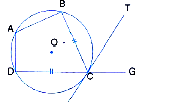
In the figure, ABCD is a cyclic quadrilateral with BC = CD. TC is tangent to the circle at point C and DC is produced to point G. If ∠BCG = 108° and O is the centre of the circle, find : Angle BCT

If Δ PQR is isosceles with PQ = PR and a circle with centre O and radius r is the incircle of the Δ PQR touching QR at T, prove that the point T bisects QR.
Solve, using formula :$x^2+x-(a+2)(a+1)=0$