Question
Use suitable identity to find the product:
$\left( {x + 4} \right)\left( {x + 10} \right)$

Answer

$\left( {x + 4} \right)\left( {x + 10} \right)$
We know that $\left( {x + a} \right)\left( {x + b} \right) = {x^2} + \left( {a + b} \right)x + ab$Here $a = 4$ and $b = 10$
We need to apply the above identity to find the product $\left( {x + 4} \right)\left( {x + 10} \right) = {x^2} + \left( {4 + 10} \right)x + \left( {4 \times 10} \right)$
$= {x^2} + 14x + 40.$
Therefore, we conclude that the product$ \left( {x + 4} \right)\left( {x + 10} \right)$ is ${x^2} + 14x + 40$

Need a full question paper?

Generate a complete, print-ready paper with questions like this in minutes — across 16+ boards, with answer keys.
Start Generating Free

Similar questions

Verify that $x^3+y^3+z^3-3 x y z=\frac{1}{2}(x+y+z)\left[(x-y)^2+(y-z)^2+(z-x)^2\right]$.
A circus tent is cylindrical to a height of $3$ metres and conical above it. If its diameter is $105m$ and the slant height of the conical portion is $53m,$ calculate the length of the canvas 5m wide to make the required tent. $\Big(\text{Use}\ \pi=\frac{22}{7}\Big).$
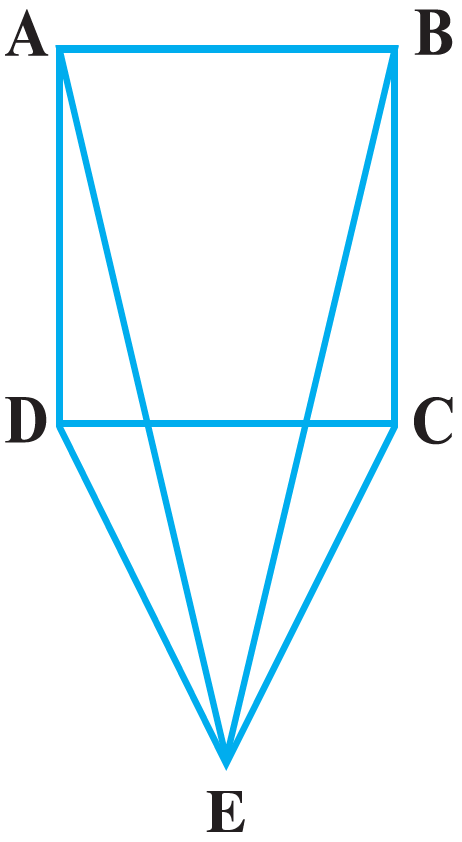
In the given figure $\triangle\text{CDE}$ is an equilateral triangle formed on a side $CD$ of a square $ABCD$. Show that $\triangle\text{ADE}\cong\triangle\text{BCE}.$
In each of the following determine rational numbers $a$ and $b$:
$\frac{4+3\sqrt5}{4-3\sqrt5}=\text{a}+\text{b}\sqrt{5}$
Metal spheres, each of radius $2\ cm$, are packed into a rectangular box of internal dimensions $16cm \times 8cm \times 8cm.$ When $16$ spheres are packed the box is filled with preservative liquid. Find the volume of this liquid. Give your answer to the nearest integer. $[\text{Use }\pi=3.14]$
Rationales the denominator and simplify: $\frac{\sqrt3-\sqrt2}{\sqrt3+\sqrt2}$
The diameter of the moon is approximately one-fourth the diameter of the earth. What fraction is the volume of the moon of the volume of the earth?
There are two cones. The curved surface area of one is twice that of the other. The slant height of the later is twice that of the former. Find the ratio of their radii.
Rationales the denominator and simplify: $\frac{1+\sqrt2}{3-2\sqrt2}$
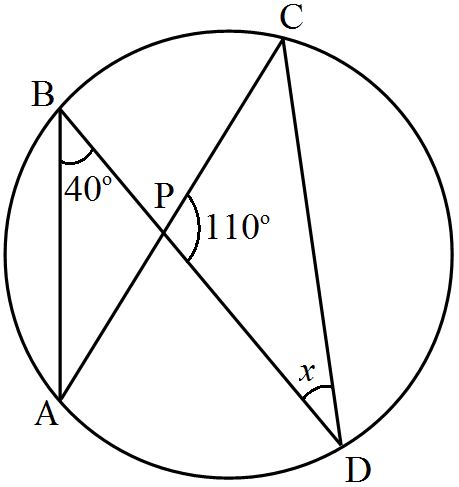
If $O$ is the centre of the circle, find the value of $x$ in the following figure: