Question
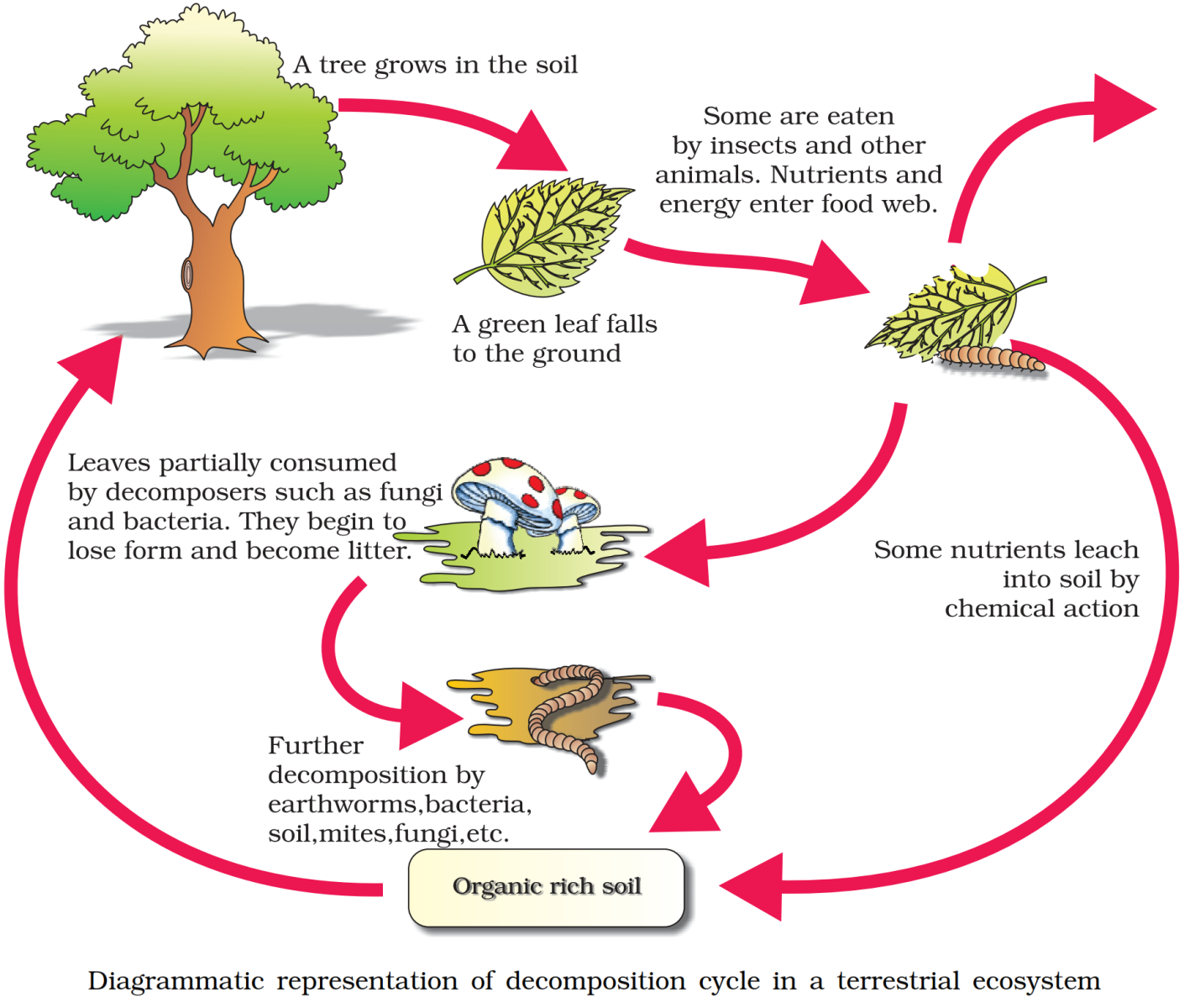
Using a flow chart explain the process of decomposition. List the factors which affect this process.

Answer

Ecomposition It is the process of breaking down of complex organic matter into inorganic substances like water, carbon dioxide and nutrients by decomposers. Detritus is the raw material for decomposition. It includes dead remains of plants (leaves, bark and flowers) and animals including faecal matter.

Different steps involved in the process of decomposition are:

  1. Fragmentation: It is process of breakdown of detritus into smaller particles by detritivores (e.g. earthworm).

  2. Leaching: It is the process by which water-soluble inorganic nutrients go down into the soil horizon and get precipitated as unavailable salts.

  3. Catabolism: It is the process of degradation of detritus into simple organic material by the action of bacterial and fungal enzymes and then their further conversion into simpler inorganic compounds.

  1. Humification: It is a process that leads to accumulation of a dark coloured amorphous and colloidal substance called humus, which is highly resistant to microbial action and undergoes decomposition at a very slow rate. Being colloidal in nature, it serves as a reservoir of nutrients.

  2. Mineralisation: It is process of degradation of humus by microbial action and release of inorganic nutrients

Need a full question paper?

Generate a complete, print-ready paper with questions like this in minutes — across 16+ boards, with answer keys.

Start Generating Free

Similar questions

Why do some adolescents start taking drugs. How can this be avoided?
What is mutualism? Describe any four examples.
Name the modern technology of crop improvement. How is it beneficial in crop improvement? Explain. ###Write an essay on tissue culture.
What role does pituitary gonadotropins play during follicular and ovulatory phases of menstrual cycle and also explain the shift in steroidal secretions.
Which vectors can be used to clone a fragment of DNA with the following lengths?
  1. 4Kb
  2. 35Kb
  3. 20Kb
  4. 250Kb
Write any three differences between benign tumour and malignant tumour.
What is foetal ejection reflex? Explain how it leads to parturition?
Work out a monohybrid cross upto F, generation, between two pea plants and two Antirrhinum plants, both having contrasting traits with respect to colour of flower. Comment on the patterns of inheritance in the crosses carried above.
For question 1-4, use this key:

Key-

  1. Ecology.
  2. Population.
  3. Community.
  4. Ecosystem.
  1. A community plus its physical environment.
  2. Study of the interactions of organisms with each other and with the physical environment.
  3. All populations that are found in a particular area.
  4. All members of the same species that inhabit a particular area.
Read the following and answer any four questions from (i) to (v) given below:

Stem cells hold the potential for manifold applications in biotechnology based next generation therapeutics. Scientists are trying to formulate better and more personalised treatment modalities against some seemingly irremediable diseases, by harnessing body's own stem cells and stem cell niche. Stem cells of different origin and level of potency are being investigated for tissue regeneration, treatment of bone defect, drug testing, gene therapy and cell based therapy for muscle damage, spinal cord injury, cancer therapy, etc. 'Tile properties of embryonic and adult stem cells to either self-renew or differentiate into multiple cell lineages make them an attractive source for cell therapies, tissue engineering and as model system for drug screening.

  1. Stem cells are widely used in medical research. Which property of stem cells makes them particularly useful in this research?
  1. They can be fused together to form a zygote.
  2. They can divide and eventually give rise to a whole organism.
  3. They can divide and be made to differentiate into various types of cell.
  4. They will continue to divide indefinitely.
  1. Stem cells can be divided into four main types. Which of the four types of stem cell can differentiate into a limited range of tissues?
  1. Adult stem cells.
  2. Embryonic stem cells.
  3. Fetal stem cells.
  4. Zygotic stem cells.
  1. Which feature of stem cells obtained from blood in the umbilical cord enables their use in the treatment of a variety of blood cancers?
  1. They can differentiate into bone marrow cells.
  2. They can differentiate into any cellular component of blood.
  3. They can replace blood stem cells affected by cancer.
  4. They are totipotent.
  1. The search for pluripotent stem cells is intense. The spennatogonium is the diploid precursor of haploid sperm in the development pathway of mouse gametes as shown below.
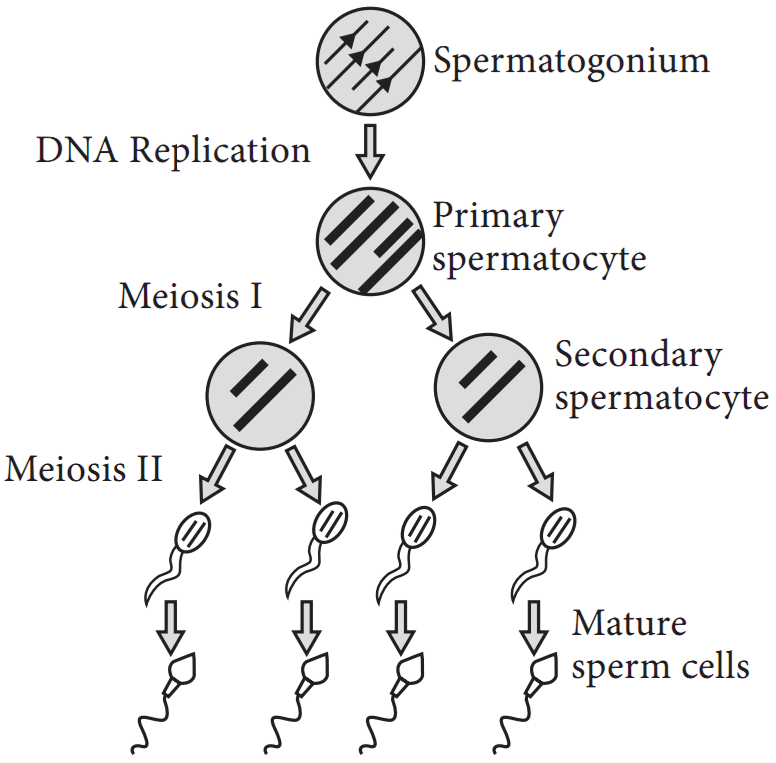
Scientists were interested to find out which stages of sperm development have stem cell capacity. Two experiments were carried out using sterile host males with testes that lacked germ cells. The results are shown in the table.

  Type of cells used Result
Experiment 1 Secondary spermatocytes were injected Fertility was not restored
Experiment 2 Spermatogonia were injected Fertility was restored for the rest of the mouse's life

What property of a stem cell is missing in the secondary spermatocytes?

  1. Specialisation.
  2. Self-renewal.
  3. Commitment.
  4. A proper stem-cell niche.
  1. Which feature of embryonic stem cells (ESCs) is illustrated below?
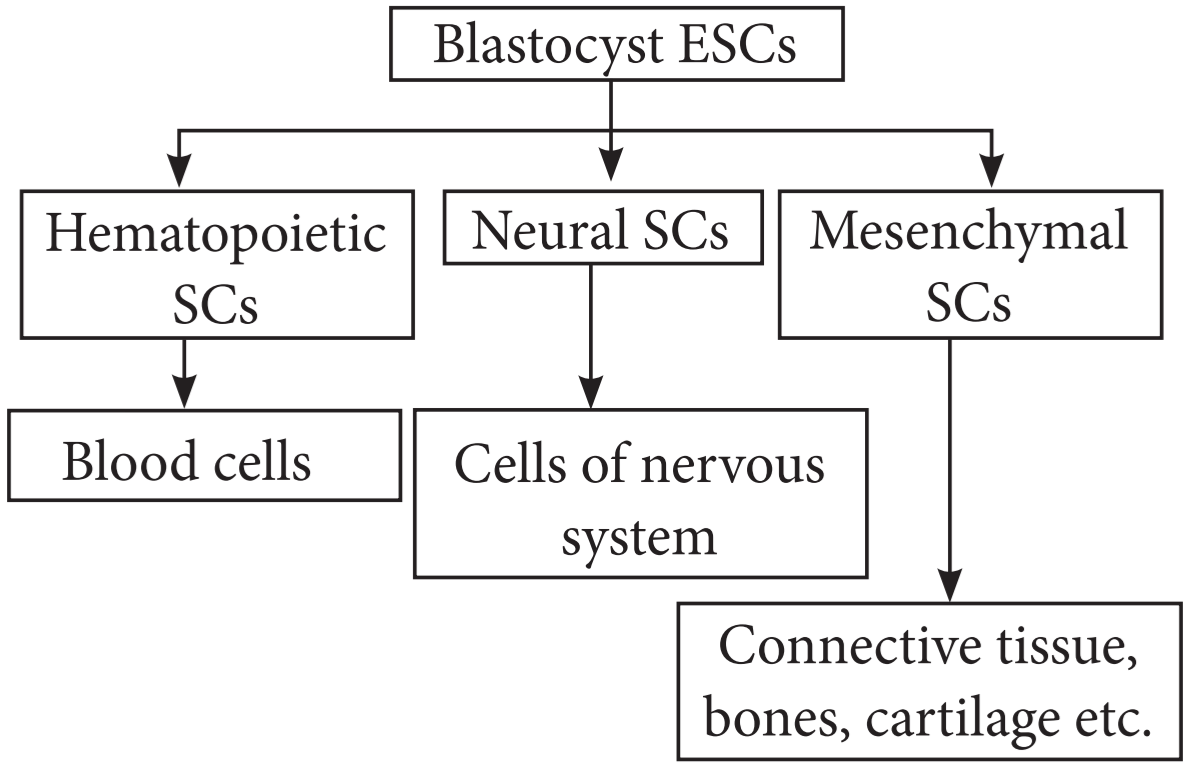
  1. ESCs are capable of dividing.
  2. ESCs are multipotent.
  3. ESCs are pluripotent.
  4. ES Cs show plasticity.