Maharashtra BoardEnglish MediumSTD 12 SciencePhysicsQuestion Bank [ 2022 ]3 Marks
Question
Using Ampere's Law, derive an expression for the magnetic induction inside an ideal solenoid carrying a steady current.
✓
Answer
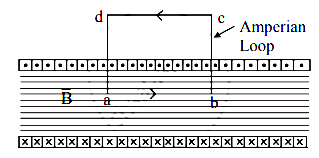
i. Consider an ideal solenoid as shown in the figure below.
Ampere's law applied to a part of a long ideal solenoid
ii. The dots (.) show that the current is coming out of the plane of the paper and the crosses $(x)$ show that the current is going into the plane of the paper, both in the coil of square cross-section wire.
iii. For the application of Ampere's law, an Amperian loop is drawn as shown in the figure and box.
iv. Using Ampere's law,
$\oint \overrightarrow{ B } \cdot \overrightarrow{ d } l =\mu_0 I$
Over the rectangular loop abcd, the above integral takes the form
$\int_{ a }^{ b } \overrightarrow{ B } \cdot \overrightarrow{ d } l +\int_{ b }^{ c } \overrightarrow{ B } \cdot \overrightarrow{ d l}+\int_{ c }^{ d } \overrightarrow{ B } \cdot \overrightarrow{ d l}+\int_{ d }^{ a } \overrightarrow{ B } \cdot \overrightarrow{ d } l =\mu_0 I$
where, $I$ is the net current encircled by the loop.
$\therefore BL +0+0+0=\mu_0 I \ldots \text {...(1) }$
Here, the second and fourth integrals are zero because $\overrightarrow{ B }$ and $\overrightarrow{ d }$ are perpendicular to each other.
The third integral is zero because outside the solenoid, $B=0$.
v. If the number of turns is $n$ per unit length of the solenoid and the current flowing through the wire is $i$, then the net current coming out of the plane of the paper is
$I = nLi$
$\therefore$ Using equation (1)
$ BL =\mu_0 nLi$
$\therefore B =\mu_0 ni . . .(2) $
Equation (2) is the required expression.
Need a full question paper?
Generate a complete, print-ready paper with questions like this in minutes — across 16+ boards, with answer keys.