Question
  1. Using Biot-Savart’s law, derive the expression for the magnetic field in the vector form at a point on the axis of a circular current loop.
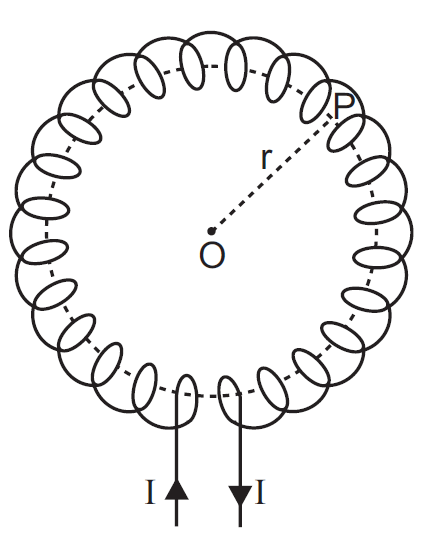
  2. What does a toroid consist of ? Find out the expression for the magnetic field inside a toroid for N turns of the coil having the average radius r and carrying a current I. Show that the magnetic field in the open space inside and exterior to the toroid is zero.
Answer

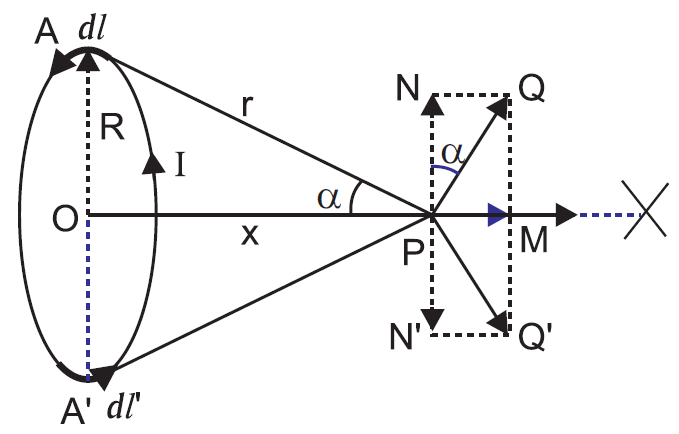
  1. Magnetic field at the axis of a circular loop: Consider a circular loop of radius R carrying current I, with its plane perpendicular to the plane of paper. Let P be a point of observation on the axis of this circular loop at a distance x from its centre O. Consider a small element of length dl of the coil at point A. The magnitude of the magnetic induction $\overrightarrow{\text{dB}}$at point P due to this element is given by


$\overrightarrow{\text{dB}}= \frac{\mu_{0}}{4\pi}\frac{\text{I}\delta\text{l}\sin\alpha}{\text{r}^{2}}$ - - - - - - (1)

The direction of $\overrightarrow{\text{dB}}$ is perpendicular to the plane containing $\overrightarrow{\text{dl}}$ and $\overrightarrow{\text{r}}$ and is given by right hand screw rule. As the angle between I $\overrightarrow{\text{dl}}$ and $\overrightarrow{\text{r}}$ is 90°, the magnitude of the magnetic induction $\overrightarrow{\text{dB}}$ is given by,

$\overrightarrow{\text{dB}} = \frac{\mu_{0}\text{I}}{4\pi} \frac{\text{dl}\sin90^{o}}{\text{r}^{2}} = \frac{\mu_{0}\text{I}\text{dl}}{4\pi\text{r}^{2}}$ - - - - (2)

If we consider the magnetic induction produced by the whole of the circular coil, then by symmetry the components of magnetic induction perpendicular to the axis will be cancelled out, while those parallel to the axis will be added up. Thus the resultant magnetic induction $\overrightarrow{\text{B}}$ at axial point P is along the axis and may be evaluated as follows:

The component of $\overrightarrow{\text{dB}}$ along the axis,

$\overrightarrow{\text{dB}}_{x} = \frac{\mu_{0}\text{I dl}}{4\pi\text{r}^{2}}\sin\alpha$ - - - - - - (3)

But sin $\alpha =\frac{\text{R}}{\text{r}}\text{ and }\text{r} = (\text{R}^{2} + \text{x}^{2})^{1/2}$

$ \therefore\overrightarrow{\text{dB}}_{x} =\frac{\mu_{0}\text{I dl}}{4\pi\text{r}^{2}}. \frac{\text{R}}{\text{r}} =\frac{\mu_{0}\text{IR}}{4\pi\text{r}^{3}}\text{dl} = \frac{\mu_{0}\text{IR}}{4\pi(\text{R}^{2} +\text{x}^{2})^{3/2}}\text{dl}$ - - - - (4)

Therefore the magnitude of resultant magnetic induction at axial point P due to the whole circular coil is given by

$ \overrightarrow{\text{B}} = \oint\frac{\mu_{0}\text{IR}}{4\pi(\text{R}^{2} + \text{x}^{2})^{3/2}}\text{dl} = \frac{\mu_{0}\text{IR}}{4\pi(\text{R}^{2} + \text{x}^{2})^{3/2}}\oint\text{dl}$

But $\oint\text{dl} = \text{ length of the loop } = 2\pi\text{R}$ - - - - - - - (5)

Therefore, $\text{B} =\frac{\mu_{0}\text{IR}}{4\pi(\text{R}^{2} + \text{x}^{2})^{3/2}}(2\pi\text{R})$

$\overrightarrow{\text{B}} = \text{B}_{x}\hat{i} =\frac{\mu_{0}\text{IR}^{2}}{2(\text{R}^{2} + \text{x}^{2})^{3/2}}\hat{\text{i}}.$
  1. A long solenoid on bending in the form of closed ring is called a toroidal solenoid.
Figure shows a toroidal solenoid of average radius ‘r’ and of N turns.

For points inside the core of toroid Current I, flowing through it, set up a magnetic field within the core.

According to Ampere’s circuital law

$\oint\overrightarrow{\text{B}}.\overrightarrow{\text{d}l} = \mu_{0}\text{I}$


where ‘I’ is the current in the toroid.

Net current =NI

$\therefore\oint\overrightarrow{\text{B}}.\overrightarrow{\text{d}l} = \mu_{0}\text{NI}$

$\Rightarrow|\text{B}|2\pi\text{r} = \mu_{0}\text{NI}$

$\Rightarrow|\text{B}| = \frac{\mu_{0}\text{NI}}{2\pi\text{r}}$

$ = \mu_{0}\text{n} \text{I}$

$\bigg[\because\text{n} = \frac{\text{N}}{2\pi\text{r}}\bigg]$
  1. For points in the open space inside the toroid: No current flows through the Amperian loop, so I =0
$\oint\overrightarrow{\text{B}}. \overrightarrow{\text{d}l} = \mu_{0|}\text{I} = 0 $

$\Rightarrow|\text{B}|_{inside} = 0 $
  1. For points in the open space exterior to the toroid : The net current entering the plane of the toroid is exactly cancelled by the net current leaving the plane of the toroid.
$\oint\overrightarrow{\text{B}}.\overrightarrow{\text{d}l} = 0$

$\Rightarrow|\text{B}|_{exterior}= 0.$

Need a full question paper?

Generate a complete, print-ready paper with questions like this in minutes — across 16+ boards, with answer keys.

Start Generating Free

Similar questions

A sphercial capacitor is made of two conducting spherical shells of radii a and b. The space between the shells is filled with a dielectric of dielectric constant K up to a radius c as shown in figure. Calculate the capacitance.
What is interference of light? Write two essential conditions for sustained interference pattern to be produced on the screen. Draw a graph showing the variation of intensity versus the position on the screen in Young's experiment when (a) both the slits are opened and (b) one of the slit is closed. What is the effect on the interference pattern in Young's double-slit experiment when: 32. 33.
i. Screen is moved closer to the plane of slits?
ii. Separation between two slits is increased. Explain.
Steam at 120°C is continuously passed through a 50cm long rubber tube of inner and outer radii 1.0cm and 1.2cm. The room temperature is 30°C. Calculate the rate of heat flow through the walls of the tube. Thermal conductivity of rubber ${= 0.15Js^{-1}}{m^{-1}}^\circ C^{-1}.$
A body is in translational equilibrium under the action of coplanar forces. If the torque of these forces is zero about a point, is it necessary that it will also be zero about any other point?
Assuming the ideal diode, draw the output waveform for the circuit given in Fig. Explain the waveform.
A coil of inductance 0.50H and resistance 100Ω is connected to a 240V, 50Hz ac supply.
  1. What is the maximum current in the coil?
  2. What is the time lag between the voltage maximum and the current maximum?
The half-life of $^{40}K$ is $1.30 \times 10^9y$. A sample of 1.00g of pure KCI gives 160 counts/ s. Calculate the relative abundance of $^{40}K$ (fraction of $^{40}K$ present) in natural potassium.
A block of mass 2.0kg moving at 2.0m/s collides head on with another block of equal mass kept at rest.
  1. Find the maximum possible loss in kinetic energy due to the collision.
  2. If the actual loss in kinetic energy is half of this maximum, find the coefficient of restitution.
Figure shows two rigid vessels A and B, each of volume $200cm^3,$ containing an ideal gas $(C_v = 12.5JK^{-1}mol^{-1})$. The vessels are connected to a manometer tube containing mercury. The pressure in both the vessels is 75cm of mercury and the temperature is 300K.
  1. Find the number of moles of the gas in each vessel.
  2. 5.0J of heat is supplied to the gas in vessel A and 10J to the gas in vessel B. Assuming there's no appreciable transfer of heat from A to B, calculate the difference in the heights of mercury in the two sides of the manometer. Gas constant, $R = 8.3JK^{-1}mol^{-1}.$
Three bulbs, each with a resistance of $180\Omega,$ are connected in parallel to an ideal battery of emf 60V. Find the current delivered by the battery when.
(a) all the bulbs are switched on, (b) two of the bulbs are switched on and (c) only one bulb is switched on.