Question
Using $\text{B}=\mu_0\text{H},$ find the ratio $\frac{\text{E}_0}{\text{H}_0}$ for a plane electromagnetic wave propagating through vacuum. Show that it has the dimensions of electric resistance. This ratio is a universal constant called the impedance of free space.
Answer

$\text{B}=\mu_0\text{H}$
$\text{H}=\frac{\text{B}}{\mu_0}$
$\frac{\text{E}_0}{\text{H}_0}=\frac{\frac{\text{B}_0}{(\mu_0\epsilon_0\text{C})}}{\frac{\text{B}_0}{\mu_0}}=\frac{1}{\epsilon_0\text{C}}$
$=\frac{1}{8.85\times10^{-12}\times3\times10^8}$
$=376.6\Omega=377\Omega$
$\text{Dimension}\frac{1}{\epsilon_0\text{C}}=\frac{1}{\big[\text{LT}^{-1}\big]\big[\text{M}^{-1}\text{L}^{-3}\text{T}^{4}\text{A}^2\big]}$
$=\frac{1}{\text{M}^{-1}\text{L}^{-2}\text{T}^{3}\text{A}^2}=\text{M}^1\text{L}^2\text{T}^{-3}\text{A}^{-2}=[\text{R}]$

Need a full question paper?

Generate a complete, print-ready paper with questions like this in minutes — across 16+ boards, with answer keys.

Start Generating Free

Similar questions

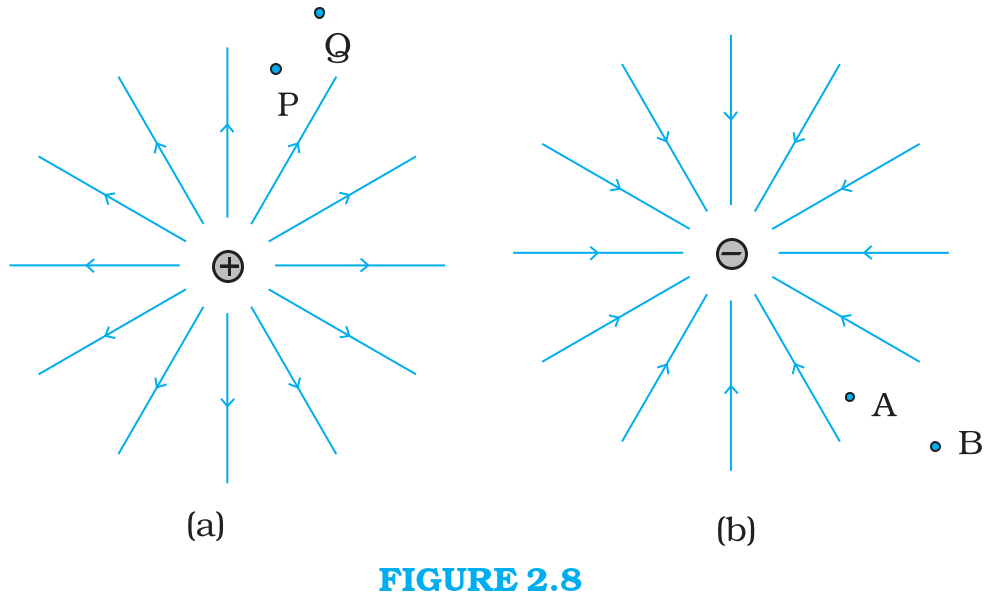
Figures 2.8 (a) and (b) show the field lines of a positive and negative point charge respectively.
Image
(a) Give the signs of the potential difference $V_{ P }-V_{ Q } ; V_{ B }-V_{ A }$.
(b) Give the sign of the potential energy difference of a small negative charge between the points $O$ and $P ; A$ and $B$.
(c) Give the sign of the work done by the field in moving a small positive charge from $Q$ to $P$.
(d) Give the sign of the work done by the external agency in moving a small negative charge from $B$ to $A$.
(e) Does the kinetic energy of a small negative charge increase or decrease in going from $B$ to $A$ ?
You are given a low resistance $R_1$ a high resistance $R_2$ and a moving coil galvanometer. Suggest how would you use these to have an instrument that will be able to measure?
  1. Current.
  2. Potential difference.
(i) If $f=0.5 m$ for a glass lens, what is the power of the lens? (ii) The radii of curvature of the faces of a double convex lens are $10 cm$ and $15 cm$. Its focal length is $12 cm$. What is the refractive index of glass? (iii) A convex lens has $20 cm$ focal length in air. What is focal length in water? (Refractive index of air-water $=1.33$, refractive index for air-glass $=1.5$.)
Explain the following:
(a) Ground Waves, (b) Sky Waves, (c) Space Waves.
Two large, thin metal plates are parallel and close to each other. On their inner faces, the plates have surface charge densities of opposite signs and of magnitude $17.0 \times 10–22 C/m^2$ . What is $E:$
  1. In the outer region of the first plate,
  2. In the outer region of the second plate, and
  3. Between the plates?
An $\alpha -$ particle collides with nucleus after passing through the potential $V$ volt. Prove that distance of closest approach of particle of atomic number $Z$ to the nucleus will be $14.4( Z / V ) \ \mathring A $.
$($Given that : $1 / 4 \pi \varepsilon_0=9.0 \times 10^9$ Newton $-$ meter $^2 /$ Coulomb $^2$ and $e=1.6 \times 10^{-19}$ Coulomb$)$
Light of frequency $7.21 \times 10^{14} Hz$ is incident on a metal surface. Electrons with a maximum speed of $6.0 \times 10^5\ m/s$ are ejected from the surface. What is the threshold frequency for photoemission of electrons?
Sketch the graph showing variation of stopping potential with frequency of incident radiations for two photosensitive materials $A$ and $B$ having threshold frequencies $v_{A > }v_{B.}$
  1. In which case is the stopping potential more and why?
  2. Does the slope of the graph depend on nature of the material used? Explain.
​​​​​​​
Two particles of masses $m_1$ and $m_2$ are joined by a light rigid rod of length $r.$ The system rotates at an angular speed co about an axis through the centre of mass of the system and perpendicular to the rod. Show that the angular momentum of the system is $\text{L}=\mu\text{r}^2\omega$ where $\mu$ is the reduced mass of the system defined as $\mu=\frac{\text{m}_1\text{m}_2}{\text{m}_1+\text{m}_2}.$
In an accelerator experiment on high$-$energy collisions of electrons with positrons, a certain event is interpreted as annihilation of an electron$-$positron pair of total energy $10.2\ BeV$ into two $γ-$rays of equal energy. What is the wavelength associated with each $γ-$ray? $(1\ BeV = 10^9\ eV)$.