Question
Using Bohr’s postulates of the atomic model, derive the expression for radius of nth electron orbit. Hence obtain the expression for Bohr’s radius.

Answer

For the electron, we have
Bohr’s Postulate $(\text{mvr} = \frac{\text{nh}}{2\pi})$
$\frac{\text{mv}^{2}}{\text{r}} = \frac{1}{4\pi\in_{o}}\frac{\text{ze}^{2}}{\text{r}^{2}}$
and mvr $ = \frac{\text{nh}}{2\pi}$
$\therefore\text{m}^{2}\text{v}^{2}\text{r}^{2} = \frac{\text{n}^{2}\text{h}^{2}}{4\pi^{2}}$
and mv2$ = \frac{1}{4\pi\in_{o}}\text{ze}^{2}$
$\therefore\text{r} = \frac{\in_{o}\text{n}^{2}\text{h}^{2}}{\pi\text{ze}^{2}\text{m}}$
Bohr’s radius (for n = 1) = $\in_{o } \text{h}^{2}/\pi\text{ze}^{2}\text{m}.$

Need a full question paper?

Generate a complete, print-ready paper with questions like this in minutes — across 16+ boards, with answer keys.
Start Generating Free

Similar questions

A 100W bulb together with its power supply is suspended from a sensitive balance. Find the change in the mass recorded after the bulb remains on for 1 year.
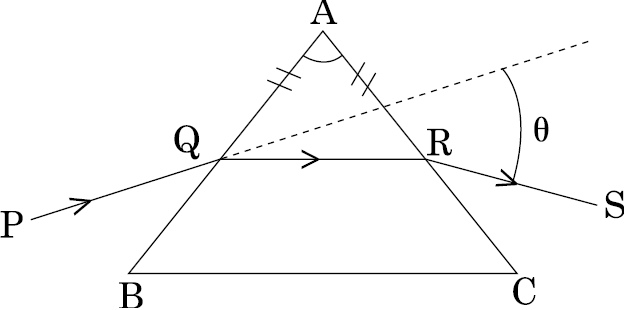
A ray PQ incident on the refracting face BA is refracted in the prism BAC as shown in the figure and emerges from the other refracting face AC as RS such that AQ = AR. If the angle of prism A = 60o and refractive index of material of prism is$\sqrt{3}$, calculate angle $\theta.$

In a photoelectric effect, the yellow light is just able to emit electrons, will green light emit photoelectrons? What about red light?
A silver wire has a resistance of $2.1\ \Omega\ \text{at}\ 27.5^\circ\text{C},$ and a resistance of $2.7\ \Omega\ \text{at}\ 100^\circ\text{C}.$ Determine the temperature coefficient of resistivity of silver.
State the reason, why GaAs is most commonly used in making a solar cell.
Write down the equations of electric potential of a point charge and electric potential of dipole. And also discuss (/mention) the points of difference between them.
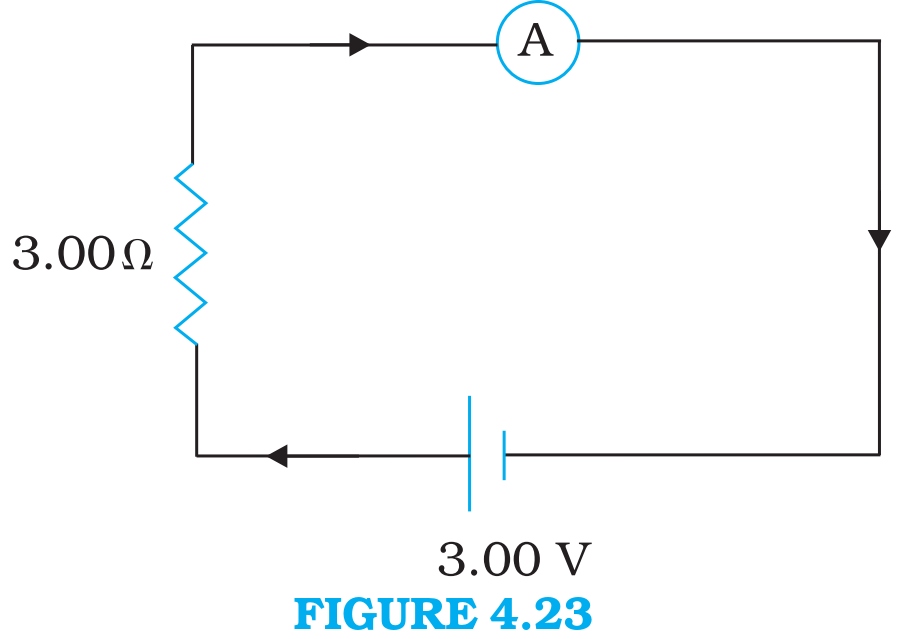
In the circuit (Fig. 4.23) the current is to be measured. What is the value of the current if the ammeter shown (a) is a galvanometer with a resistance $R_G=60.00 \Omega$; (b) is a galvanometer described in (a) but converted to an ammeter by a shunt resistance $r_s=0.02 \Omega$; (c) is an ideal ammeter with zero resistance?
Image
Suggest a method to produce a rainbow in your house.
A 12·5 eV electron beam is used to excite a gaseous hydrogen atom at room temperature. Determine the wavelengths and the corresponding series of the lines emitted.
Write applications of the resonance phenomenon in the $L - C - R$ series circuit.