Question
  1. Using Bohr's second postulate of quantization of orbital angular momentum show that the circumference of the electron in the $n^{th}$ orbital state in hydrogen atom is n times the de Broglie wavelength associated with it.
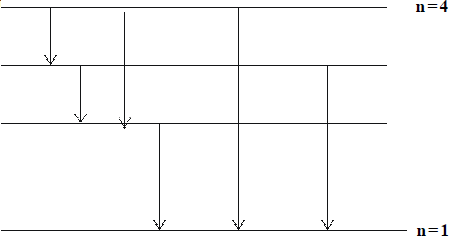
  2. The electron in hydrogen atom is initially in the third excited state.What is the maximum number of spectral lines which can be emitted when it finally moves to the ground state?
Answer

  1. According to Bohr's second postulate
  2. $\text{mvr}_{n} =\frac{\text{nh}}{2\pi}$
    $\Rightarrow2\pi\text{r}_{n} = \frac{\text{nh}}{\text{mv}}$
    But $\frac{\text{h}}{\text{mv}} =\frac{\text{h}}{\text{p}} =\lambda$
    $\therefore2\pi\text{r}_{n} = \text{n}\lambda$
  3. For third excited state $n = 4$
  4. for ground state $n = 1$
    Hence possible transitions are
    $n_1 = 4$ to $n_1 = 3, 2, 1$
    $n_1 = 3$ to $n_1 = 2, 1$
    $n_1 = 2$ to$ n_1 = 1$
    Total number of transitions $= 6$
    Alternate Answer

Need a full question paper?

Generate a complete, print-ready paper with questions like this in minutes — across 16+ boards, with answer keys.

Start Generating Free

Similar questions

  1. Derive Snell's law on the basis of Huygen's wave theory when light is travelling from a denser to a rarer medium.
  2. Draw the sketches to differentiate between plane wavefront and spherical wavefront.
Arrange the following electromagnetic waves in the order of their increasing wavelength:
  1. $\gamma- \text{rays}$.
  2. Microwaves.
  3. X-rays.
  4. Radio waves.
How are infra-red waves produced? What role does infra-red radiation play in (i) Maintaining the Earth’s warmth and (ii) Physical therapy?
In a soccer practice session the football is kept at the centre of the field $40$ yards from the $10ft$ high goalposts. A goal is attempted by kicking the football at a speed of $64ft/s$ at an angle of $45^\circ$ to the horizontal. Will the ball reach the goal post?
Electromotive forces of two cells are $E_1$ and $E _2$ and their internal resistances are $r_1$ and $r_2$. Find equivalent electromotive force and equivalent internal resistance on joining them in series.
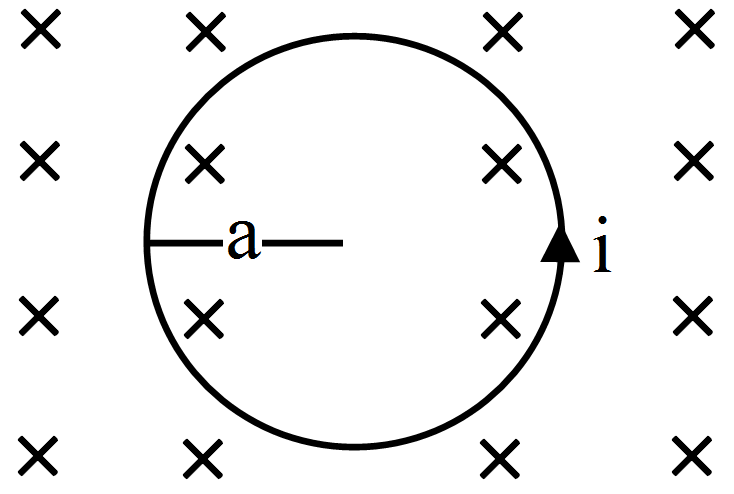
The shows a circular wire loop of radius a and carrying a current i, which is placed in a perpendicular magnetic field B.
  1. Consider a small part dl of the wire. Find the force on this part of the wire exerted by the magnetic field.
  2. Find the force of compression in the wire.
A charged capacitor of capacitance C is discharged through a resistance R. A radioactive sample decays with an average-life $\tau.$ Find the value of R for which the ratio of the electrostatic field energy stored in the capacitor to the activity of the radioactive sample remains constant in time.
  1. A giant refracting telescope at an observatory has an objective lens of focal length $15 m$. If an eyepiece of focal length $1.0 \ cm$ is used, what is the angular magnification of the telescope?
  2. If this telescope is used to view the moon, what is the diameter of the image of the moon formed by the objective lens? The diameter of the moon is $3.48 \times 10^{6 }m,$ and the radius of lunar orbit is $3.8 \times 10^{8 }m$.
$(a)$ Obtain the expression for the magnetic energy stored in a solenoid in terms of magnetic field $B,$ area $A$ and length $l$ of the solenoid. $(b)$ How does this magnetic energy compare with the electrostatic energy stored in a capacitor?
In Joly's differential steam calorimeter, $3g$ of an ideal gas is contained in a rigid closed sphere at $20^\circ C.$ The sphere is heated by steam at $100^\circ C$ and it is found that an extra $0.095g$ of steam has condensed into water as the temperature of the gas becomes constant. Calculate the specific heat capacity of the gas in $Jg^{-1} K^{-1}.$ The latent heat of vaporisation of water $= 540\ cal-g^{-1}.$
Estimate the number of electrons in $100g$ of water. How much is the total negative charge on these electrons?