Question
Using Bohr's total postulates, derive the expression for the total energy of the electron in the stationary states of hydrogen atom.

Answer

According to Bohr's postulates, in a hydrogen atom, a single electron revolves around a nucleus of charge +e. For an electron moving with a uniform speed in a circular orbit of a given radius, the centripetal force is provided by Coulomb force of attraction between the electron and the nucleus. The gravitational attraction may be neglected as the mass of electron and proton is very small. So,
$m v^2 / r = ke ^2 / r ^2\left(\right.$ where, $\left.k =1 / 4 \pi \varepsilon_0\right)$
or $m v^2= ke ^2 / r$.
where, m = mass of electron, r = radius of electronic orbit, v = velocity of electron
Again, by Bohr's second postulates
$mvr = nh / 2 \pi$
where, $n=1,2,3, \ldots$ or $v=n h / 2 \pi m r$
Putting the value of $v$ in Eq. (i)
$m\left(\frac{n h}{2 \pi m r}\right)^2=\frac{k r^2}{r} \Rightarrow r=\frac{n^2 h^2}{4 \pi^2 k m e^2}$
Kinetic energy of electron ,
$E_K=\frac{1}{2} m v^2=\frac{k e^2}{2 r}\left(\because \frac{m v^2}{r}=\frac{k e^2}{r^2}\right)$
Using Eq(ii), we get
$E_K=\frac{k \kappa^2}{2} \frac{4 \pi^2 k m c^2}{n^2 h^2}=\frac{2 \pi^2 k^2 m c^4}{n^2 h^2}$
Potential energy of electron,
$E_P=-\frac{k(e) \times(e)}{r}=-\frac{k x^2}{r}$
Using Eq(ii), we get
$E_P=-k e^2 \times \frac{4 \pi^2 k m c^2}{n^2 h^2}=-\frac{4 \pi^2 k^2 m e^4}{n^2 h^2}$
Hence, total energy of the electron in the $n ^{ th }$ orbit
$\begin{array}{l}E=E_P+E_K=-\frac{4 \pi^2 k^2 m e^4}{n^2 h^2}+\frac{2 \pi^2 k^2 m e^4}{n^2 h^2} \\
=-\frac{2 \pi^2 k^2 m e^4}{n^2 h^2}\end{array}$

Need a full question paper?

Generate a complete, print-ready paper with questions like this in minutes — across 16+ boards, with answer keys.
Start Generating Free

Similar questions

A capacitor of unknown capacitance is connected across a battery of V volts. The charge stored in it is 360 $\mu$C. When potential across the capacitor is reduced by 120 V, the charge stored in it becomes 120 $\mu$C.
Calculate:
  1. The potential V and the unknown capacitance C.
  2. What will be the charge stored in the capacitor, if the voltage applied had increased by 120 V?
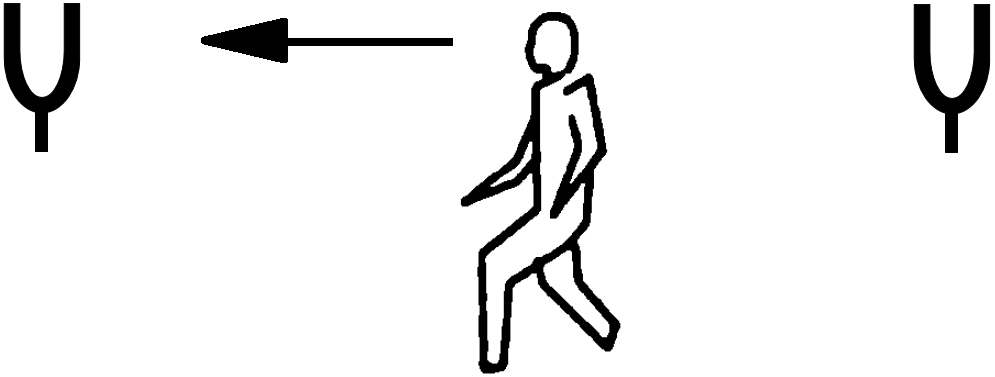
Two identical tuning forks vibrating at the same frequency 256Hz are kept fixed at some distance apart. A listener runs between the forks at a speed of 3.0m/s so that he approaches one tuning fork and recedes from the other figure. Find the beat frequency observed by the listener. Speed of sound in air = 332ms/s.

Using Gauss's law obtain the expression for the electric field due to a uniformly charged thin spherical shell of radius R at a point outside the shell. Draw a graph showing the variation of electric field with r, for r > R and r < R.
For a normal eye, the far point is at infinity and the near point of distinct vision is about 25 cm in front of the eye. The cornea of the eye provides a converging power of about 40 dioptres, and the least converging power of the eye-lens behind the cornea is about 20 dioptres. From this rough data estimate the range of accommodation (i.e., the range of converging power of the eye-lens) of a normal eye.
What is meant by nuclear mass defect?
A ball is given a speed v on a rough horizontal surface. The ball travels through a distance l on the surface and stops.
  1. What are the initial and final kinetic energies of the ball?
  2. What is the work done by the kinetic friction?
Two electric charges $+Q$ and $-Q(x-y)$ are placed at the points $\left(-x_2, 0\right)$ and $\left(x_1, 0\right)$ respectively in the plane. Find the magnitude and direction of the resultant electric field at the origin $(0,0)$.
A magnifying glass is a converging lens placed close to the eye. A farsighted person uses spectacles having converging lenses. Compare the functions of a converging lens used as a magnifying glass and as spectacles.
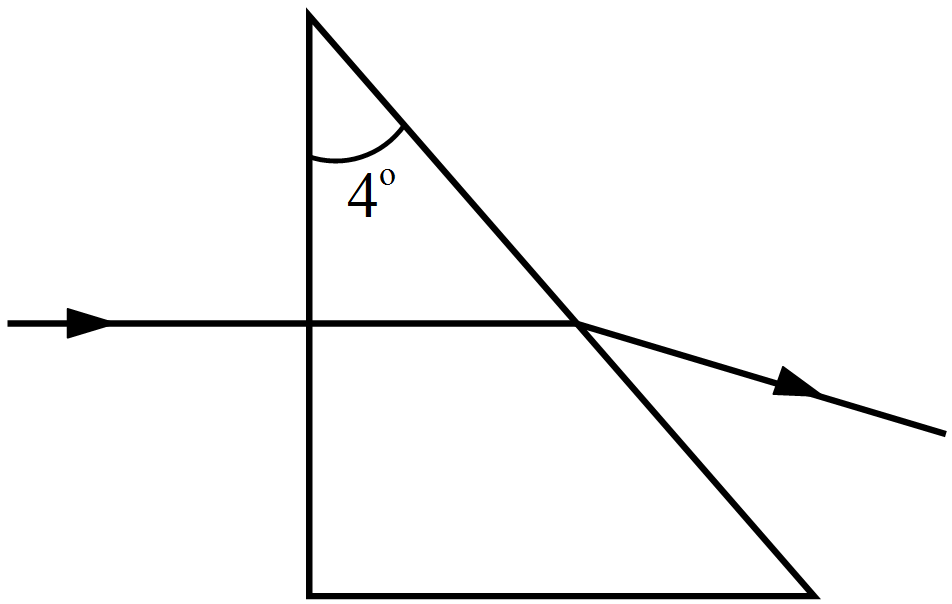
Find the angle of deviation suffered by the light ray shown in figure. The refractive index $\mu=1.5$ for the prism material.

The pendulum of a certain clock has time period 2.04s. How fast or slow does the clock run during 24 hours?