Question
Using electrostatic analogue, obtain the magnetic field $\vec{B}_{\text {equator }}$ at a distance $d$ on the perpendicular bisector of a magnetic dipole of magnetic length $2 l$ and moment $\vec{M}$. For far field, verify that
$\vec{B}_{\text {equator }}=\left(\frac{\mu_0}{4 \pi}\right) \frac{-\vec{M}}{\left(d^2+l^2\right)^{3 / 2}}$
Answer

The magnitude of the electric intensity at a point at a distance r from an electric charge q in vacuum is given by
$E=\frac{1}{4 \pi \varepsilon_0} \frac{|q|}{r^2}$where $ε_0$ is the permittivity of free space. This intensity is directed away from the charge, if the charge is positive and towards the charge, if the charge is negative.
A magnetic pole is similar to an electric charge. The N-pole is similar to a positive charge and the S-pole is similar to a negative charge. Like an electric charge, a magnetic pole is assumed to produce a magnetic field in the surrounding region. The magnetic field at any point is denoted by a vector quantity called magnetic induction. Thus, by analogy, the magnitude of the magnetic induction at a point at a distance r from a magnetic pole of strength $q_m$ is given by
$B =\frac{\mu_0}{4 \pi} \frac{q_{ m }}{r^2}$
This induction is directed away from the pole if it is an N-pole (strength $+ x)$ and towards the pole if it is an S-pole (strength $-q_m)$.
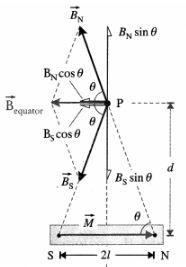
Consider a point P on the equator of a magnetic dipole with pole strengths $+ q_m$ and $– q_m$ and of magnetic length $21$. Let P be at a distance d from the centre of the dipole,


Image
The magnetic induction of a bar magnet at an equatorial point
The magnetic induction at P due to the N-pole is directed along NP (away from the N-pole) while that due to the S-pole is along PS (towards the S-pole), each having a magnitude
$ B _{ N }= B _{ S }=\left(\frac{\mu_0}{4 \pi}\right) \frac{q_{ m }}{\left(d^2+l^2\right)}$
$\left(\because NP = SP =\sqrt{d^2+l^2}\right)$
The inductions due to the two poles are equal in magnitude so that the two, oppositely directed equatorial components, $B_N \sin θ$ and $B_S \sin θ$, cancel each other.
Therefore, the resultant induction is in a direction’ parallel to the axis of the magnetic dipole and has direction opposite to that of the magnetic moment of the magnetic dipole. The component of the induction due to the two poles along the axis is
$\left(\frac{\mu_0}{4 \pi}\right) \frac{q_{ m }}{\left(d^2+l^2\right)} \cos \theta$
where $\theta$ is the angle shown in the diagram. From the diagram,
$\cos \theta=\frac{l}{\left(d^2+l^2\right)^{1 / 2}}$
The total induction at $P$ is then
$ B  =\left(B_{ N }+B_{ S }\right) \cos \theta$
$ =\left(\frac{\mu_0}{4 \pi}\right) \frac{2 q_{ m }}{\left(d^2+l^2\right)} \cos \theta$
$=\left(\frac{\mu_0}{4 \pi}\right) \frac{2 q_{ m }}{\left(d^2+l^2\right)} \cdot \frac{l}{\left(d^2+l^2\right)^{1 / 2}}$
$\therefore B  =\left(\frac{\mu_0}{4 \pi}\right) \frac{M}{\left(d^2+l^2\right)^{3 / 2}} $
where $M=2 q_{ m } l$ is the magnetic moment of the dipole.
$\vec{B}_{\text {equator }}=\left(\frac{\mu_0}{4 \pi}\right) \frac{-\vec{M}}{\left(d^2+l^2\right)^{3 / 2}}$
The minus sign shows that the direction of $\vec{B}_{\text {equator }}$ is opposite to that of $\vec{M}$.
If the dipole is very short, i.e., $l \ll d$, we can ignore $l^2$ in comparison with $d^2$. We then get
$\vec{B}_{\text {equator }}=\left(\frac{\mu_0}{4 \pi}\right) \frac{(-\vec{M})}{d^3}$
Thus, for a short dipole the induction varies in-versely as the cube of the distance from it.

Need a full question paper?

Generate a complete, print-ready paper with questions like this in minutes — across 16+ boards, with answer keys.

Start Generating Free

Similar questions

Explain the working of an atomizer.
OR
A perfume bottle or atomizer sprays a fluid that is in the bottle. How does the fluid rise up in the vertical tube in the bottle?
When an AC source is connected to an ideal inductor show that the average power supplied by the source over a complete cycle is zero.
Define angular SHM. State the differential equation of angular SHM. Hence derive an expression for the period of angular SHM in terms of
(i) the torsion constant
(ii) the angular acceleration.
State Bohr's third postulate for hydrogen $(H_2)$ atom. Derive Bohr's formula for the wave number. Obtain expressions for longest and shortest wavelength of spectral lines in ultraviolet region for hydrogen atom.
An isosceles prism of refracting angle $179^{\circ}$ and refractive index 1.6 is used as a biprism by' keeping it $10 cm$ away from a slit, the edge of the biprism being parallel to the slit. The slit is illuminated by a light of wavelength $600 nm$ and the screen is $90 cm$ away from the biprism. Calculate the location of the centre of the 10 th dark band from the centre of the interference pattern and the path difference at this location.
Express the kinetic energy of a rotating body in terms of its angular momentum.
Calculate the value of resistance needed to convert a moving$-$coil galvanometer of $60 \Omega$ which gives a full scale deflection for a current of $50\ mA$ into
$(i)$ an ammeter of range $0-5 A$
$(ii)$ a voltmeter of range $0-50 V$.
A flywheel rotating about an axis through its centre and perpendicular to its plane loses $100 \mathrm{~J}$ of energy on slowing down from $60 \mathrm{rpm}$ to $30 \mathrm{rpm}$. Find its moment of inertia about the given axis and the change in its angular momentum.
Draw a neat, labelled energy level diagram for H atom showing the transitions. Explain the series of spectral lines for H atom, whose fixed inner orbit numbers are 3 and 4 respectively.
Define ideal simple pendulum and obtain an expression for its periodic time.