Question
Using factor theorem, factorize the following polynomials:
2y3 + y2 - 2y - 1

Answer

Let p(y) = 2y3 + y2 - 2y - 1
By hit and trial method
p(1) = 2(1)3 + (1)2 - 2(1) - 1
= 2 + 1 - 2 - 1 = 0
So, y -1 is a factor of this polynomial.

Now,
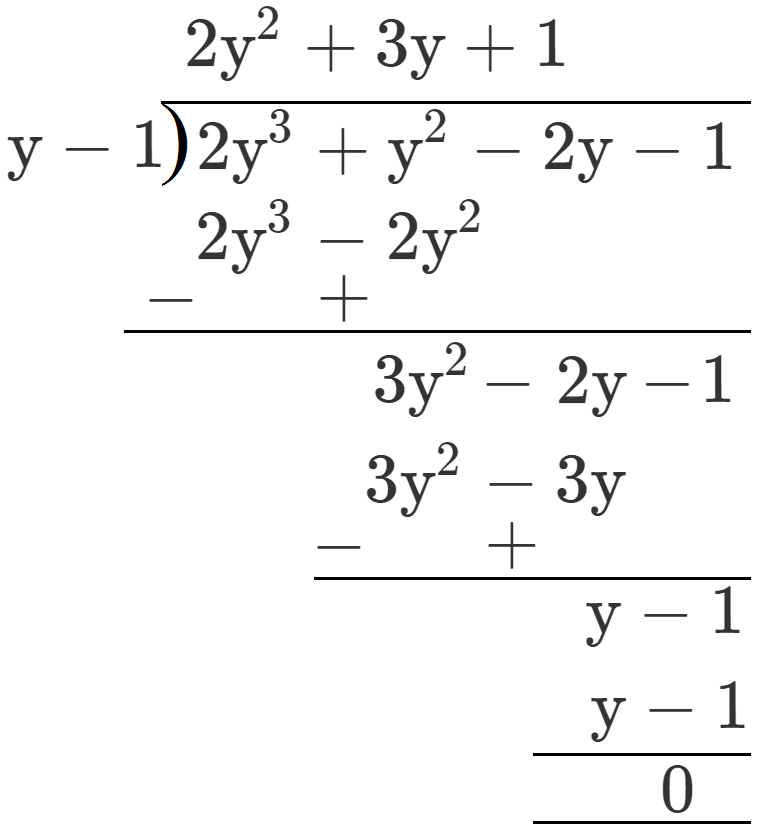
By long division method,
$\therefore$ 2y3 + y2 - 2y - 1 = (y - 1)(2y2 + 3y + 1)
= (y - 1)(2y2 + 2y + y + 1)
= (y - 1)[2y(y + 1) + 1(y + 1)]
= (y - 1)(y + 1)(2y + 1)

Need a full question paper?

Generate a complete, print-ready paper with questions like this in minutes — across 16+ boards, with answer keys.
Start Generating Free

Similar questions

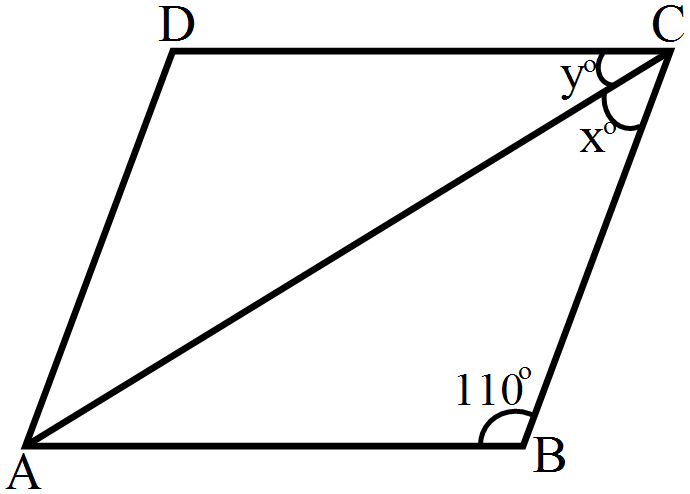
In each of the figures given below, ABCD is a rhombus. Find the value of x and y in each case.

Simplify:
$\frac{2\sqrt{6}}{{\sqrt2}+\sqrt{3}}+\frac{6\sqrt{2}}{{\sqrt6}+\sqrt{3}}-\frac{8\sqrt{3}}{{\sqrt6}+\sqrt{2}}$
Three girls Ishita, Isha and Nisha are playing a game by standing on a circle of radius 20m drawn in a park. Ishita throws a ball to Isha, Isha to Nisha and Nisha to Ishita. If the distance between Ishita and Isha and between Isha and Nisha is 24m each, what is the distance between Ishita and Nisha.
Factorize:
$\Big(\text{x}^2+\frac{1}{\text{x}^2}\Big)-4\Big(\text{x}+\frac{1}{\text{x}}\Big)+6$
If the ratio of mean and median of a certain data is 2 : 3, then find the ratio of its mode and mean.
In a cyclic quadrilateral ABCD if AB || CD and $\angle\text{B}=70^\circ,$ find the remaining angles.
In a triangle ABC, if L and M are points on AB and AC respectively such that LM || BC. Prove that:
  1. $\text{ar}(\triangle\text{LCM})=\text{ar}(\triangle\text{LBM})$
  2. $\text{ar}(\triangle\text{LBC})=\text{ar}(\triangle\text{MBC})$
  3. $\text{ar}(\triangle\text{ABM})=\text{ar}(\triangle\text{ACL})$
  4. $\text{ar}(\triangle\text{LOB})=\text{ar}(\triangle\text{MOC})$
If a pair of opposite sides of a cyclic quadrilateral are equal, prove that its diagonals are also equal.
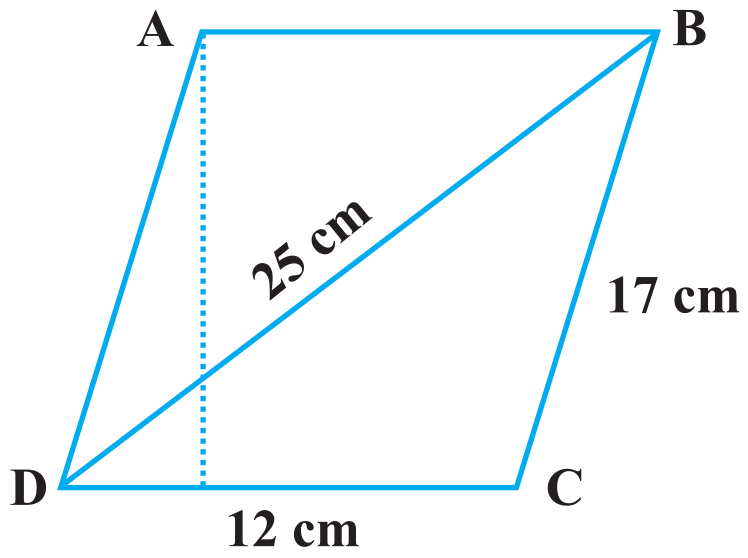
Find the area of a parallelogram given in also find the length of the altitude from vertex A on the side DC.

Draw a line segment AB bisect it. Bisect one of the equal parts to obtain a line segment of length $\frac{1}{2}(\text{AB})$