Question
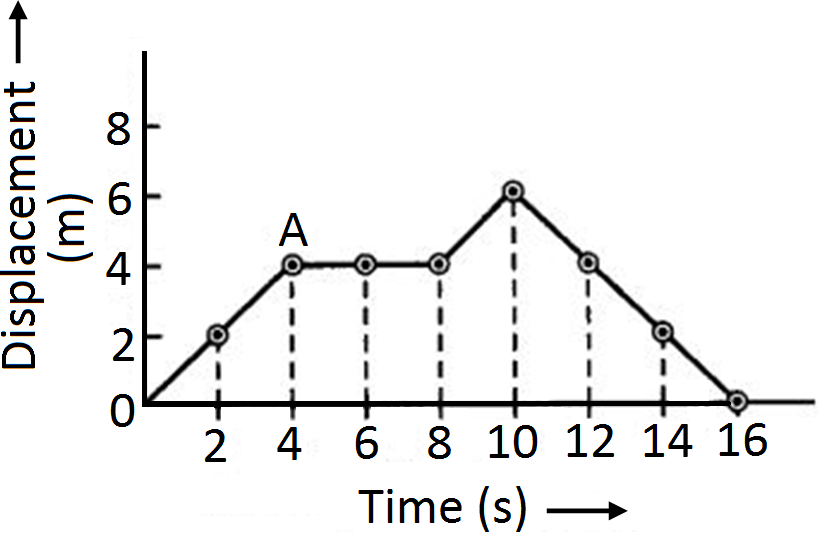
Using following data, draw time-displacement graph for a moving object:
Time (s)
0
2
4
6
8
10
12
14
16
Displacement (m)
0
2
4
4
4
6
4
2
0
 Use this graph to find average velocity for first 4s, for next 4s and for last 6s.

Answer

Therefore, displacement-time graph is shown in figure.
Average velocity for first $4\text{s}=\frac{\text{Change in displacement}}{\text{Total time takan}}$$\text{v}=\frac{4-0}{4-0}=\frac{4\text{m}}{4\text{s}}=1\text{ms}^{-1}$
Average velocity for next 4s (i.e., in the interval of 4s to 8s), $\text{v}=\frac{4-4}{8-4}=\frac{0}{4}=0$ Average velocity for last $6\text{s}=\frac{(0-6)\text{m}}{(16-10)\text{s}}=\Big(\frac{-6}{6}\Big)=1\text{ms}^{-1}$

Need a full question paper?

Generate a complete, print-ready paper with questions like this in minutes — across 16+ boards, with answer keys.

Start Generating Free

Similar questions

Write the cations and anions present, if any, in the following:
  1. $CH_3COONa$
  2. $NaCl$
  3. $H_2$
  4. $NH_4NO_3$
Which of the following are matter?
Chair, air, love, smell, hate, almonds, thought, cold, lemon water, smell of perfume.
A car is travelling along the road at $8\ ms^{-1}.$ It accelerates at $1\ ms^{-2}$ for a distance of $18m.$ How fast is it then travelling?
A ball $X$ of mass $1\ kg$ travelling at $2\ m/s$ has a head$-$on collision with an identical ball $Y$ at rest. $X$ stops and $Y$ moves off. Calculate the velocity of $Y$ after the collision.
One of the forms of a naturally occurring solid compound $P$ is usually used for making the floors of houses. On adding a few drops of dilute hydrochloric acid to $P,$ brisk effervescence are produced. When $50g$ of reactant $P$ was heated strongly, than $22g$ of a gas $Q$ and $28g$ of a solid $R$ were produced as products. Gas $Q$ is the same which produced brisk effervescence on adding dilute $\text{HCl}$ to$ P.$ Gas $Q$ is said to cause global warming whereas solid $R$ is used for white$-$washing.
  1. What is $(i)$ solid $P (ii)$ gas $Q,$ and $(iii)$ solid $R.$
  2. What is the total mass of $Q$ and $R$ obtained from $50g$ of $P$?
  3. How does the total mass of $Q$ and $R$ formed compare with the mass of $P$ taken?
  4. What conclusion do you get from the comparison of masses of products and reactant?
  5. Which law of chemical combination is illustrated by the example given in this problem?
Give two examples each of longitudinal waves and transverse waves.
Draw a well-labelled diagram of an eukaryotic nucleus. How is it different from nucleoid?
There are three substances X, Y and Z. The substance X does not have a fixed melting point or boiling point and it still shows the individual properties of its constituents. The substance Y is a pure substance which occurs in nature as such. The substance Y has a fixed melting point and boiling point but it cannot be broken down into simpler substances by any chemical means. The substance Z is also a pure substance whose properties are entirely different from those of its constituents. The substance Z can, however, be divided by electrolysis into two substances which belong to the same class of substances as Y.
  1. What type of substance could X be? Name one substance like X.
  2. What type of substance could Y be? Name one substance like Y.
  3. What type of substance could Z be? Name one substance like Z.
  4. Whish process involves absorption or release of an appreciable amount of energy: formation of substance X or formation of substance Z?
  5. Name the three groups into which all the substances like Y are divided on the basis of their properties.
How does the force of attraction between the two bodies depend upon their masses and distance between them? A student thought that two bricks tied together would fall faster than a single one under the action of gravity. Do you agree with his hypothesis or not? Comment.
What are different types of tissues in plants? Describe simple tissues.