Answer

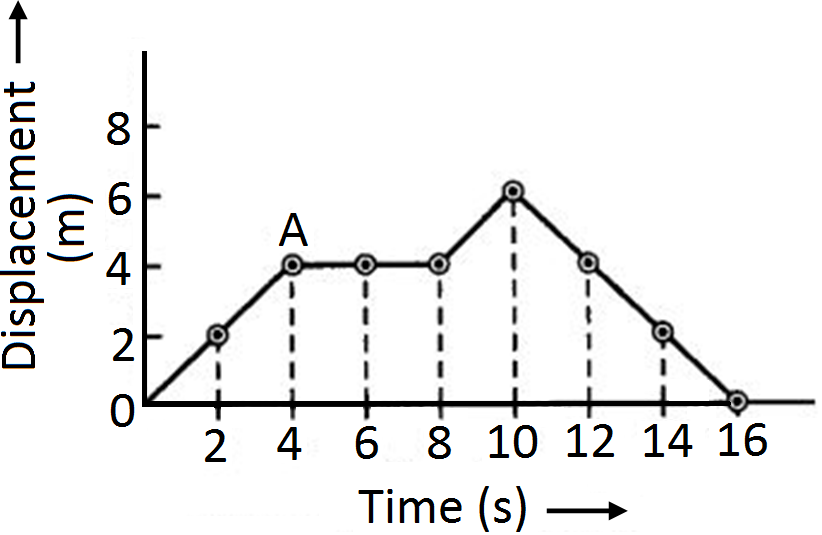
Therefore, displacement-time graph is shown in figure.


Average velocity for first $4\text{s}=\frac{\text{Change in displacement}}{\text{Total time takan}}$

$\text{v}=\frac{4-0}{4-0}=\frac{4\text{m}}{4\text{s}}=1\text{ms}^{-1}$

Average velocity for next 4s (i.e., in the interval of 4s to 8s), $\text{v}=\frac{4-4}{8-4}=\frac{0}{4}=0$

Average velocity for last $6\text{s}=\frac{(0-6)\text{m}}{(16-10)\text{s}}=\Big(\frac{-6}{6}\Big)=1\text{ms}^{-1}$

Need a full question paper?

Generate a complete, print-ready paper with questions like this in minutes — across 16+ boards, with answer keys.

Start Generating Free

Similar questions

A car is travelling along the road at $8ms^{-1}$. It accelerates at $1ms^{-2}$ for a distance of $18m$. How fast is it then travelling?
Describe an experiment to show that sound cannot pass through vacuum.
  1. How does a boat float in water?
  2. A piece of steel has a volume of $12\ cm^3,$ and a mass of $96\ g$. What is its density: $(i)$ in $g/cm^3$ $(ii)$ in $kg/m^3?$
There are three substances $X, Y$ and $Z$. The substance $X$ does not have a fixed melting point or boiling point and it still shows the individual properties of its constituents. The substance $Y$ is a pure substance which occurs in nature as such. The substance $Y$ has a fixed melting point and boiling point but it cannot be broken down into simpler substances by any chemical means. The substance $Z$ is also a pure substance whose properties are entirely different from those of its constituents. The substance $Z$ can, however, be divided by electrolysis into two substances which belong to the same class of substances as $Y$.
  1. What type of substance could $X$ be? Name one substance like $X$.
  2. What type of substance could $Y$ be? Name one substance like $Y$.
  3. What type of substance could $Z$ be? Name one substance like $Z$.
  4. Whish process involves absorption or release of an appreciable amount of energy: formation of substance $X$ or formation of substance $Z$?
  5. Name the three groups into which all the substances like $Y$ are divided on the basis of their properties.
On a level road, a scooterist applies brakes to slow down from a speed of $10m/s$ to $5m/s$. If the mass of the scooterist and the scooter be $150\ kg$, calculate the work done by the brakes. (Neglect air resistance and friction)
Calculate the number of aluminium ions present in $0.051g$ of aluminium oxide. (Hint: The mass of an ion is the same as that of an atom of the same element. Atomic mass of $Al = 27u)$
If $1$ gram of sulphur dioxide contains $x$ molecules, how many molecules will be present in $1$ gram of oxygen? $(S = 32u; O = 16u)$
What are the advantages of classifying organisms?
What is artificial insemination? Describe this technique.
Explain the role of workers in a bee colony.