Question
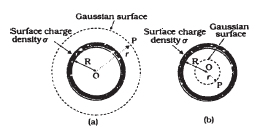
Using Gauss’s theorem, show mathematically that for any point outside the shell, the field due to a uniformly charged thin spherical shell is the same as if the entire charge of the shell is concentrated at the centre. Why do you expect the electric field inside the shell to be zero according to this theorem?
Answer

$\phi =\oint\limits_{s}\overrightarrow{\text{E}}.\overrightarrow{\text{d}}\text{s} = \frac{\text{q}}{\varepsilon_{\circ}}$
Derivation: $\text{E}\times4\pi\text{r}^{2} =\frac{\sigma}{\varepsilon_{\circ}}4\pi\text{R}^{2}$
$\therefore \text{E} = \frac{\sigma\text{R}^{2}}{\varepsilon_{\circ}\text{r}^{2}}$
where $\text{q} = 4\pi\text{R}^{2}\sigma$ is the total charge on the spherical shell. Electrostatic field is zero, since total charge inside the shell is zero or charge reside on the surface of the shell.

Need a full question paper?

Generate a complete, print-ready paper with questions like this in minutes — across 16+ boards, with answer keys.

Start Generating Free

Similar questions

Draw a schematic diagram of the experimental arrangement used by Davisson and Germer to establish the wave nature of electrons. Explain briefly how the de-Broglie relation was experimentally verified in case of electrons.
An electron and a photon each have a wavelength of 1.00 nm. Find:
  1. Their momenta,
  2. The energy of the photon, and
  3. The kinetic energy of electron.
A long, straight wire of radius r carries a current i and is placed horizontally in a uniform magnetic field B pointing vertically upward. The current is uniformly distributed over its cross-section.
  1. At what points will the resultant magnetic field have maximum magnitude? What will be the maximum magnitude?
  2. What will be the minimum magnitude of the resultant magnetic field?
A light ray falling at an angle of 45° with the surface of a clean slab of ice of thickness 1m is refracted into it at an angle of 30°. Calculate the time taken by the light rays, to cross the slab. Speed of light in vacuum $= 3 \times 10^8m/s$
A hypothetical magnetic field existing in a region is given by $\overrightarrow{\text{B}}=\text{B}_0\overrightarrow{\text{e}}_\text{r},$ where $\overrightarrow{\text{e}}_\text{r}$ denotes the unit vector along the radial direction. A circular loop of radius a, carrying a current i, is placed with its plane parallel to the x-y plane and the centre at (0, 0, d). Find the magnitude of the magnetic force acting on the loop.
  1. Define mutual inductance.
  2. A pair of adjacent coils has a mutual inductance of 1.5 H. If the current in one coil changes from 0 to 20 A in 0.5 s, what is the change of flux linkage with the other coil?
  1. A radioactive nucleus 'A' undergoes a series of decays as given below:
$\text{A}\xrightarrow\alpha\text{A}_1\xrightarrow\beta\text{A}_2\xrightarrow\alpha\text{A}_3\xrightarrow\gamma\text{A}_4$

The mass number and atomic number of $A_2$ are 176 and 71 respectively. Determine the mass and atomic numbers of $A_4$ and A.
  1. Write the basic nuclear process underlying $\beta+$ and $\beta-$ decays.
Should the energy of a photon be called its kinetic energy or its internal energy?
Show that a force that does no work must be a velocity dependent force.
Derive an expression for the axial magnetic field of a finite solenoid of length 2l and radius r carrying current I. Under what condition does the field become equivalent to that produced by a bar magnet?