APPLICATION OF INTEGRALS — MATHS STD 12 Science — Question
Rajasthan BoardEnglish MediumSTD 12 ScienceMATHSAPPLICATION OF INTEGRALS5 Marks
Question
Using integration, Find the area bounded by the the triangle whose vartices are $(2, 1), (3, 4)$ and $(5, 2).$
✓
Answer
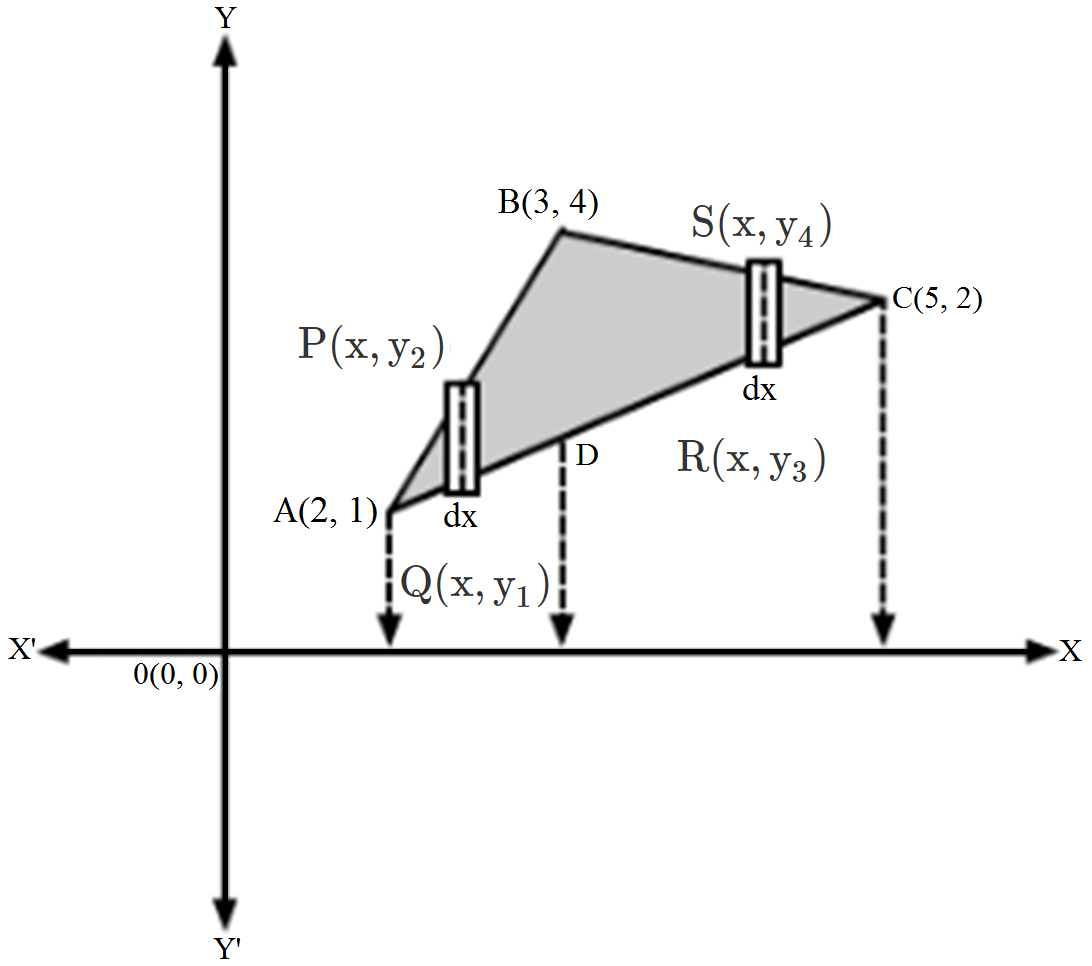
Consider the points $A(2, 1), B(3, 4)$ and $C(5, 2)$
We need to find area of shaded triangle $ABC$
Equation of $AB$ is
$\text{y}-1=\Big(\frac{4-3}{3-2}\Big)(\text{x}-2)$
$\Rightarrow\text{x}-3\text{y}-5=0\ ...(\text{i})$
Equation of $BC$ is
$\text{y}-4=\Big(\frac{2-4}{5-3}\Big)(\text{x}-3)$
$\Rightarrow\text{x}=\text{y}-7=0\ ...(\text{ii})$
Equation of $CA$ is
$\text{y}-2=\Big(\frac{2-1}{5-2}\Big)(\text{x}-5)$
$\Rightarrow\text{x}-3\text{y}+2=0\ ...(\text{iii})$
Area of $\triangle\text{ABC}= \text{Area of}\ \triangle\text{ABC}+ \text{Area of }\triangle\text{ABC}$ in the,
Consided point $P(x_1, y_2)$ on $AB$ and $Q(x_1, y_1)$ on $AD$
Thus, the area of appoximating with length $= |y_2 - y_1|$ from $x = 2,$ to $x = 3$
$\therefore$ Area of $\triangle\text{ABC}=\int\limits_{2}^{3}|\text{y}_{2}-\text{y}_{1}|\text{dx} $
$\Rightarrow\text{A}=\int\limits_{2}^{3}(\text{y}_{2}-\text{y}_{1})\text{dx} $
$\Rightarrow\text{A}=\int\limits_{2}^{3}(3\text{x}-5)-\Big(\frac{\text{x}-1}{3}\Big)\text{dx}$
$\Rightarrow\text{A}=\int\limits_{2}^{3}\frac{(9\text{x}-15-\text{x}-1)}{3}\text{dx}$
$\Rightarrow\text{A}=\int\limits_{2}^{3}\frac{(8\text{x}-16)}{3}\text{dx}$
$\Rightarrow\text{A}=\frac{1}{3}\Big[8\text{x}^{2}-16\text{x}\Big]\text{dx}$
$\Rightarrow\text{A}=\frac{1}{3}(68-64)$
$\Rightarrow\text{A}=\frac{4}{3}\ \text{sq.}\ \text{units}$
Need a full question paper?
Generate a complete, print-ready paper with questions like this in minutes — across 16+ boards, with answer keys.