Question
Using integration, Find the area bounded by the the triangle whose vartices are (2, 1), (3, 4) and (5, 2).
Answer


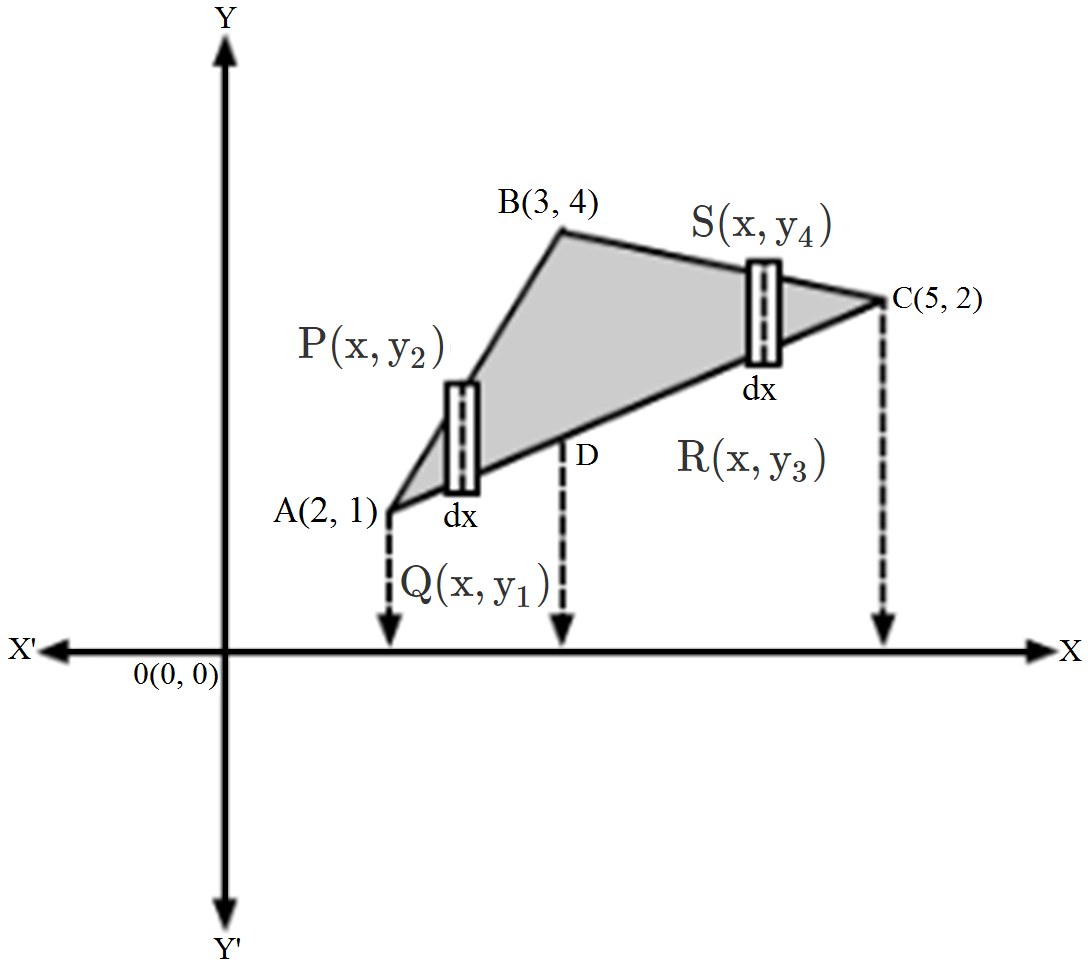
Consider the points A(2, 1), B(3, 4) and C(5, 2)

We need to find area of shaded triangle ABC

Equation of AB is 

$\text{y}-1=\Big(\frac{4-3}{3-2}\Big)(\text{x}-2)$

$\Rightarrow\text{x}-3\text{y}-5=0\ ...(\text{i})$

Equation of BC is 

 $\text{y}-4=\Big(\frac{2-4}{5-3}\Big)(\text{x}-3)$

$\Rightarrow\text{x}=\text{y}-7=0\ ...(\text{ii})$

Equation of CA is

 $\text{y}-2=\Big(\frac{2-1}{5-2}\Big)(\text{x}-5)$

$\Rightarrow\text{x}-3\text{y}+2=0\ ...(\text{iii})$

Area of $\triangle\text{ABC}= \text{Area of}\ \triangle\text{ABC}+ \text{Area of }\triangle\text{ABC}$ in the, 

Consided point P(x1, y2) on AB and Q(x1, y1) on AD

Thus, the area of appoximating with length = |y2 - y1| from x = 2, to x = 3

$\therefore$ Area of $$$\triangle\text{ABC}=\int\limits_{2}^{3}|\text{y}_{2}-\text{y}_{1}|\text{dx} $

$\Rightarrow\text{A}=\int\limits_{2}^{3}(\text{y}_{2}-\text{y}_{1})\text{dx} $

$\Rightarrow\text{A}=\int\limits_{2}^{3}(3\text{x}-5)-\Big(\frac{\text{x}-1}{3}\Big)\text{dx}$

$\Rightarrow\text{A}=\int\limits_{2}^{3}\frac{(9\text{x}-15-\text{x}-1)}{3}\text{dx}$

$\Rightarrow\text{A}=\int\limits_{2}^{3}\frac{(8\text{x}-16)}{3}\text{dx}$

$\Rightarrow\text{A}=\frac{1}{3}\Big[8\text{x}^{2}-16\text{x}\Big]\text{dx}$

$\Rightarrow\text{A}=\frac{1}{3}(68-64)$

$\Rightarrow\text{A}=\frac{4}{3}\ \text{sq.}\ \text{units}$

Need a full question paper?

Generate a complete, print-ready paper with questions like this in minutes — across 16+ boards, with answer keys.

Start Generating Free

Similar questions

An insurance company insured 2000 scooter drivers, 4000 car drivers and 6000 truck drivers. The probability of an accident involving a scooter, a car and a truck are 0.01, 0.03 and 0.15 respectively. One of the insured persons meets with an accident. What is the probability that he is a scooter driver.
Solve the following systems of linear equations by cramer's rule:
3x + y + z = 2,
2x - 4y + 3z = -1,
4x + y - 3z = -11
Two schools P and Q want to award their selected students on the values of Discipline, Politeness and Punctuality. The school P wants to award ₹ x each, ₹ y each and ₹ z each the three respectively values to its 3, 2 and 1 students with a total award money of ₹ 1,000School Q wants to spend ₹ 1,500 to award its 4, 1 and 3 students on the respective values (by giving the same award money for three values as before). If the total amount of awards for one prize on each value is ₹ 600, using matrices, find the award money for each value. Apart from the above three values, suggest one more value for awards.
If y = Aemx + Benx, show that $\frac{{{d^2}y}}{{d{x^2}}} - \left( {m + n} \right)\frac{{dy}}{{dx}} + mny = 0$
Prove that the points having position vectors $\hat{\text{i}}+2\hat{\text{j}}+3\hat{\text{k}},\ 3\hat{\text{i}}+4\hat{\text{j}}+7\hat{\text{k}}$ and $-3\hat{\text{i}}-2\hat{\text{j}}-5\hat{\text{k}}$ are collinear.
Find $\frac{\text{dy}}{\text{dx}},$ when
$\text{x}=\text{e}^{\theta}\Big(\theta+\frac{1}{\theta}\Big)\text{ and y}=\text{e}^{-\theta}\Big(\theta-\frac{1}{\theta}\Big)$
If P is a point and ABCD is a quadrilateral and $\overrightarrow{\text{AP}}+\overrightarrow{\text{PB}}+\overrightarrow{\text{PD}}=\overrightarrow{\text{PC}}$, show that ABCD is a parallelogram.
Evaluate the following definite integrals:
$\int\limits_{0}^{\frac{\pi}{2}}\cos^4\text{x}\text{ dx}$
If A = {a, b, c}, then the relation R = {(b, c)} on A is:
  1. Reflexive only.
  2. Symmetric only.
  3. Transitive only.
  4. Reflexive and transitive only.
A class has 15 students whose ages are 14, 17, 15, 14, 21, 19, 20, 16, 18, 17, 20, 17, 16, 19 and 20 years respectively. One student is selected in such a manner that each has the same chance to being selected and the age X of the selected student is recorded. What is the probability distribution of the random variable X.