Question
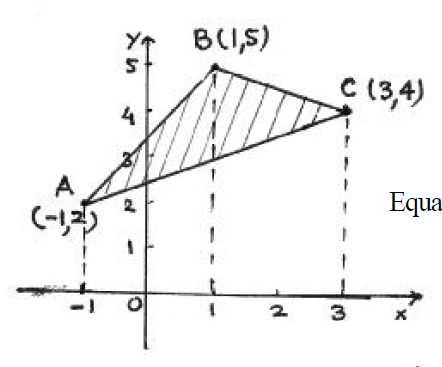
Using integration, find the area of the region bounded by the triangle whose vertices are (–1, 2), (1, 5) and (3, 4).
Answer

Correct fiqure

Equation of
$\text{AB is}:\text{y} =\frac{1}{2}(3 \text{x} + 7 )$
$\text{BC is:}\text{y} = \frac{1}{2}(11 - \text{x})$
$\text{AC is}:\text{y} =\frac{1}{2}(\text{x} + 5 )$
Required area $ =\frac{1}{2}\int\limits_{-1}^{1}(3 \text{x} + 7 )\text{dx} + \frac{1}{2}\int\limits_{1}^{3}(11 - \text{x})\text{dx} - \frac{1}{2}\int\limits_{-1}^{3}(\text{x} + 5 )\text{dx}$
$ = \bigg[\frac{1}{12}(3 \text{x} + 7 )^{2}\bigg]_{-1}^{1} - \frac{1}{4}\bigg[(11-\text{x})^{2}\bigg]_{1}^{3} - \frac{1}{4}\bigg[(\text{x} + 5)^{2}\bigg]_{-1}^{3}$
= 7 + 9 – 12 = 4 sq. units.

Need a full question paper?

Generate a complete, print-ready paper with questions like this in minutes — across 16+ boards, with answer keys.

Start Generating Free

Similar questions

Show that the function defined by f(x) = | cos x | is a continuous function.
Solve the following differential equations:$\frac{\text{dy}}{\text{dx}}=\frac{\text{e}^{\text{x}}(\sin^2\text{x}+\sin2\text{x})}{\text{y}(2\log\text{y}+1)}$
Differentiate the following functions with respect to x:
$3\text{e}^{-3\text{x}}\log(1+\text{x})$
Find $\frac{\text{dy}}{\text{dx}}$
$\text{y}=\text{x}^{\sin\text{x}}+\big(\sin\text{x}\big)^\text{x}$
Show that $2\tan^{-1}\text{x}+\sin^{-1}\frac{2\text{x}}{1+\text{x}^2}$ is constant for $\text{x}\geq1,$ find that constant.
If the functions f(x), defined below is continuous at x = 0, find the value of k.
$\text{f(x)}=\begin{cases}\frac{1-\cos2\text{x}}{2\text{x}^2},&\text{x}<0\\\text{k},&\text{x}=0\\\frac{\text{x}}{|\text{x}|},&\text{x}>0\end{cases}$ 
 $\text{If }\overrightarrow{\text{a}}=\hat{\text{i}}-\hat{\text{j}}+\hat{\text{7k}};\text{ and }\overrightarrow{b}=\hat{\text{5i}}-\hat{\text{j}}+\lambda\hat{\text{k}},$ then find the value of $\lambda,$ so that $\overrightarrow{a}+\overrightarrow{b}$ and $\overrightarrow{a}-\overrightarrow{b}$ are perpendicular vectors.
Find the point on the curve $\frac{\text{x}^2}{9}+\frac{\text{y}^2}{16}=1$ at which the tangent are:
  1.  parallel to x-axis
  2.  paralle to y- axis
Solve the following differential equation:
$(1+\text{y}^2)+(\text{x}-\text{e}^{\tan^{-1}\text{y}})\frac{\text{dy}}{\text{dx}}=0$
Find graphically, the maximum value of $\text{z = 2x + 5y},$ subject to constraints given below:
$2x + 4y \leq 8$
$3x + y \leq 6$
$x + y \leq 4$
$x\geq 0, y\geq 0$