Question
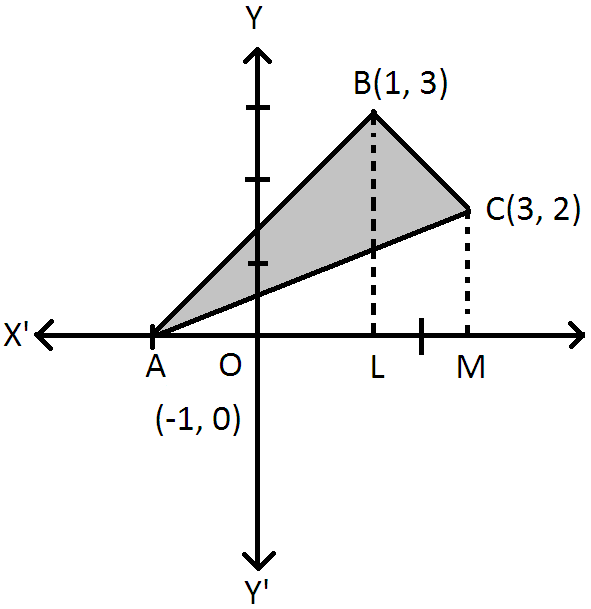
Using integration, find the area of the region bounded by the triangle whose vertices are (-1, 0), (1, 3) and (3, 2).
Answer

Here, Vertices of triangle are A(-1, 0), B(1, 3) and C(3, 2).
$\therefore$ Equation of the line is $\text{y}-0=\frac{3-0}{1-(-1)}(\text{x}-(-1))$ $\bigg[\therefore\text{y}-\text{y}_1=\frac{\text{y}_2-\text{y}_1}{\text{x}_2-\text{x}_1}(\text{x}-\text{x}_1)\bigg]$ $\Rightarrow\text{y}=\frac32(\text{x}+1)$ $\therefore\text{Area of }\Delta\text{ABL}$ = Area bounded by line AB and x-axis $=\begin{vmatrix}\int\limits^1_{-1}\text{y dx} \end{vmatrix}\Big[\therefore\text{At A, x}=-1\text{ and at B},\text{ x}=1\Big]$ $=\begin{vmatrix}\int\limits^1_{-1}\frac32(\text{x}+1)\text{dx} \end{vmatrix}$ $=\frac32\begin{vmatrix}\int\limits^1_{-1}(\text{x}+1)\text{dx} \end{vmatrix}=\frac32\begin{vmatrix}\bigg(\frac{\text{x}^2}{2}+\text{x}\bigg)^1_{-1} \end{vmatrix}$ $=\frac32\begin{vmatrix}\bigg(\frac{1}{2}+\text{1}\bigg)-\bigg(\frac{1}{2}-\text{1}\bigg)\end{vmatrix}$ $=\frac32\bigg(\frac32+\frac12\bigg)=\frac32.\frac42=3\dots(\text{i})$ Again equation of line BC is $\text{y}-3=\frac{2-3}{3-1}(\text{x}-1)\Rightarrow\text{y}=\frac12(7-\text{x})$ $\therefore$ Area of trapezium BLMC = Area bounded by line BC and x-axis $=\begin{vmatrix}\int\limits^3_{1}\text{y dx} \end{vmatrix}=\begin{vmatrix}\int\limits^3_{1}\frac12(7-\text{x})\text{dx} \end{vmatrix}$ $=\frac12\begin{vmatrix}\bigg(7\text{x}-\frac{\text{x}^2}{2}\bigg)^3_1 \end{vmatrix}$ $=\frac12\begin{vmatrix}\bigg(21-\frac{\text{9}}{2}\bigg)-\bigg(7-\frac{\text{1}}{2}\bigg)\end{vmatrix}$ $=\frac12\bigg(21-\frac{\text{9}}{2}-7+\frac12\bigg)=\frac12\Big(\frac{42-9-14+1}{2}\Big)$ $=\frac14\times20=5\dots(\text{ii})$ Again equation of line AC is $\text{y}-0=\frac{2-0}{3-(-1)}(\text{x}-(-1))\Rightarrow\text{y}=\frac12(\text{x}+1)$ $\therefore$ Area of triangle ACM = Area bounded by line AC and x-axis $=\begin{vmatrix}\int\limits^3_{-1}\text{y dx} \end{vmatrix}=\begin{vmatrix}\int\limits^3_{-1}\frac12(\text{x}+1)\text{dx} \end{vmatrix}=\frac12\begin{vmatrix}\Big(\frac{\text{x}^2}{2}+\text{x}\Big)^3_{-1} \end{vmatrix}$ $=\frac12\begin{vmatrix}\Big(\frac92+3\Big)-\Big(\frac12-1\Big)\end{vmatrix}$ $=\frac12\Big(\frac92+3-\frac12+1\Big)$ $=\frac12\Big(\frac{9+6-1+2}{2}\Big)$ $=\frac14\times16=4\dots(\text{iii})$ $\therefore$ Required area = Area of $\Delta\text{ABL}$ + Area of Trapezium BLMC - Area of $\Delta\text{ACM}$ = 3 + 5 - 4 = 4 sq. units

Need a full question paper?

Generate a complete, print-ready paper with questions like this in minutes — across 16+ boards, with answer keys.

Start Generating Free

Similar questions

Show that $\text{f}(\text{x})=\text{x}^\frac{1}{3}$ is not differentible at x = 0.
If $\vec{\text{a}}=2\hat{\text{i}}-3\hat{\text{j}}+\hat{\text{k}},\vec{\text{b}}=-\hat{\text{i}}+\hat{\text{k}},\vec{\text{c}}=2\hat{\text{j}}-\hat{\text{k}}$are three vectors, find the aera of the parallelogram having diagonals $\big(\vec{\text{a}}+\vec{\text{b}}\big)$ and $\big(\vec{\text{b}}+\vec{\text{c}}\big).$
Show that the function f defined as follows,
$\text{f(x)}=\begin{cases}3\text{x}-2, & 0<\text{x}\leq1\\2\text{x}^2-\text{x,} & 1<\text{x}\leq2\\5\text{x}-4,&\text{x}>2\end{cases}$
is countinuous at x = 2, but not differentiable there at x = 2.
Find the area bounded by the curve $\text{y}=\sqrt{\text{x}},$ x = 2y + 3 in the first quadrant and x-axis.
$\text{if } \vec{\text{a}} = 2\hat{\text{i}} + \hat{\text{j}} - \hat{\text{k}}, \vec{\text{b}} = 4\hat{\text{i}} - 7\hat{\text{j}} + \hat{\text{k}}, \text{find a vector } \vec{\text{c}} \text{ such that } \vec{\text{a}} \times \vec{\text{c}} \text{ and } \vec{\text{a }} . \vec{\text{c}} = 6.$
Find the angle between the follwing pairs of lines:$\vec{\text{r}}=\lambda\big(\hat{\text{i}}+\hat{\text{j}}+2\hat{\text{k}}\big)$ and $\vec{\text{r}}=2\hat{\text{j}}+\mu\big\{\big(\sqrt{3}-1\big)\hat{\text{i}}-\big(\sqrt{3}+1\big)\hat{\text{j}}+4\hat{\text{k}}\big\}$
Suppose we have four boxes A, B, C and D containing coloured marbles as given below:

Box

Marble colour


Red

White

Black

A

B

C

D

1

6

8

0

6

2

1

6

3

2

1

4

One of the boxes has been selected at random and a single marble is drawn from it. If the marble is red, what is the probability that it was drawn from box A?, box B? box C?

A firm manufactures $3$ products $A, B$ and $C.$ The profits are $Rs. 3, Rs. 2$ and $Rs. 4$ respectively. The firm has $2$ machines and below is the required processing time in minutes for each machine on each product:
Machine
Products
$A$ $B$ $C$
$M_1$ $4$ $3$ $5$
$M_2$ $2$ $2$ $4$
Machines $M_1$ and $M_{2}$ have $2000$ and $2500$ machine minutes respectively. The firm must manufacture $100 A's, 200 B's$ and $50 C's$ but not more than $150 A's.$ Set up a $\text{LPP}$ to maximize the profit.
Evaluate the following integrals:
$\int(\text{x}+3)\sqrt{3-4\text{x}-\text{x}^2}\text{dx}$
In a dice game, a player pays a stake of Rs. 1 for each throw of a die. She receives Rs. 5 if the die shows a 3, Rs. 2 if the die shows a 1 or 6, and nothing otherwise. What is the player’s expected profit per throw over a long series of throws?