Question
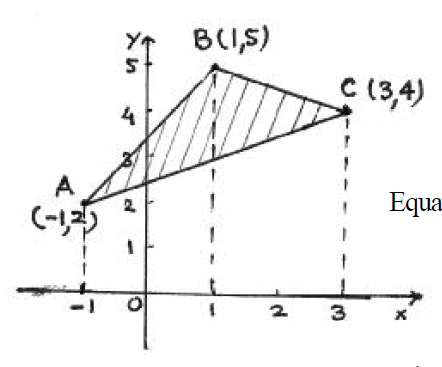
Using integration, find the area of the region bounded by the triangle whose vertices are (–1, 2), (1, 5) and (3, 4).
Answer

Correct fiqure

Equation of
$\text{AB is}:\text{y} =\frac{1}{2}(3 \text{x} + 7 )$
$\text{BC is:}\text{y} = \frac{1}{2}(11 - \text{x})$
$\text{AC is}:\text{y} =\frac{1}{2}(\text{x} + 5 )$
Required area $ =\frac{1}{2}\int\limits_{-1}^{1}(3 \text{x} + 7 )\text{dx} + \frac{1}{2}\int\limits_{1}^{3}(11 - \text{x})\text{dx} - \frac{1}{2}\int\limits_{-1}^{3}(\text{x} + 5 )\text{dx}$
$ = \bigg[\frac{1}{12}(3 \text{x} + 7 )^{2}\bigg]_{-1}^{1} - \frac{1}{4}\bigg[(11-\text{x})^{2}\bigg]_{1}^{3} - \frac{1}{4}\bigg[(\text{x} + 5)^{2}\bigg]_{-1}^{3}$
= 7 + 9 – 12 = 4 sq. units.

Need a full question paper?

Generate a complete, print-ready paper with questions like this in minutes — across 16+ boards, with answer keys.

Start Generating Free

Similar questions

Prove that the curves $xy = 4$ and $x^2 + y^2 = 8$ touch each other.
If $\text{y}=\sin\Big[2\tan^{-1}\Big\{\sqrt{\frac{1-\text{x}}{1+\text{x}}}\Big\}\Big],$ find $\frac{\text{dy}}{\text{dx}}.$
Solve the following L.P.P. graphically:
$\text{Miximise}\ \ \ \ \ \ \ \ \ \ \ \ \ \ \ \ \ \ \ \ \ \ \ \ \ \ \ \ \ \ \ \ \ \ \ \ \ \ \ \text{ }\text{ }\text{ }\text{Z} = 4x + \text{y}\\ \text{Subect to following constraints} \text{ }\text{ }\text{ }\text{ }\text{ }x + \text{y} \leq 50\\ \ \ \ \ \ \ \ \ \ \ \ \text{}\text{} \text{ }\ \ \ \ \ \ \ \ \ \ \ \ \ \ \ \ \ \ \ \ \ \ \ \ \ \ \ \ \ \ \ \ \ \ \ \ \ \ \ \ \ \ \ \ \ \ 3x + \text{y} \leq 90\\ \text{ }\text{ }\text{ }\text{ }\text{ }\text{ }\text{ }\text{ }\text{ }\text{ }\text{ }\text{ }\text{ }\text{ }\text{ }\text{ }\text{ }\text{ }\text{ }\text{ }\text{ }\ \ \ \ \ \ \ \ \ \ \ \ \ \ \ \ \ \ \ \ \ \ \ \ \ \ \ \ \ \ \ \ \ \ \ \ \ x \ \geq 10\\ \text{ }\text{ }\text{ }\text{ }\text{ }\text{ }\ \ \ \ \ \ \ \ \ \ \ \ \ \ \ \ \ \ \ \ \ \ \ \ \ \ \ \ \ \ \ \ \ \ \ \ \ \ \ \ \ \ \ \ \ \ \ \ \ \ \ \ x, \text{y} \geq 0$
In each of the form a differential equation representing the given family of curves by eliminating arbitrary constants a and b.
$y = e^x (acos\ x + bsin\ x)$
Find the particular solution of the differential equation $(1 + y^2) + (x – \text{e}^{\tan^{-1}}$y)$\frac{\text{dy}}{\text{dx}}=0$ given that $y = 0$ when $x=1.$
Evaluate the following definite integrals:
$\int\limits_{0}^{\frac{\pi}{2}}\sin^3\text{x}\text{ dx}$
If $\text{y}=\frac{\text{e}^\text{x}-\text{e}^{-\text{x}}}{\text{e}^{\text{x}}+\text{e}^{-\text{x}}},$ prove that $\frac{\text{dy}}{\text{dx}}=1-\text{y}^2$
Verify the Rolle’s theorem for each of the functions:
$\text{f(x)}=\sin^4\text{x}+\cos^4\text{x}\text{ in }\Big[0,\frac{\pi}{2}\Big].$
Evaluate the following intregals:
$\int\frac{\text{x}^2+\text{x}+1}{(\text{x}+1)^2(\text{x}+2)}\ \text{dx}$
Differentiate the following functions with respect to x:
$(\text{x}^\text{x})\sqrt{\text{x}}$