APPLICATION OF INTEGRALS — Maths STD 12 Science — Question
Gujarat BoardEnglish MediumSTD 12 ScienceMathsAPPLICATION OF INTEGRALS5 Marks
Question
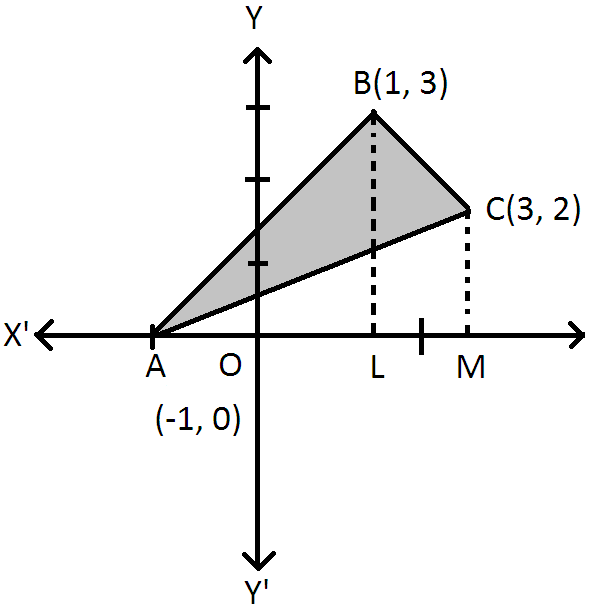
Using integration, find the area of the region bounded by the triangle whose vertices are (-1, 0), (1, 3) and (3, 2).
✓
Answer
Here, Vertices of triangle are A(-1, 0), B(1, 3) and C(3, 2).
$\therefore$ Equation of the line is $\text{y}-0=\frac{3-0}{1-(-1)}(\text{x}-(-1))$ $\bigg[\therefore\text{y}-\text{y}_1=\frac{\text{y}_2-\text{y}_1}{\text{x}_2-\text{x}_1}(\text{x}-\text{x}_1)\bigg]$ $\Rightarrow\text{y}=\frac32(\text{x}+1)$ $\therefore\text{Area of }\Delta\text{ABL}$ = Area bounded by line AB and x-axis $=\begin{vmatrix}\int\limits^1_{-1}\text{y dx} \end{vmatrix}\Big[\therefore\text{At A, x}=-1\text{ and at B},\text{ x}=1\Big]$ $=\begin{vmatrix}\int\limits^1_{-1}\frac32(\text{x}+1)\text{dx} \end{vmatrix}$ $=\frac32\begin{vmatrix}\int\limits^1_{-1}(\text{x}+1)\text{dx} \end{vmatrix}=\frac32\begin{vmatrix}\bigg(\frac{\text{x}^2}{2}+\text{x}\bigg)^1_{-1} \end{vmatrix}$ $=\frac32\begin{vmatrix}\bigg(\frac{1}{2}+\text{1}\bigg)-\bigg(\frac{1}{2}-\text{1}\bigg)\end{vmatrix}$ $=\frac32\bigg(\frac32+\frac12\bigg)=\frac32.\frac42=3\dots(\text{i})$ Again equation of line BC is $\text{y}-3=\frac{2-3}{3-1}(\text{x}-1)\Rightarrow\text{y}=\frac12(7-\text{x})$ $\therefore$ Area of trapezium BLMC = Area bounded by line BC and x-axis $=\begin{vmatrix}\int\limits^3_{1}\text{y dx} \end{vmatrix}=\begin{vmatrix}\int\limits^3_{1}\frac12(7-\text{x})\text{dx} \end{vmatrix}$ $=\frac12\begin{vmatrix}\bigg(7\text{x}-\frac{\text{x}^2}{2}\bigg)^3_1 \end{vmatrix}$ $=\frac12\begin{vmatrix}\bigg(21-\frac{\text{9}}{2}\bigg)-\bigg(7-\frac{\text{1}}{2}\bigg)\end{vmatrix}$ $=\frac12\bigg(21-\frac{\text{9}}{2}-7+\frac12\bigg)=\frac12\Big(\frac{42-9-14+1}{2}\Big)$ $=\frac14\times20=5\dots(\text{ii})$ Again equation of line AC is $\text{y}-0=\frac{2-0}{3-(-1)}(\text{x}-(-1))\Rightarrow\text{y}=\frac12(\text{x}+1)$ $\therefore$ Area of triangle ACM = Area bounded by line AC and x-axis $=\begin{vmatrix}\int\limits^3_{-1}\text{y dx} \end{vmatrix}=\begin{vmatrix}\int\limits^3_{-1}\frac12(\text{x}+1)\text{dx} \end{vmatrix}=\frac12\begin{vmatrix}\Big(\frac{\text{x}^2}{2}+\text{x}\Big)^3_{-1} \end{vmatrix}$ $=\frac12\begin{vmatrix}\Big(\frac92+3\Big)-\Big(\frac12-1\Big)\end{vmatrix}$ $=\frac12\Big(\frac92+3-\frac12+1\Big)$ $=\frac12\Big(\frac{9+6-1+2}{2}\Big)$ $=\frac14\times16=4\dots(\text{iii})$ $\therefore$ Required area = Area of $\Delta\text{ABL}$ + Area of Trapezium BLMC - Area of $\Delta\text{ACM}$ = 3 + 5 - 4 = 4 sq. units
Need a full question paper?
Generate a complete, print-ready paper with questions like this in minutes — across 16+ boards, with answer keys.