Question
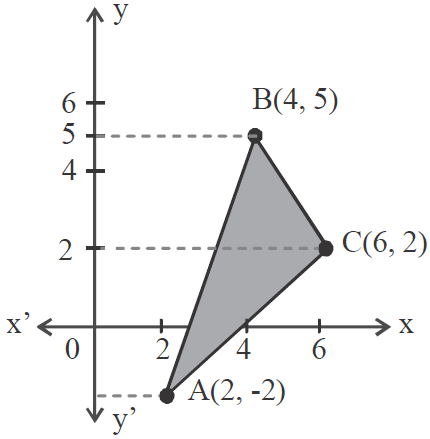
Using integration, find the area of the region bounded by the triangle whose vertices are (2, –2), (4, 5) and (6, 2).

Answer

yet A = (2 - 2)
B = (4, 5)
C = (6, 2)
We have to find the area of $\triangle\text{ABC}$ 
Equation of line AB $\text{y}-5=\Big(\frac{-2-5}{2-4}\Big)(\text{x}-4)$
$\text{y}-5=\frac72(\text{x}-4)$
$2\text{y}-10=7\text{x}-28$
$\text{7x}-2\text{y}=-10+28$
$\text{7x}-2\text{y}=18\dots(\text{i})$
Equation of line BC $\text{y}-2=\Big(\frac{5-2}{4-6}\Big)(\text{x}-6)$
$-2\text{y}+4=3\text{x}-18$
$4+18=3\text{x}+\text{2y}$
$\text{3x}+\text{2y}=22\dots{\text{(ii)}}$
Equation of line AC $\text{y}-2=\frac{-2-2}{2-6}(\text{x}-6)$
$\text{y}-2=\frac{-4}{-4}(\text{x}-6)$
$\text{y}-2=\text{x}-6$
$\text{x}-\text{y}=-2+6$
$\text{x}-\text{y}=4\dots(\text{iii})$
So the required are:

$\text{ar}(\triangle\text{ABC})=\int_\limits{2}^{2} (\text{y}+4)\text{dy}+\Big(\frac{-2}{3}\Big)\\\int_\limits{2}^{5}(\text{y}-11)\text{dy}-\int_\limits{-2}^{5}\frac27(\text{y}+9)\text{dy}$
$=\frac12\Big[(\text{y}+4)^2\Big]^2_{-2}-\frac13\Big[(\text{y}-11)^2\Big]^5_{2}-\frac17\Big[(\text{y}+9)^2\Big]^5_{-2}$
$=16+15-21=10.$

Need a full question paper?

Generate a complete, print-ready paper with questions like this in minutes — across 16+ boards, with answer keys.
Start Generating Free

Similar questions

Prove that the curves $\text{y}^{2} = 4x \text{ and } x^{2} = 4y $ divided the area of square bounded by $x = 0, x = 4,y=4 \text{ and } y = 0$ into three equal parts.
Evaluate the following integrals:$\int\tan^{-1}\Big(\frac{2\text{x}}{1-\text{x}^2}\Big)\text{dx}$
Discuss the continuity of $\text{f(x)}=\sin|\text{x}|$
Find the position vector of a point R which divides the line joining two points P and Q whose position vectors are $(2\overrightarrow{\text{a}}+\overrightarrow{\text{b}})$ and$(\overrightarrow{\text{a}}-3\overrightarrow{\text{b}})$ respectively, externally in the ratio 1:2. Also, show that P is the mid point of the line segment RQ.
Check the commutativity and associativity of the following binary operations:
'*' on Q defined by a * b = a - b for all a, b ∈ Q.
Find a point on the parabola $y = (x - 4)^2,$ where the tangent is parallel to the chord joining $(4, 0)$ and $(5, 1).$
$\text{Let } \vec{\text a} = \hat{\text{i}} + \hat{\text{j}} + \hat{\text{k}}, \vec{\text{b}} = \hat{\text{i}} \text{ and } \vec{\text{c}} = \text{c}_{1} \hat{\text{i}} + \text{c}_{2} \hat{\text{j}} + \text{c}_{3} \hat{\text{k}}, \text{then}$
  1. Let $c_1 = 1$ and $c_2 = 2,$ find $c_3$ which makes $\vec{\text{a}}, \vec{\text{b}} \text{ and }\vec{\text{c}} \text{ coplanar.}$
  2. If $c_2 = –1$ and $c_3 = 1,$ show that no value of $c_1$ can make $\vec{\text{a}}, \vec{\text{b}} \text{ and } \vec{\text{c}} \text{ coplanar}.$
Find the intercepts made on the coordinate axes by the plane 2x + y - 2z = 3 and also find the direction cosines of the normal to the plane.
Find a solution of $ x \left( x ^ { 2 } - 1 \right) \frac { d y } { d x } = 1 , $ which satisfy the condition $y = 0$ when $x = 2.$
If $\text{A}=\begin{bmatrix}3&-2\\4&-2\end{bmatrix},$ find $k$ such that $A^2 = kA - 2I_2.$