Question
Using integration, find the area of the region bounded by the triangle whose vertices are (2, –2), (4, 5) and (6, 2).
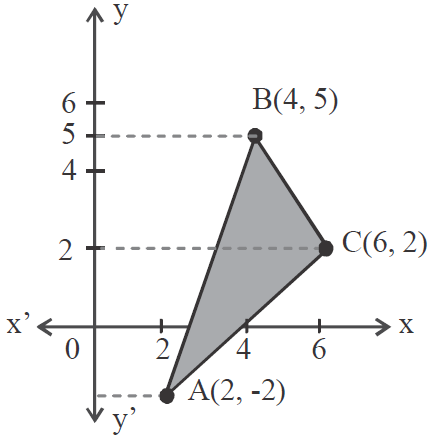
Answer

yet A = (2 - 2)
B = (4, 5)
C = (6, 2)
We have to find the area of $\triangle\text{ABC}$ 
Equation of line AB $\text{y}-5=\Big(\frac{-2-5}{2-4}\Big)(\text{x}-4)$
$\text{y}-5=\frac72(\text{x}-4)$
$2\text{y}-10=7\text{x}-28$
$\text{7x}-2\text{y}=-10+28$
$\text{7x}-2\text{y}=18\dots(\text{i})$
Equation of line BC $\text{y}-2=\Big(\frac{5-2}{4-6}\Big)(\text{x}-6)$
$-2\text{y}+4=3\text{x}-18$
$4+18=3\text{x}+\text{2y}$
$\text{3x}+\text{2y}=22\dots{\text{(ii)}}$
Equation of line AC $\text{y}-2=\frac{-2-2}{2-6}(\text{x}-6)$
$\text{y}-2=\frac{-4}{-4}(\text{x}-6)$
$\text{y}-2=\text{x}-6$
$\text{x}-\text{y}=-2+6$
$\text{x}-\text{y}=4\dots(\text{iii})$
So the required are:

$\text{ar}(\triangle\text{ABC})=\int_\limits{2}^{2} (\text{y}+4)\text{dy}+\Big(\frac{-2}{3}\Big)\\\int_\limits{2}^{5}(\text{y}-11)\text{dy}-\int_\limits{-2}^{5}\frac27(\text{y}+9)\text{dy}$
$=\frac12\Big[(\text{y}+4)^2\Big]^2_{-2}-\frac13\Big[(\text{y}-11)^2\Big]^5_{2}-\frac17\Big[(\text{y}+9)^2\Big]^5_{-2}$
$=16+15-21=10.$

Need a full question paper?

Generate a complete, print-ready paper with questions like this in minutes — across 16+ boards, with answer keys.

Start Generating Free

Similar questions

Solve the following differential equations:

$\text{y}(1+\text{e}^{\text{x}})\text{dy}=(\text{y}+1)\text{e}^{\text{x}}\text{ dx}$

A manufacturer considers that men and women workers are equally efficient and so he pays them at the same rate. He has 30 and 17 units of workers (male and female) and capital respectively, which he uses to produce two types of goods A and B. To produce one unit of A, 2 workers and 3 units of capital are required while 3 workers and 1 unit of capital is required to produce one unit of B. If A and B are priced at100 and120 per unit respectively, how should he use his resources to maximise the total revenue? Form the above as an LPP and solve graphically. Do you agree with this view of the manufacturer that men and women workers are equally efficient and so should be paid at the same rate?
Find $\frac{\text{dy}}{\text{dx}}$ of the functions expressed in parametric:
$\text{x}=\text{e}^\theta\Big(\theta+\frac{1}{\theta}\Big),\text{ y}=\text{e}^{-\theta}\Big(\theta-\frac{1}{\theta}\Big)$
If $\text{x}=\text{a}\Big(\text{t}+\frac{1}{\text{t}}\Big)\text{ and y}=\text{a}\Big(\text{t}-\frac{1}{\text{t}}\Big),$ prove that $\frac{\text{dy}}{\text{dx}}=\frac{\text{x}}{\text{y}}$
Minimise and Maximise Z = x + 2y
subject to $\text{x}+2\text{y}\geq100,\ 2\text{x}-\text{y}\leq0,\ 2\text{x}+ \text{y}\leq200;\ \text{x},\ \text{y}\geq0.$
Show that the function g(x) = x - [x] is discontinuous at all integral points. Here [x] denotes the greatest integer function.
Find the value of a and b so that the function f given by $\text{f(x)}=\begin{cases}1,&\text{if }\text{ x}\leq3\\\text{ax}+\text{b},&\text{if }3<\text{x}<5\\7,&\text{if }\text{ x}\geq5\end{cases}$ is continuous x = 3 and x = 5.
Two groups are competing for the positions of the Board of Directors of a Corporation. The probabilities that the first and the second groups will win are 0.6 and 0.4 respectively. Further, if the first group wins, the probability of introducing a new product is 0.7 and the corresponding probability is 0.3 if the second group wins. Find the probability that the new product introduced was by the second group.
Show that the right circular cone of least curved surface and given volume has an altitude equal to $\sqrt 2 $ times the radius of the base.
Show that $\text{f}(\text{x})=\cos\text{x}$ is a decreasing function on $(0,\pi),$ increasing in $(-\pi,0)$ and neither increasing nor decreasing in $(-\pi,\pi).$