Question
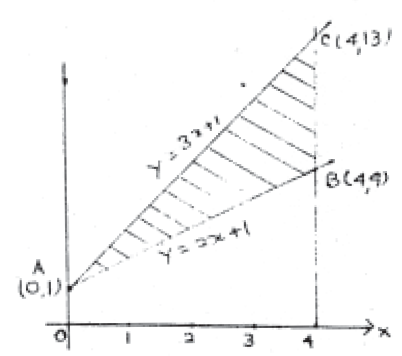
Using integration find the area of the triangular region whose sides have equations y = 2x + 1, y = 3x + 1 and x = 4.

Answer


Getting the points of intersection as 
A(0,1),B(4, 9) and C(4,13)
Area $\Delta$ ABC = $\int\limits_0^4\text{x}\text{(3x + 1)}\text{dx}-\int\limits_0^4\text{(2x + 1)}\text{dx}$
$=\int\limits_0^4\text{x dx}=\Bigg[\frac{\text{x}^{2}}{\text{2}}\Bigg]^4_0=8\text{sq. units}$.

Need a full question paper?

Generate a complete, print-ready paper with questions like this in minutes — across 16+ boards, with answer keys.

Start Generating Free

Similar questions

Find the area bounded by the lines y = 4x + 5, y 5 - x and 4y = x + 5.
If four points A, B, C and D with position vectors $4\hat{\text{i}}+3\hat{\text{j}},5\hat{\text{i}}+\text{x}\hat{\text{j}}+7\hat{\text{k}},5\hat{\text{i}}+3\hat{\text{j}}$ and $7\hat{\text{i}}+6\hat{\text{j}}+\hat{\text{k}}$ respectively are coplanar, then find the value of x.
Evaluate the following integrals:$\int\text{x}\tan^2\text{x dx}$
Evaluate $\int_{\frac{-\pi}{4}}^{\frac{\pi}{4}} \sin ^2 x d x$.
If $a, b$ and $c$ are all non-zero and $\begin{vmatrix}1+\text{a}&1&1\\1&1+\text{b}&1\\1&1&1+\text{c} \end{vmatrix}=0,$ then prove that $\frac{1}{\text{a}}+\frac{1}{\text{b}}+\frac{1}{\text{c}}+1=0.$
A factory manufactures two types of screws A and B, each type requiring the use of two machines, an automatic and a hand-operated. It takes 4 minutes on the automatic and 6 minutes on the hand-operated machines to manufacture a packet of screws ‘A’ while it takes 6 minutes on the automatic and 3 minutes on the hand-operated machine to manufacture a packet of screws ‘B’. Each machine is available for at most 4 hours on any day. The manufacturer can sell a packet of screws ‘A’ at a profit of 70 paise and screws ‘B’ at a profit of Rs. 1. Assuming that he can sell all the screws he manufactures, how many packets of each type should the factory owner produce in a day in order to maximize his profit? Formulate the above LPP and solve it graphically and find the maximum profit.
Find the general solution of the differential equation $\frac{d y}{d x}-y=\cos x$
$\text{if } \vec{\text{a}} = 2\hat{\text{i}} + \hat{\text{j}} - \hat{\text{k}}, \vec{\text{b}} = 4\hat{\text{i}} - 7\hat{\text{j}} + \hat{\text{k}}, \text{find a vector } \vec{\text{c}} \text{ such that } \vec{\text{a}} \times \vec{\text{c}}=\vec{\text{b }} \text{ and } \vec{\text{a }} . \vec{\text{c}} = 6.$
The slope of a curve at each of its points is equal to the square of the abscissa of the point. Find the particular curve through the point $(−1, 1)$.
Determine the points on the curve $x^2 = 4y$ which are nearest to the point $(0, 5).$