Question
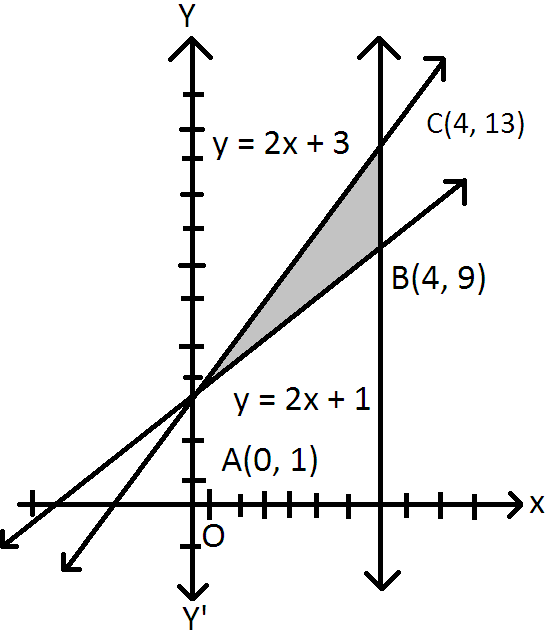
Using integration, find the area of the triangular region whose sides have the equations y = 2x + 1, y = 3x + 1 and x = 4.

Answer

Equations of one side of triangle is
y = 2x + 1 ...(i) second line of triangle is y = 3x + 1 ...(ii) third line of triangle is x = 4 ...(iii) Solving eq. (i) and (ii), we get x = 0 and y = 1 $\therefore$ Point of intersection of lines (i) and (ii) is A(0, 1) Putting x = 4 in eq. (i), we get y = 9 $\therefore$ Point of intersection of lines (i) and (iii) is B(4, 9) Putting x = 4 in eq. (i), we get y = 13 $\therefore$ Point of intersection of lines (ii) and (iii) is C(4, 13) $\therefore$ Area between line (ii) i.e., AC and x-axis $=\begin{vmatrix}\int\limits^4_{0}\text{y dx} \end{vmatrix}=\begin{vmatrix}\int\limits^4_{0}(3\text{x}+1)\text{dx} \end{vmatrix}=\bigg(\frac{3\text{x}^2}{2}+\text{x}\bigg)^4_0$ = 24 + 4 = 28 sq. units ...(iv) Again Area between line (i) i.e., AB and x-axis $=\begin{vmatrix}\int\limits^4_{0}\text{y dx} \end{vmatrix}=\begin{vmatrix}\int\limits^4_{0}(2\text{x}+1)\text{dx} \end{vmatrix}=\bigg(\text{x}^2+\text{x}\bigg)^4_0$ = 16 + 4 = 20 sq. units …(v) Therefore, Required area of $\Delta\text{ABC}$ = Area given by (iv) - Area given by (v) = 28 - 20 = 8 sq. units

Need a full question paper?

Generate a complete, print-ready paper with questions like this in minutes — across 16+ boards, with answer keys.
Start Generating Free

Similar questions

There are 4 cards numbered 1, 3, 5 and 7, one number on one card. Two cards are drawn at random without replacement. Let X denote the sum of the numbers on the two drawn cards. Find the mean and variance of X.
Solve the following differential equations:$\frac{\text{dy}}{\text{dx}}=\frac{\text{e}^{\text{x}}(\sin^2\text{x}+\sin2\text{x})}{\text{y}(2\log\text{y}+1)}$
Find the cartesian form of the equations of the following planes.
$\vec{\text{r}}=(1+\text{s}+\text{t})\hat{\text{i}}+(2-\text{s}+\text{t})\hat{\text{j}}+(3-2\text{s}+2\text{t})\hat{\text{k}}$
A rectangle is inscribed in a semi-circle of radius r with one of its sides on diameter of semi-circle. Find the dimension of the rectangle so that its area is maximum. Find also the area.
Evaluate the following integrals:
$\int\frac{\text{x}^2}{(\text{x}^2+1)(3\text{x}^2+4)}\ \text{dx}$
Evaluate the following intregals:
$\int\frac{\text{x}}{(\text{x}^2-\text{a}^2)(\text{x}^2-\text{b}^2)}\ \text{dx}$
If x and y are connected parametrically by the equations given in Exercise without eliminating the parameter, Find $\frac{\text{dy}}{\text{dx}}.$
$\text{x}=\frac{\sin^3\text{t}}{\sqrt{\cos2\text{t}}},\text{y}\frac{\cos^3\text{t}}{\sqrt{\cos2\text{t}}}$
Using properties of determinants, prove the following:
$\begin{vmatrix} \text{x}^2+1 & \text{ xy } & \text{xz} \\ \text{xy} & \text{y}^2+1 & \text{yz} \\ \text{xz} & \text{yz} & \text{z}^2+1 \end{vmatrix} = 1+\text{x}^2+\text{y}^2+\text{z}^2.$
Find the equatoion of the passing through the points (1, -1, 2) and (2, -2, 2) and which is perpendicular to the plane 6x - 2y + 2z = 9.
Evaluate the integral $\int_{0}^{1} \sin ^{-1}\left(\frac{2 x}{1+x^{2}}\right) d x$ using substitution.