Question
Using mathematical methods and algorithms, derive kinetic equations for uniformly accelerated motion
Answer

self

Need a full question paper?

Generate a complete, print-ready paper with questions like this in minutes — across 16+ boards, with answer keys.

Start Generating Free

Similar questions

A metal block of heat capacity $800^{\circ} \mathrm{C}^{-1}$ placed in a room at $20^{\circ} \mathrm{C}$ is heated electrically. The heater is switched off when the temperature reaches $30^{\circ} \mathrm{C}$. The temperature of the block rises at the rate of $2^{\circ} \mathrm{Cs}^{-1}$ just after the heater is switched on and falls at the rate of $0.2^{\circ} \mathrm{Cs}^{-1}$ just after the heater is switched off. Assume Newton's law of cooling to hold.
  1. Find the power of the heater.
  2. Find the power radiated by the block just after the heater is switched off.
  3. Find the power radiated by the block when the temperature of the block is $25^\circ C$.
  4. Assuming that the power radiated at $25^\circ C$ represents the average value in the heating process, find the time for which the heater was kept on.
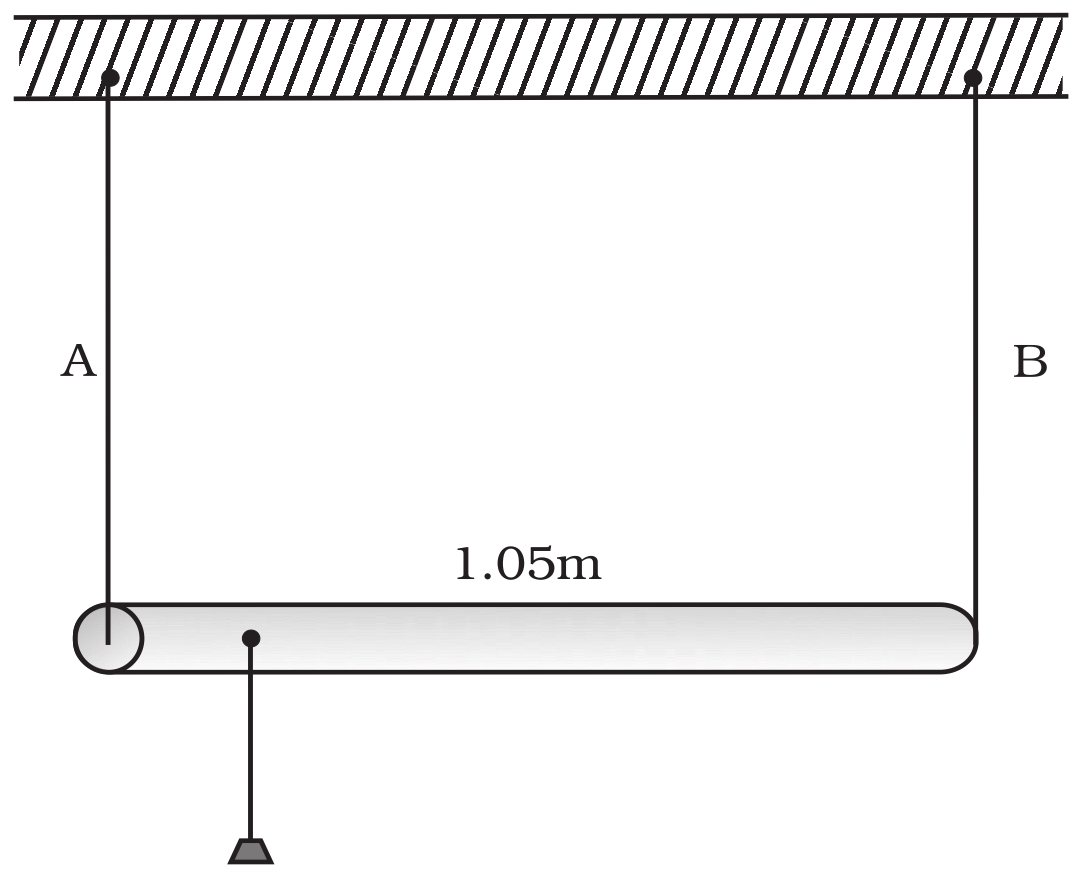
A rod of length $1.05m$ having negligible mass is supported at its ends by two wires of steel (wire A) and aluminium (wire B) of equal lengths as shown in Fig. The cross-sectional areas of wires A and B are $1.0mm^2$ and $2.0mm^2$, respectively. At what point along the rod should a mass m be suspended in order to produce (a) equal stresses and (b) equal strains in both steel and aluminium wires.
A hole of radius $r_1$ is made centrally in a uniform circular disc of thickness d and radius $r_2$. The inner surface (a cylinder of length d and radius $r_1​​​​​​​$) is maintained at a temperature $\theta_1$ and the outer surface (a cylinder of length d and radius $r_2$) is maintained at a temperature $\theta_2(\theta_1>\theta_2).$ The thermal conductivity of the material of the disc is K. Calculate the heat flowing per unit time through the disc.
The Reynold's number $n_R$ for a liquid flowing through a pipe depends upon:
  1. The density of the liquid $\rho,$
  2. The coefficient of viscosity $\eta,$
  3. the speed of flow of the liquid $\upsilon,$
  4. The radius of the tube $r.$
Define coefficient of viscosity and give its SI unit. On what factors does the terminal velocity of a spherical ball falling through a viscous liquid depend? Derive the formula:$\text{v}_\text{t}=\frac{2}{9}\frac{\text{a}^2\text{g}}{\eta}(\text{r}-\text{r}')$
where the symbols have their usual meaning.
A person travels by a car at a speed of 180km/h. It takes exactly 10 hours by his wristwatch to go from the station A to the station B:
  1. What is the rest distance between the two stations?
  2. How much time is taken in the road frame by the car to go from the station A to the station B?
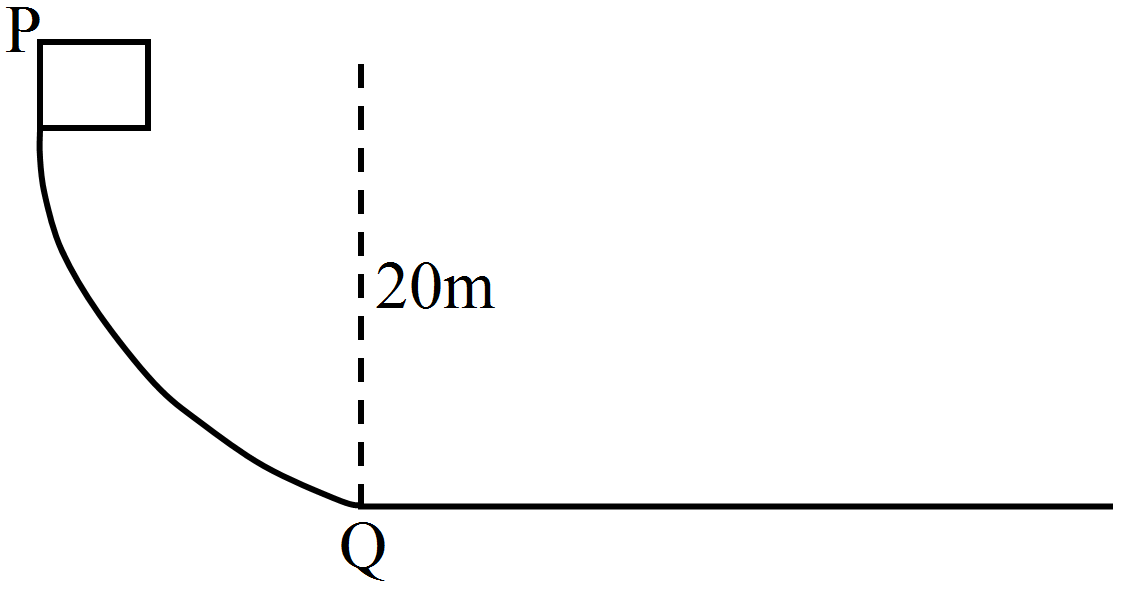
A block of mass $200g$ is released from P which slides down without friction till it reaches a point Q of a circular path of radius $2.0m$. Find.
  1. The velocity of the block at point Q and.
  2. The coefficient of friction if the block comes to rest $2.0m$ from Q, assuming the horizontal part of the path is rough. Take $g = 10ms^{-2}$.
Explain Doppler effect in sound. Obtain an expression for apparent frequency of sound when source and listener are approaching each other.
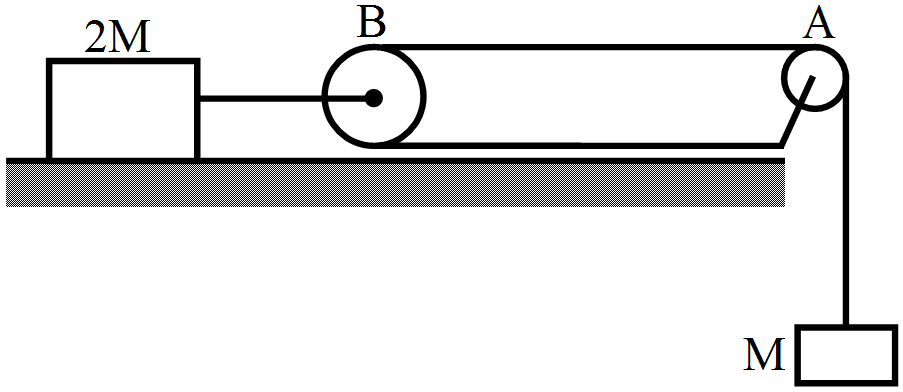
Consider the situation shown in figure. Both the pulleys and the string are light and all the surfaces are frictionless.
  1. Find the acceleration of the mass M.
  2. Find the tension in the string.
  3. Calculate the force exerted by the clamp on the pulley A in the figure.
An elastic spring of force constant K is compressed by an amount x. Show that its potential energy is $\frac{1}{2}\text{Kr}^2.$