Question
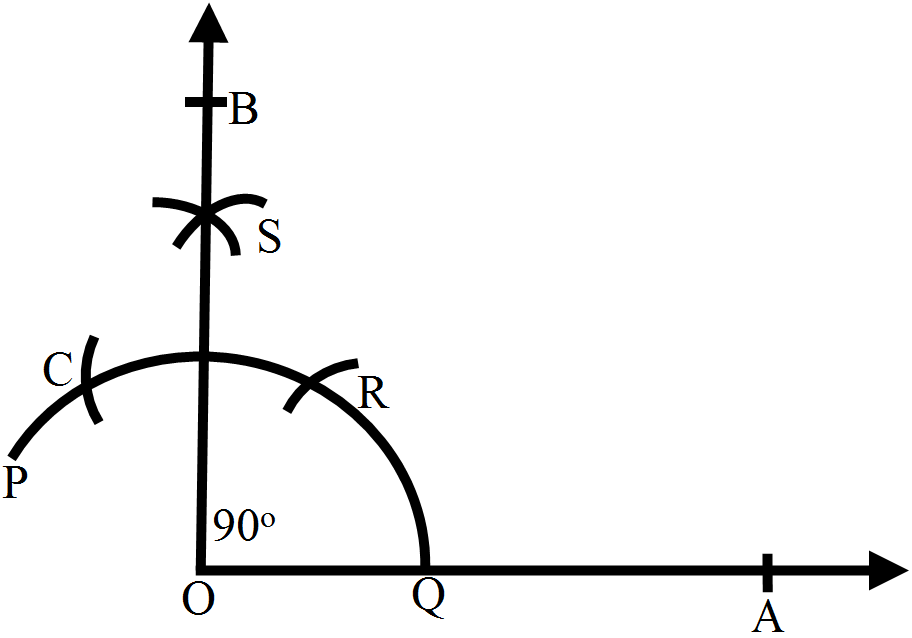
Using ruler and compasses only, draw a right angle.
Answer

Draw a ray $OA.$ With a convenient radius and centre at $O,$ draw an arc $PQ$ with the help of a compass intersecting the ray $OA$ at $P.$ With the same radius and centre at $P,$ draw another arc intersecting the arc $PQ$ at $R.$ With the same radius and centre at $R,$ draw an arc cutting the arc $PQ$ at $C,$ opposite $P.$ Taking $C$ and $R$ as the centre, draw two arcs of radius more than half of $CR$ that intersect each other at $S.$ Join $O$ and $S$ and extend the line to $B.$
$\angle\text{AOB}$ is the required angle of $90^\circ .$

Need a full question paper?

Generate a complete, print-ready paper with questions like this in minutes — across 16+ boards, with answer keys.
Start Generating Free

Similar questions

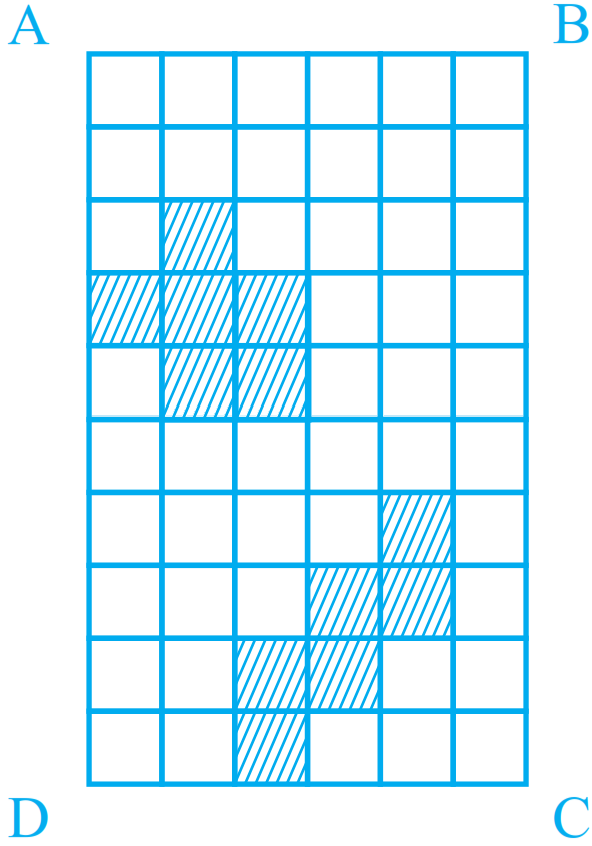
In Fig. each square is of unit length

$a.\ $What is the perimeter of the rectangle $ABCD?$
$b.\ $What is the area of the rectangle $ABCD?$
$c.\ $Divide this rectangle into ten parts of equal area by shading squares. $($Two parts of equal area are shown here$)$
$d.\ $Find the perimeter of each part which you have divided. Are they all equal?
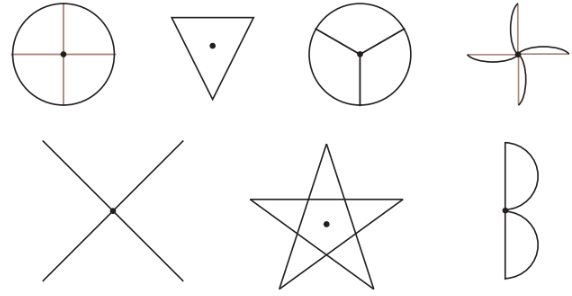
Which of the following figures have more than one angle of symmetry?
Image
Catherine threw a dice 40 times and noted the number appearing each time as shown below :
$1$ $3$ $5$ $6$ $6$ $3$ $5$ $4$ $1$ $6$
$2$ $5$ $3$ $4$ $6$ $1$ $5$ $5$ $6$ $1$
$1$ $2$ $2$ $3$ $5$ $2$ $4$ $5$ $5$ $6$
$5$ $1$ $6$ $2$ $3$ $5$ $2$ $4$ $1$ $5$
Make a table and enter the data using tally marks. Find those numbers that appear an equal number of times.
If $4, a, a, 36$ are in proportion, then $a =$
Draw a line segment $AB$ of length $8\ cm.$ At each end of this line segment, draw a line perpendicular to $AB.$ Are these two lines parallel?
If $a, b, c$ are in proportion, then
Draw a line segment of length $12.8\ cm.$ Using compasses, divide it into four equal parts. Verify by actual measurement.
In a college, out of $4320$ students, $2300$ are girls. Find the ratio of number of boys to the total number of students.
Find the sum of :$–50, –200$ and $300$
Given some line segment $\overline{\text{AB}}$, whose length you do not know, construct $\overline{\text{PQ}}$ such that the length of $\overline{\text{PQ}}$ is twice that of $\overline{\text{AB}}$.