Question
Using second law of motion, derive the relation between force and acceleration. A bullet of 10g strikes a sand-bag at a speed of $103m s^{-1}$ and gets embedded after travelling $5\ cm.$ Calculate
  1. The resistive force exerted by the sand on the bullet.
  2. The time taken by the bullet to come to rest.
Answer

If a body of mass $( m ),$ moving at velocity $( u )$ accelerates uniformly at $(a)$ for time $T$,
so that its velocity changes to $v$, then initial momentum $p _1= mu$ and final momentum $p _2= mv$
$ \therefore$ Change in momentum $= p _2- p _1= mv - mu = m (v -u)$ According to the second law of mation,force
$\text{F}\propto\frac{\text{Change in momentum}}{\text{Time}}$
$\Rightarrow\text{F}\propto\frac{\text{p}_2-\text{p}_1}{\text{t}}$
$\Rightarrow\text{F}\propto\frac{\text{m(v}-\text{u})}{\text{t}}$
$\Rightarrow\text{F}\propto\text{ma}$
$\Big[\text{where},\frac{\text{v}-\text{u}}{\text{t}}=\text{a}\Big]$
$\Rightarrow\text{F}=\text{kma}$ Here, $\text{k}=1$
$\therefore \text{F}=\text{ma}$ Given, $\text{m}=10\text{g}=\frac{10}{1000}\text{kg}=0.01\text{kg},\text{u}=10^3\text{m/s},\text{v}=0 [\because 1kg = 1000g] $ and $\text{s}=5\text{cm}=\frac{5}{100}\text{m}=0.05\text{m}[\because 1m = 100cm]$
  1. From thrid equation of motion, $\text{v}^2=\text{u}^2+2 \text {as}$
$\Rightarrow\text{v}^2-\text{u}^2+2\text{as}$
$\Rightarrow\text{a}=\frac{\text{v}^2-\text{u}^2}{2\text{s}}=\frac{(0)^2-(10^3)^2}{2\times0.05}$
$\text{a}=\frac{-10^6}{0.1}=-10^7\text{m/s}^2$
Now, force applied by the bullet,
F = ma
$= 0.01 \times 10^7 = -10^5 N$ [negative sing show against the direction of motion]
The resistive force exerted by the sand on the bullet $= 10^5 N$
  1. From first equation of motion, $\text{v = u + at}$
$\Rightarrow\text{at = v}-\text{u}$
Now, time taken by bullet to come to rest, $\text{t}=\frac{\text{v}-\text{u}}{\text{a}}$
$\Rightarrow\text{t}=\frac{0-10^3}{-10^7}$
$\Rightarrow\text{t}=\frac{-10^3}{-10^7}=10^3\times10^{-7}$
$\Rightarrow\text{t}=10^{-4}\text{s}$
Hence, force $(F) = 10^5 N$ and time $(t) = 10^{-4} s.$

Need a full question paper?

Generate a complete, print-ready paper with questions like this in minutes — across 16+ boards, with answer keys.

Start Generating Free

Similar questions

If a planet existed whose mass was twice that of the earth and whose radius is $3$ times greater. How much will a $1\ kg$ mass weigh in the planet$?$
Distinguish between fertilizer and manure. Give suitable examples. What are advantages and disadvantages of using fertilizer?
How does the force of attraction between the two bodies depend upon their masses and distance between them$?$ A student thought that two bricks tied together would fall faster than a single one under the action of gravity. Do you agree with his hypothesis or not$?$ Comment.
Write short note on protochordates.
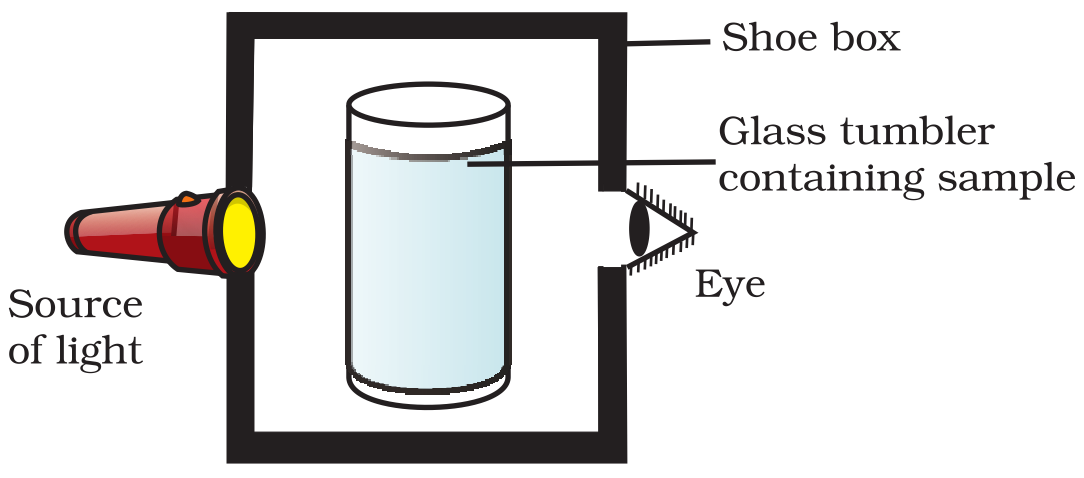
A group of students took an old shoe box and covered it with a black paper from all sides. They fixed a source of light (a torch) at one end of the box by making a hole in it and made another hole on the other side to view the light. They placed a milk sample contained in a beaker/ tumbler in the box as shown in the they were amazed to see that milk taken in the tumbler was illuminated. They tried the same activity by taking a salt solution but found that light simply passed through it?
  1. Explain why the milk sample was illuminated. Name the phenomenon involved.
  2. Same results were not observed with a salt solution. Explain.
  3. Can you suggest two more solutions which would show the same effect as shown by the milk solution?
What are pisces? Classify and explain two different kinds of fishes by the help of suitable examples.
Fractional distillation is suitable for separation of miscible liquids with a boiling point difference of about $25\ K$ or less. What part of fractional distillation apparatus makes it efficient and possess an advantage over a simple distillation process. Explain using a diagram.
What is feed? What are different type of feed? How is it differ with respect to age and functions?
A truck of mass $M$ is moved under a force $F.$ If the truck is then loaded with an object equal to the mass of the truck and the driving force is halved, then how does the acceleration change?
State the contribution of Biologists, such as Woese and Whittaker in formulating the basis of classification?