Question
Using step-deviation method, calculate the mean marks of the following distribution
Class Interval $50 - 55$ $55 - 60$ $60 - 65$ $65 - 70$ $70 - 75$ $75 - 80$ $80 - 85$ $85 - 90$
Frequency $5$ $20$ $10$ $10$ $9$ $6$ $12$ $8$

Answer

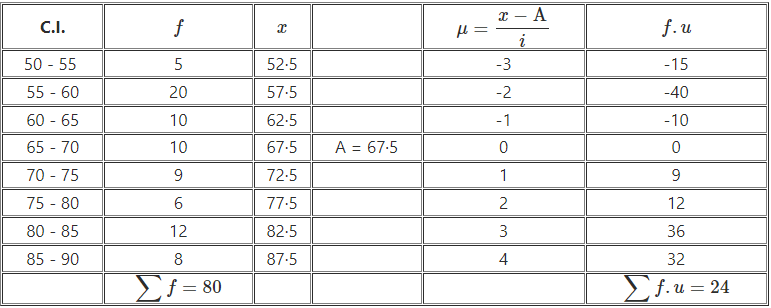
Image
$\therefore \text { Mean } X = A +\frac{\sum f \cdot u}{\sum f} \times i \quad .[ i =\text { length of C.I. }] $
$ =67.5+\frac{24}{80} \times 5$
$ =67.5+1.5 $
$ =69 .$

Need a full question paper?

Generate a complete, print-ready paper with questions like this in minutes — across 16+ boards, with answer keys.

Start Generating Free

Similar questions

Draw line segments OA = 4.5 cm, OB = 3.2 cm such that ∠ AOB = 45°. Construct a circle touching OA at A and passing through B.
From the following cumulative frequency table , find :
Median ,Lower quartile ,Upper quaetile
Marks$($less than$)$ $10 $ $20$ $30$ $40$ $50$ $60$ $70$ $80$ $90$ $100$
Cumulative frequency $5$ $24$ $37$ $40$ $42$ $48$ $70$ $77$ $79$ $80$
Divide Rs 50,760 into two parts such that if one part is invested in 8% Rs 100 shares at 8% discount and the other in 9% Rs 100 shares at 8% premium, the annual incomes from both the investments are equal.
The height and radius of base of a cylinder area in the ratio $3: 1$. if it volume is $1029 \ cm ^3$; find it total surface area.
In the adjoining figure, O is the centre of the circle and AB is a tangent to it at point B. ∠BDC = 65° Find ∠BAO.
Calculate the amount and the compound interest for the following:
Rs. 16,000 at $15 \%$ p.a. in $2 \frac{2}{3}$ years
Mr Shameem invested 33 1/3% of his savings in 20% Rs 50 shares quoted at Rs 60 and the remainder of the savings in 10% Rs 100 share quoted at ₹ 110. If his total income from these investments is Rs 9,200; find :
(1) his total savings
(2) the number of Rs 50 share
(3) the number of Rs 100 share
The angles of elevation of the top of a tower from two points A and B at a distance of a and b respectively from the base and in the same straight line with it are complementary. Prove that the height of the tower is $\sqrt{a b}$.
Ankita started paying Rs 400 per month in a 3 years recurring deposit. After six months her brother Anshul started paying Rs 500 per month in a $2 \frac{1}{2}$ years recurring deposit. The bank paid $10 \%$ p.a. simple interest for both. At maturity who will get more money and by how much?
Prove the following identitie:
$\cot ^2 A\left(\frac{\sec A-1}{1+\sin A}\right)+\sec ^2 A\left(\frac{\sin A-1}{1+\sec A}\right)=0$