Question
Using the proprties of determinants in Exercise:
$\begin{vmatrix}\text{y}^2\text{z}^2&\text{yz}&\text{y}+\text{z}\\\text{z}^2\text{x}^2&\text{zx}&\text{z}+\text{x}\\\text{x}^2\text{y}^2&\text{xy}&\text{x}+\text{y}\end{vmatrix}=0$
Answer

We have, $\begin{vmatrix}\text{y}^2\text{z}^2&\text{yz}&\text{y}+\text{z}\\\text{z}^2\text{x}^2&\text{zx}&\text{z}+\text{x}\\\text{x}^2\text{y}^2&\text{xy}&\text{x}+\text{y}\end{vmatrix}$
$[\text{Multiplying R}_1, \text{R}_2, \text{R}_3\text{ by x, y, z respectively}]$
$=\frac{1}{\text{xyz}}\begin{vmatrix}\text{xy}^2\text{z}^2&\text{xyz}&\text{xy}+\text{xz}\\\text{x}^2\text{yz}^2&\text{xyz}&\text{yz}+\text{xy}\\\text{x}^2\text{y}^2\text{z}&\text{xyz}&\text{xz}+\text{yz}\end{vmatrix}$
$\big[\text{Taking (xyz) common from C}_1\text{ and C}_2\big]$
$=\frac{1}{\text{xyz}}(\text{xyz})^2\begin{vmatrix}\text{yz}&1&\text{xy}+\text{xz}\\\text{xz}&1&\text{yz}+\text{xy}\\\text{xy}&1&\text{xz}+\text{yz}\end{vmatrix}$
$[\text{Applying C}_3\rightarrow\text{C}_3+\text{C}_1]$
$=\text{xyz}\begin{bmatrix}\text{yz}&1&\text{xy}+\text{yz}+\text{zx}\\\text{xz}&1&\text{xy}+\text{yz}+\text{zx}\\\text{xy}&1&\text{xy}+\text{yz}+\text{zx}\end{bmatrix}$
$\big[\text{Taking (xy}+\text{yz}+\text{zx})\text{ common from }\text{C}_3\big]$
$=\text{xyz (yz}+\text{yz}+\text{zx})\begin{vmatrix}\text{yz}&1&1\\\text{xz}&1&1\\\text{xy}&1&1\end{vmatrix}$
$=0$
$\big[\because\text{C}_2\text{ and C}_3\text{ are identical}\big]$

Need a full question paper?

Generate a complete, print-ready paper with questions like this in minutes — across 16+ boards, with answer keys.

Start Generating Free

Similar questions

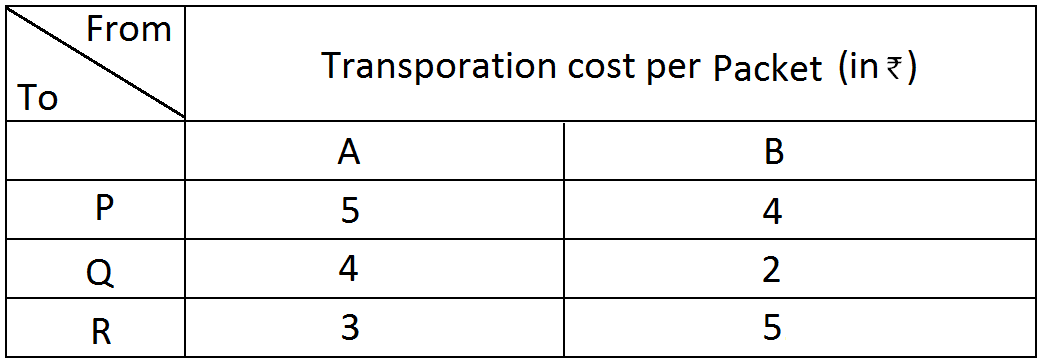
A medical company has factories at two places, A and B. From these places, supply is made to each of its three agencies situated at P, Q and R. The monthly requirements of the agencies are respectively 40, 40 and 50 packets of the medicines, while the production capacity of the factories, A and B, are 60 and 70 packets respectively. The transportation cost per packet from the factories to the agencies are given below:

How many packets from each factory be transported to each agency so that the cost of transportation is minimum? Also find the minimum cost?
Prove that the curves $y^2 = 4x$ and $x^2 + y^2 - 6x + 1 = 0$ touch each other at the point $(1, 2).$
For the following differntial equations verify that the accompanying function is a solution:
Differential equation Function
$\text{x}\frac{\text{dy}}{\text{dx}}+\text{y}=\text{y}^2$ $\text{y}=\frac{\text{a}}{\text{x}+\text{a}}$
Find the foot of perpendicular from the point (2, 3, 4) to the line $\frac{4-\text{x}}{2}=\frac{\text{y}}{6}=\frac{1-\text{z}}{3}.$ Also, find the perpendicular distance from the given point to the line.
Find the intervals in which the following functions are increasing or decreasing.
$\text{f}(\text{x})=5\text{x}^{\frac{3}{2}}-3\text{x}^{\frac{5}{2}},\text{x}>0$
If $\text{y}=\sqrt{\text{a}^2-\text{x}^2},$ prove that $\text{y}\frac{\text{dy}}{\text{dx}}+\text{x}=0$
If AB = BA for any two sqaure matrices, prove by mathematical induction that $(AB)^n = A^nB^n.$
If $x = a \cos^3 \theta$ and $y = a \sin^3 \theta$, then find the value of $\frac{\text{f}^{2}\text{y}}{\text{dx}}\text{at}\theta = \frac{\pi}{6}.$
A chemical company produces two compounds, $A$ and $B.$ The following table gives the units of ingredients, $C$ and $D$ per kg of compounds $A$ and $B$ as well as minimum requirements of $C$ and $D$ and costs per kg of $A$ and $B$. Find the quantities of $A$ and $B$ which would give a supply of $C$ and $D$ at a minimum cost.
 
Compound
Minimum requirement
$A$
$B$
 
Ingredient $C$
$1$
$2$
$80$
Ingredient $D$
$3$
$1$
$75$
Coist $($in Rs.$)$ per Kg
$4$
$6$
 
Find the equation of the normal to the curve $x^2 + 2y^2 - 4x - 6y + 8 = 0$ at the point whose abscissa is $2.$