Question
Using the standard electrode potentials given in Table 3.1, predict if the reaction between the following is feasible:
Br2 (aq) and Fe2+ (aq).

Answer

$\ \ \ \text{Br}_{2\text{(aq)}}+2\text{e}^-\ \ \xrightarrow{\ \ \ \ \ \ \ \ \ \ \ \ \ } 2\text{Br}^{-}_\text{(aq)} \ \ \ \ \ \ \ \ \ \ \ \ \ \ \ \ \ \ \ \ \ \ \ \ \ \ \ \ \ \ \ \ \ \ \ \ \ \ ;\ \ \ \ \ \ \ \ \ \ \ \ \text{E}^\circ=+1.09\ \text{V}\\\text{Fe}^{2+}_\text{(aq)}\ \ \ \ \ \ \ \ \ \ \ \ \ \ \ \ \ \ \xrightarrow{\ \ \ \ \ \ \ \ \ \ \ \ \ } \text{Fe}^{3+}_{\text{(aq)}}+\text{e}^-\big]\times2\ \ \ \ \ \ \ \ \ \ \ \ \ \ \ \ \ \ \ \ \ ;\ \ \ \ \ \ \ \ \ \ \ \text{E}^\circ=-0.77\ \text{V}\\\overline{\text{Br}_\text{2(aq)}+2\text{Fe}^{2+}_\text{(aq)}\xrightarrow{\ \ \ \ \ \ \ \ \ \ \ \ \ }2\text{Br}^{-}_\text{(aq)}+2\text{Fe}^{3+}_\text{(aq)} \ \ \ \ \ \ \ \ \ \ \ \ \ \ \ \ \ \ \ \ \ \ ;\ \ \ \ \ \ \ \ \ \ \ \ \text{E}^\circ=+0.32\ \text{V}}$
Since E° for the overall reaction is positive, the reaction between Br2 (aq) and Fe2+ (aq)s is feasible.

Need a full question paper?

Generate a complete, print-ready paper with questions like this in minutes — across 16+ boards, with answer keys.
Start Generating Free

Similar questions

Answer the following:
(a) The rate of a reaction is given by rate = k [N2O5]. In this equation what does k stand for?
(b) Is it possible to determine or predict the rate law theoretically by merely looking at the equation?
Preparation of alcohols from alkenes involves the electrophilic attack on alkene carbon atom. Explain its mechanism.
Which alkyl halide from the following pairs would you expect to react more rapidly by an SN2 mechanism? Explain your answer.
$\text{CH}_3\text{CH}_2\text{CH}_2\text{CH}_2\text{Br}\ \text{or}\ \text{CH}_3\text{CH}_2\text{CH}\text{CH}_3\\\ \ \ \ \ \ \ \ \ \ \ \ \ \ \ \ \ \ \ \ \ \ \ \ \ \ \ \ \ \ \ \ \ \ \ \ \ \ \ \ \ \ \ \ \ \ \ \ \ \ \ \ \ \ \ \ \mid\\\ \ \ \ \ \ \ \ \ \ \ \ \ \ \ \ \ \ \ \ \ \ \ \ \ \ \ \ \ \ \ \ \ \ \ \ \ \ \ \ \ \ \ \ \ \ \ \ \ \ \ \ \ \ \ \text{Br}$
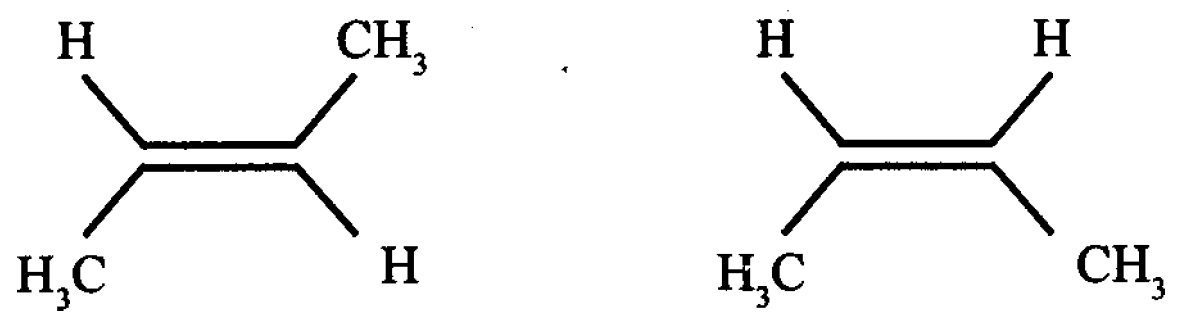
Identify whether the following pairs of compounds are structural or geometrical isomers:

  1.  

  1.  

Write the cell reaction of a lead storage battery when it is discharged. How does the density of the electrolyte change when the battery is discharged?
State the types of chemical reaction of diazonium salts.
Define the following as related to protein :
Denaturation
A + 2B → 3C + 2D. The rate of disappearance of B is 1 × 10⁻² mol L-1 s -1. What will be:
  1. Rate of the reaction.
  2. Rate of change in concentration of A and C?
In a reaction between A and B, the initial rate of reaction (r0) was measured for different initial concentrations of A and B as given below:
A/mol L-1 0.20 0.20 0.40
B/mol L-1 0.30 0.10 0.05
r0/mol L-1 s-1 5.07 × 10-5 5.07 × 10-5 1.43 × 10-4
What is the order of the reaction with respect to A and B?
Calculate the volume of water which could be added to 20 ml of 0.65 m HCl to dilute the solution to 0.2 m?