Question
Using the standard electrode potentials given in the Table, predict if the reaction between the following is feasible:
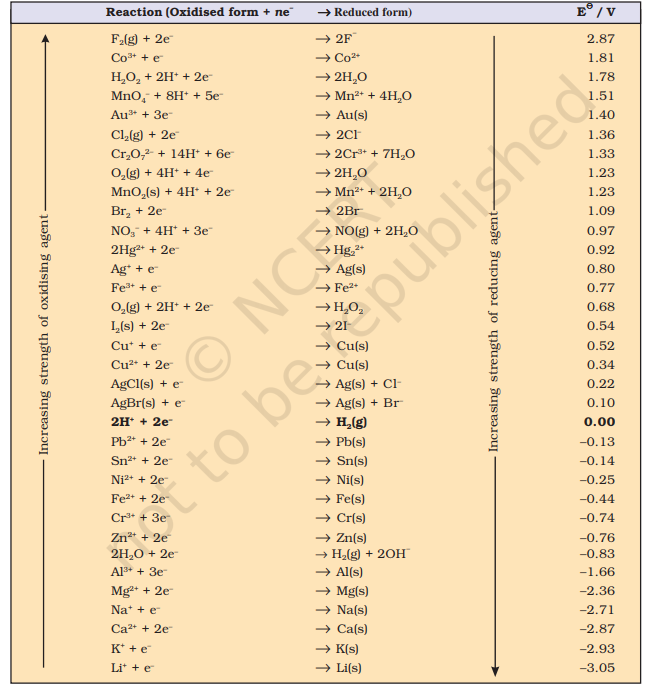
Ag(s) and Fe3+(aq).

Answer

The possible reaction between Ag(s) and Fe3+(aq) is given by,

$\text{Ag}_{(\text{s})}+2\text{Fe}^{3+}_{(\text{aq})}\rightarrow\text{Ag}^{+}_{(\text{aq})}+\text{Fe}^{2+}_{(\text{aq})}$

$\text{Oxidation half equation:}\ \ \ \ \ \ \ \text{Ag}_{(\text{s})}\xrightarrow{\ \ \ \ \ \ }\text{Ag}^{+}_{(\text{aq})}+\text{e}^-;\ \ \text{E}^\circ=-0.80\text{V}\\\text{Reduction half equation:}\ \ \text{Fe}^{3+}_{(\text{aq})}+\text{e}^-\xrightarrow{\ \ \ \ \ }\text{Fe}^{2+}_{(\text{aq})};\ \ \ \ \ \ \ \ \text{E}^\circ=+0.77\text{V}\\\overline{\ \ \ \ \ \ \ \ \ \ \ \ \ \ \ \ \ \ \ \ \ \ \ \ \ \ \ \ \ \ \ \ \ \ \ \ \ \ \ \ \ \ \ \ \ \ \ \ \ \ \ \ \ \ \ \ \ \ \ \ \ \ \ \ \ \ \ \ \ \ \ \ \ \ \ \ \ \ \ \ \ \ \ \ \ \ \ \ \ \ \ \ \ \ \ \ \ \ \ \ \ \ \ \ \ \ \ \ \ \ \ \ \ \ \ \ \ \ }\\\ \ \ \ \ \ \ \ \ \ \ \ \ \ \ \ \ \ \ \ \ \ \ \ \ \ \ \ \ \ \ \ \ \text{Ag}^{}_{(\text{s})}+\text{Fe}^{3+}_{(\text{aq})}\xrightarrow{\ \ \ \ \ }\text{Ag}^{+}_{(\text{aq})}+\text{Fe}^{2+}_{(\text{aq})};\ \ \ \text{E}^\circ=-0.03\text{V}$

Here, E° for the overall reaction is negative. Hence, the reaction between Ag(s) and Fe3+(aq) is not feasible.

Need a full question paper?

Generate a complete, print-ready paper with questions like this in minutes — across 16+ boards, with answer keys.

Start Generating Free

Similar questions

Consider the reactions:

6CO2(g) + 6H2O(l) → C6H12O6(aq) + 6O2(g)

Why it is more appropriate to write these reactions as:

6CO2(g) + 12H2O(l) → C6H12O6(aq) + 6H2O(l) + 6O2(g)

Also suggest a technique to investigate the path of the above redox reactions.

What happen when: (i) Methane is oxidised by oxygen in presence of M0203. (ii) Ethane is oxidised in presence of manganese acetate. (iii) Isobutane is oxidised by KMnO4.
Depict the galvanic cell in which the reaction $Zn ( s )+2 Ag ^{+}( aq ) \longrightarrow Zn ^{2+}( aq )+2 Ag ( s )$ takes place, Further show:
i. which of the electrode is negatively charged,
ii. the carriers of the current in the cell, and
iii. individual reaction at each electrode.
pH of a solution of a strong acid is 5.0. What will be the pH of the solution obtained after diluting the given solution a 100 times?
Calculate the energy required for the process,
$\text{He}^+(\text{g})\rightarrow\text{He}^{2+}\text{(g)}+\text{e}^-$
The ionization energy for the H atom in the ground state is 2.18 × 10⁻¹⁸J atom–1
Identify the type of reactions:
  1. $\text{CH}_4+\text{Cl}_2\xrightarrow{\text{sunlight}}\text{CH}_3\text{Cl}+\text{HCl}$
  2. $\text{C}_6\text{H}_6+(\text{conc.})\text{HNO}_36\xrightarrow{\text{conc.}\text{H}_2\text{SO}_4}\text{C}_6\text{H}_5\text{NO}_2+\text{H}_2\text{O}$
  3. $ \ \ \ \ \ \ \ \ \ \ \ \ \ \ \ \ \ \ \ \ \ \ \ \ \ \ \ \ \ \ \ \ \ \ \ \ \ \ \ \ \ \ \ \ \ \ \ \ \ \ \ \ \ \ \ \ \ \ \ \ \ \ \ \ \ \text{Br}\\\ \ \ \ \ \ \ \ \ \ \ \ \ \ \ \ \ \ \ \ \ \ \ \ \ \ \ \ \ \ \ \ \ \ \ \ \ \ \ \ \ \ \ \ \ \ \ \ \ \ \ \ \ \ \ \ \ \ \ \ \ \ \ \ \ \ |\\\text{CH}_3-\text{CH}=\text{CH}_2+\text{HBr}\xrightarrow{\ \ \ \ \ \ \ }\text{CH}_3-\text{CH}-\text{CH}_3$
  4. $\ \ \ \ \ \ \ \ \ \ \ \ \ \text{O}\ \ \ \ \ \ \ \ \ \ \ \ \ \ \ \ \ \ \ \ \ \ \ \ \ \ \ \ \ \ \ \ \ \ \ \ \ \ \ \ \ \ \ \ \ \ \ \text{OH}\\\ \ \ \ \ \ \ \ \ \ \ \ \ \| \ \ \ \ \ \ \ \ \ \ \ \ \ \ \ \ \ \ \ \ \ \ \ \ \ \ \ \ \ \ \ \ \ \ \ \ \ \ \ \ \ \ \ \ \ \ \ \ \ \ |\\ \text{CH}_3-\text{C}-\text{CH}_3+\text{HCN}\xrightarrow{\ \ \ \ \ \ \ \ }\text{CH}_3-\text{C}-\text{CH}_3\\\ \ \ \ \ \ \ \ \ \ \ \ \ \ \ \ \ \ \ \ \ \ \ \ \ \ \ \ \ \ \ \ \ \ \ \ \ \ \ \ \ \ \ \ \ \ \ \ \ \ \ \ \ \ \ \ \ \ \ \ \ \ \ \ \ |\\\ \ \ \ \ \ \ \ \ \ \ \ \ \ \ \ \ \ \ \ \ \ \ \ \ \ \ \ \ \ \ \ \ \ \ \ \ \ \ \ \ \ \ \ \ \ \ \ \ \ \ \ \ \ \ \ \ \ \ \ \ \ \ \ \text{CN}$
  5. $\text{CH}_3-\text{CH}=\text{CH}_2\xrightarrow[\text{peroxide}]{\text{HBr}}\text{CH}_3\text{CH}_2\text{CH}_2\text{Br}$
  6. $\text{CH}_3\text{Cl}+\text{KOH}(\text{aq})\xrightarrow{\ \ \ \ \ \ \ \ \ }\text{CH}_3\text{OH}+\text{KCl}$
Dual behaviour of matter proposed by de Broglie led to the discovery of electron microscope often used for the highly magnified images of biological molecules and other type of material. If the velocity of the electron in this microscope is 1.6 × 10⁶ms–1, calculate de Broglie wavelength associated with this electron.
  1. What is role of copper oxide in estimation of carbon and hydrogen?
  2. How do we test phosphorus in given organic compound?
  3. What is shape of $\stackrel{\oplus\ \ }{\text{CH}_3}$ (methyl carbocation) and $\stackrel{\oplus\ \ }{\text{CH}_3}$ (methyl carbanion)?
What is the number of photons of light with wavelength 4000 pm which provides 1 J of energy?
Among the second period elements the actual ionization enthalpies are in the order $Li < B <$ $Be < C < O < N < F <$ Ne.
Explain why
(i) Be has higher $\Delta_{ i } H$ than B
(ii) O has lower $\Delta_i H$ than N and F ?