Question
Using the standard electrode potentials given in the Table, predict if the reaction between the following is feasible:
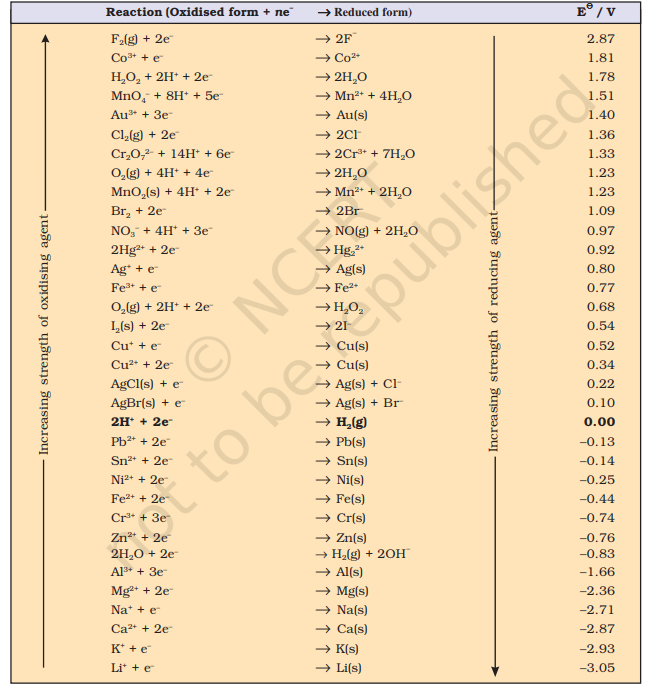
Fe3+(aq) and I-(aq).

Answer

The possible reaction between Fe3+(aq) + I-(aq) is given by,

$2\text{Fe}^{3+}_{(\text{aq})}+2\text{I}^-_{(\text{aq})}\rightarrow2\text{Fe}^{2+}_{(\text{aq})}+\text{I}_{2(\text{s})}$

$\text{Oxidation half equation:}\ \ \ \ \ \ \ \ \ \ 2\text{I}^-_{(\text{aq})}\xrightarrow{\ \ \ \ \ \ \ }\text{I}_{2(\text{s})}+2\text{e}^-;\ \ \text{E}^\circ=-0.54\text{V}\\\text{Reduction half equation:}\ [\text{Fe}^{3+}_{(\text{aq})}+\text{e}^-\xrightarrow{\ \ \ \ \ \ }\text{Fe}^{2+}_{(\text{aq})}]\times2;\ \ \text{E}^\circ=+0.77\text{V}\\\overline{\ \ \ \ \ \ \ \ \ \ \ \ \ \ \ \ \ \ \ \ \ \ \ \ \ \ \ \ \ \ \ \ \ \ \ \ \ \ \ \ \ \ \ \ \ \ \ \ \ \ \ \ \ \ \ \ \ \ \ \ \ \ \ \ \ \ \ \ \ \ \ \ \ \ \ \ \ \ \ \ \ \ \ \ \ \ \ \ \ \ \ \ \ \ \ \ \ \ \ \ \ \ \ \ \ \ \ \ \ \ \ \ \ \ \ \ \ \ }\\ \ \ \ \ \ \ \ \ \ \ \ \ \ \ \ \ \ \ \ \ \ \ \ \ \ \ \ \ \ \ \ \ \ \ \ \ \ \ 2\text{Fe}^{3+}_{(\text{aq})}+2\text{I}^-_{(\text{aq})}\xrightarrow{\ \ \ \ \ \ \ \ }2\text{Fe}^{2+}_{(\text{aq})}+\text{I}_{2(\text{s})};\ \ \text{E}^\circ=+0.23\text{V}$

E° for the overall reaction is positive. Thus, the reaction between $\text{Fe}^{3+}_{(\text{aq})}$ and $\text{I}^-_{(\text{aq})}$ is feasible.

Need a full question paper?

Generate a complete, print-ready paper with questions like this in minutes — across 16+ boards, with answer keys.

Start Generating Free

Similar questions

Which of the following pairs of elements would have a more negative electron gain enthalpy? 
O or F
Arrange the species in each group in order of increasing ionisation energy and give reason:
  1. K+, Cl-, Ar
  2. Na, Mg, Al
  3. C, N, O
A bulb emits light of wavelength $4500\mathring{\text{A}}.$ The bulb is rated as 150 watt and 8% energy is emitted as light. How many photons are emitted by the bulb per second?
[h = 6.626 × 10⁻³⁴Js]
What effect does branching of an alkane chain has on its boiling point?
In astronomical observations, signals observed from the distant starts are generally weak. If the photon detector receives a total of $=3.15 \times 10^{-18} J$ from the radiations of 600 nm . Calculate the number of photons received by the detector.
In a reaction
$A + B _2 \rightarrow AB _2$
Identify the limiting reagent, if any, in the following reaction mixtures.
(i) 300 atoms of A + 200 molecules of B
(ii) 2 mol A + 3 mol B
(iii) 100 atoms of A + 100 molecules of B
(iv) 5 mol A + 2.5 mol B
(v) 2.5 mol A + 5 mol B
The equilibrium constant for the following reaction is $1.6 \times 10^5$ at 1024 K
$H _2( g )+ B r _2( g ) \rightleftharpoons 2 H B r ( g )$
Find the equilibrium pressure of all gases if 10.0 bar of HBr is introduced into a sealed container at 1024 K .
Identify the type of redox reaction taking place in the following.
  1. $3\stackrel{0\ \ \ \ \ \ \ \ \ \ \ \ }{\text{Mg(s)}}+\stackrel{0\ \ \ \ \ \ \ \ \ \ \ }{\text{N}_2\text{(g)}}\ \xrightarrow{\ \ \ \ \ \ \ \ \ \ }\ \stackrel{+2\ \ \ \ -3\ \ \ \ \ \ \ \ }{\text{Mg}_3\text{N}_2\text{(s)}}$
  2. $\stackrel{+5\ \ \ \ \ \ -2\ \ \ \ \ \ \ }{\text{V}_2\text{O}_5\text{(s)}}5\stackrel{0\ \ \ \ \ \ \ \ \ \ }{\text{Ca(s)}}\xrightarrow{\ \ \ \ \ \ \ }2\stackrel{0\ \ \ \ \ \ \ \ }{\text{V(s)}}+\text{5}\stackrel{+2\ \ -2\ \ \ \ \ \ \ \ \ \ }{\text{CaO(s)}}$
  3. $2\stackrel{+1\ +5\ -2\ \ \ \ \ \ \ \ \ \ \ \ }{\text{KClO}_3(\text{s})}\xrightarrow{\ \ \ \ \ \ \ }2\stackrel{+1\ \ -1\ \ \ \ \ \ \ \ \ \ }{\text{KCl(s)}}+3\stackrel{0\ \ \ \ \ \ \ \ \ \ }{\text{O}_2\text{(g)}}$
  4. $\stackrel{0}{\text{Ca}\text{(s)}}+2\stackrel{+1-2}{\text{H}_2\text{O}\text{l}}\ \xrightarrow{\ \ \ \ \ \ \ \ \ \ \ }\stackrel{+2\ \ -2+1\ \ \ \ \ \ \ \ \ \ \ \ \ \ \ \ \ \ }{\text{Ca(OH)}_2(\text{aq})}+\stackrel{0}{\text{H}}_2\text{(g)}$
  5. $\stackrel{0\ \ \ \ \ \ \ \ \ \ \ }{\text{Br}_2(\text{l})}+\stackrel{-1\ \ \ \ \ \ \ \ \ \ \ \ }{2\text{I}^-(\text{aq})}\xrightarrow{\ \ \ \ \ \ \ \ \ \ }\stackrel{1-}{\text{2Br}^-}(\text{aq})+\stackrel{0\ \ \ \ \ \ \ \ \ \ }{\text{I}_2\text{(s)}}$
Calculate the molarity of a solution of ethanol in water, in which the mole fraction of ethanol is 0.040 (assume the density of water to be one).
Arrange the bonds in order of increasing ionic character in the molecules: LiF, K2O, N2 , SO2 and ClF3.