Question
Using the standard electrode potentials given in the Table, predict if the reaction between the following is feasible:
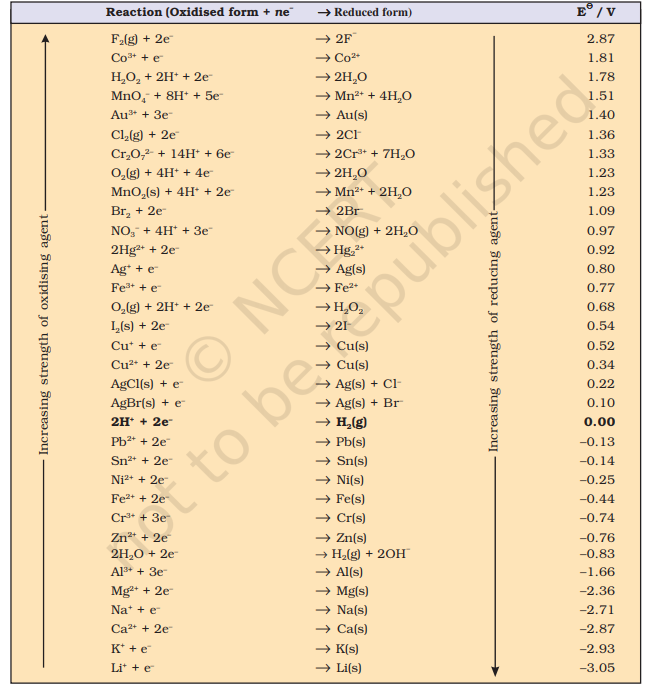
Br2(aq) and Fe2+(aq).

Answer

The possible reaction between Br2(aq) and Fe2+(aq) is given by,

$\text{Br}_{2(\text{s})}+2\text{Fe}^{2+}_{(\text{aq})}\rightarrow2\text{Br}^-_{(\text{aq})}+2\text{Fe}^{3+}_{(\text{aq})}$

$\text{Oxidation half equation:}\ \ \ \ \ \ \ \text{Fe}^{2+}_{(\text{aq})}\xrightarrow{\ \ \ \ \ \ }\text{Fe}^{3+}_{(\text{aq})}+\text{e}^-]\times2\ \ ;\text{E}^\circ=-0.77\text{V}\\\text{Reduction half equation:}\ \ \text{Br}^{}_{2(\text{aq})}+2\text{e}^-\xrightarrow{\ \ \ \ \ }2\text{Br}^{-}_{(\text{aq})}\ \ \ \ \ \ \ \ \ ; \text{E}^\circ=+1.09\text{V}\\\overline{\ \ \ \ \ \ \ \ \ \ \ \ \ \ \ \ \ \ \ \ \ \ \ \ \ \ \ \ \ \ \ \ \ \ \ \ \ \ \ \ \ \ \ \ \ \ \ \ \ \ \ \ \ \ \ \ \ \ \ \ \ \ \ \ \ \ \ \ \ \ \ \ \ \ \ \ \ \ \ \ \ \ \ \ \ \ \ \ \ \ \ \ \ \ \ \ \ \ \ \ \ \ \ \ \ \ \ \ \ \ \ \ \ \ \ \ \ \ \ \ \ }\\\ \ \ \ \ \ \ \ \ \ \ \ \ \ \ \ \ \ \ \ \ \ \ \ \ \ \text{Br}^{}_{2(\text{aq})}+2\text{Fe}^{2+}_{(\text{aq})}\xrightarrow{\ \ \ \ \ }2\text{Br}^{-}_{(\text{aq})}+2\text{Fe}^{3+}_{(\text{aq})}\ \ \ \ \ ;\text{E}^\circ=-0.32\text{V}$

Here, E° for the overall reaction is positive. Hence, the reaction between Br2(aq) and Fe2+(aq) is feasible.

Need a full question paper?

Generate a complete, print-ready paper with questions like this in minutes — across 16+ boards, with answer keys.

Start Generating Free

Similar questions

For the reaction, $\text{CH}_4(\text{g})+2\text{H}_2\text{S(g)}\rightleftharpoons\text{CS}_2\text{(g)}+4\text{H}_2(\text{g})$ at 1173K, the magnitude of the equilibrium constant, Kc is 3.6. For each of the following compositions, decide whether reaction mixture is at equilibrium. If it is not, decide in which direction the reaction should go?

  1. $[\text{CH}_4]=1.07\text{M},[\text{H}_2\text{S}]=1.20\text{M},[\text{CS}_2]$

$=0.90\text{M},[\text{H}_2]=1.78\text{M}$

  1. $[\text{CH}_4]=1.45\text{M},[\text{H}_2\text{S}]=1.29\text{M},[\text{CS}_2]$

$=1.25\text{M},[\text{H}_2]=1.75\text{M}$

Show that the circumference of the Bohr orbit for the hydrogen atom is an integral multiple of the de Broglie wavelength associated with the electron revolving around the orbit.
What is meant by the term bond order? Calculate the bond order of $\text{N}_2,\text{O}_2,\text{O}^+_2$ and $\text{O}^-_2.$
Write down the formulae of the first four members of each homologous series beginning with the following compounds.
  1. $\text{CH}_2=\text{CH}_2$
  2. $\text{HCOOH}$
  3. $\text{CH}_3\text{COCH}_3$
  4. $\text{CH}_3\text{OH}$
  5. $\text{HC}\equiv\text{CH}$
Calculate the molarity of a solution of ethanol in water, in which the mole fraction of ethanol is 0.040 (assume the density of water to be one).
“Stability of carbocations depends upon the electron releasing inductive effect of groups adjacent to positively charged carbon atom involvement of neighbouring groups in hyperconjugation and resonance.”
Write structures of various carbocations that can be obtained from 2-methylbutane. Arrange these carbocations in order of increasing stability.
  1. State first law of thermodynamics.
  2. Heat (q) and work function (w) individually are not state functions but their sum is always a state function. Why?
  3. Define extensive property with example.
Can an element with atomic number 126, if discovered, be accommodated in the present Un set up of the long form of periodic table?
For the reaction, $\text{N}_2(\text{g})+3\text{H}_2(\text{g})\rightleftharpoons2\text{NH}_3(\text{g}),$ the partial pressures of N2 and H2 are 0.80 and 0.40 atmosphere respectively at equilibrium. The total pressure of the system is 2.80 atmosphere. What is Kp for the above reaction?
Calculate the number of atoms in each of the following
1. 52 mole of Ar
2. 52 u of He
3. 52 g of He .