Question
Using the standard electrode potentials given in the Table, predict if the reaction between the following is feasible:
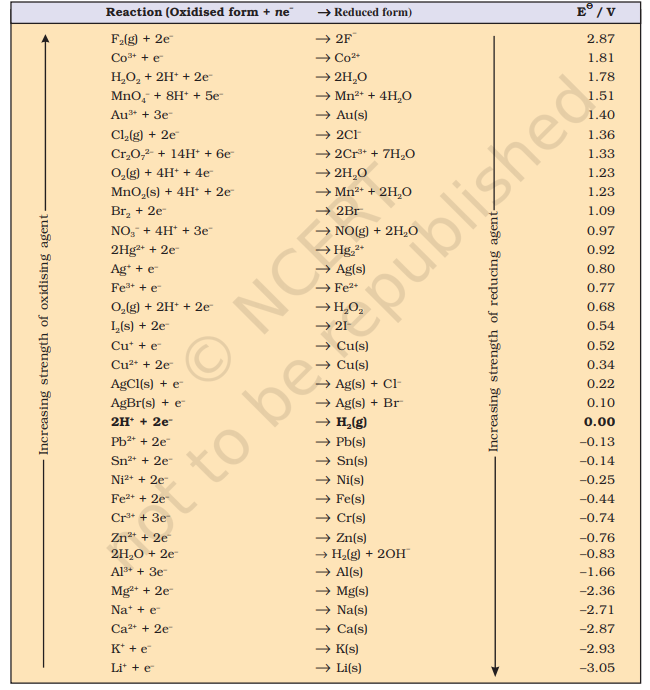
Fe3+(aq) and Cu(s).

Answer

The possible reaction between Fe3+(aq) and Cu(s) is given by,

$2\text{Fe}^{3+}_{(\text{aq})}+\text{Cu}_{(\text{s})}\rightarrow2\text{Fe}^{2+}_{(\text{s})}+\text{Cu}^{2+}_{(\text{aq})}$

$\text{Oxidation half equation:}\ \ \ \ \ \ \ \text{Cu}_{(\text{s})}\xrightarrow{\ \ \ \ \ \ }\text{Cu}^{2+}_{(\text{aq})}+2\text{e}^-;\ \ \text{E}^\circ=-0.34\text{V}\\\text{Reduction half equation:}\ \ [\text{Fe}^{3+}_{(\text{aq})}+\text{e}^-\xrightarrow{\ \ \ \ \ }\text{Fe}^{2+}_{(\text{s})}]\times2;\ \ \ \text{E}^\circ=+0.77\text{V}\\\overline{\ \ \ \ \ \ \ \ \ \ \ \ \ \ \ \ \ \ \ \ \ \ \ \ \ \ \ \ \ \ \ \ \ \ \ \ \ \ \ \ \ \ \ \ \ \ \ \ \ \ \ \ \ \ \ \ \ \ \ \ \ \ \ \ \ \ \ \ \ \ \ \ \ \ \ \ \ \ \ \ \ \ \ \ \ \ \ \ \ \ \ \ \ \ \ \ \ \ \ \ \ \ \ \ \ \ \ \ \ \ \ \ \ \ \ \ \ \ }\\\ \ \ \ \ \ \ \ \ \ \ \ \ \ \ \ \ \ \ \ \ \ \ \ \ \ \ \ \ \ \ \ 2\text{Fe}^{3+}_{(\text{aq})}+\text{Cu}_{(\text{s})}\xrightarrow{\ \ \ \ \ }2\text{Fe}^{2+}_{(\text{s})}+\text{Cu}^{2+}_{(\text{aq})};\ \ \ \text{E}^\circ=+0.43\text{V}$

E° positive for the overall reaction is positive. Hence, the reaction between Fe3+(aq) and Cu(s) is feasible.

Need a full question paper?

Generate a complete, print-ready paper with questions like this in minutes — across 16+ boards, with answer keys.

Start Generating Free

Similar questions

Find out the value of Kc for each of the following equilibria from the value of Kp:
$2\text{NOCl (g)}\rightleftharpoons2\text{NO (g) + Cl}_2\text{ (g)};\text{ k}_{\text{p}}=1.8\times10^{-2}\text{ at }500\text{K}$
Discuss the concept of hybridisation. What are the different types of hybridization that carbon can exhibit?
Apart from tetrahedral geometry, another possible geometry for $C H _{ 4 }$ is square planar with the four H atoms at the corners of the square and the $C$ atom at its centre. Explain why $C H _{ 4 }$ is not square planar?
$\text{Pent-1-yne}\xrightarrow[(\text{ii})\ \text{CH}_3-\text{I}]{(\text{i})\ \text{NaNH}_2/\text{NH}_3}\text{A}\xrightarrow[\text{Lindlar's catalyst}]{\text{H}_2}\text{B}\xrightarrow{\text{Br}_2}\text{‘C’}$

Identify A, B and C compounds and give their reactions.

What are the oxidation number of the underlined elements in the following and how do you rationalise your results?
CH3COOH
A compound on analysis was found to contain C = 34.6%, H = 3.85%, and 0 = 61.55%. Calculate its empirical formula.
  1. Which orbital is non-directional?
  2. What are the frequency and wavelength of a photon emitted during a transition from n = 5 state to n = 2 state in the hydrogen atom?

(h = 6.626 × 10⁻³⁴Js)

Which method can be used to find out the strength of reductant/oxidant in a solution? Explain with an example.
Write chemical reactions of:
  1. Wurtz-Fittig reaction.
  2. Kolbe's electrolytic method.
  3. B-Elimination reaction.
The pH of 0.1 M solution of cyanic acid (HCNO) is 2.34. Calculate the ionization constant of the acid and its degree of ionization in the solution.