Question
Using the standard electrode potentials given in the Table, predict if the reaction between the following is feasible:
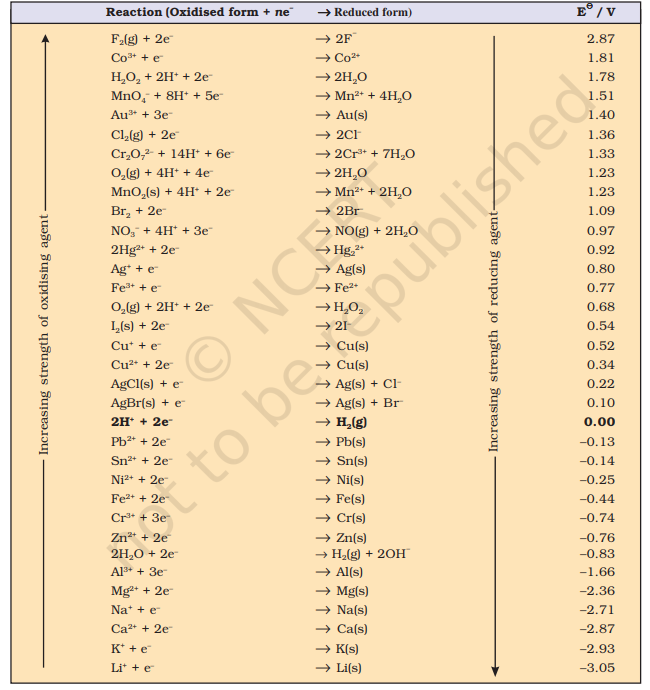
Ag+(aq) and Cu(s).

Answer

The possible reaction between Ag+(aq) + Cu(s) is given by,

$2\text{Ag}^+_{(\text{aq})}+\text{Cu}_{(\text{s})}\rightarrow2\text{Ag}_{(\text{s})}+\text{Cu}^{2+}_{(\text{aq})}$

$\text{Oxidation half equation:}\ \ \ \ \ \ \ \ \text{Cu}_{(\text{s})}\xrightarrow{\ \ \ \ \ }\text{Cu}^{2+}_{(\text{aq})}+2\text{e}^-;\ \ \text{E}^\circ=-0.34\text{V}\\\text{Reduction half equation:}\ \ [\text{Ag}^+_{(\text{aq})}+\text{e}^-\xrightarrow{\ \ \ \ \ }\text{Ag}_{(\text{s})}]\times2;\ \ \ \text{E}^\circ=+0.80\text{V}\\\overline{\ \ \ \ \ \ \ \ \ \ \ \ \ \ \ \ \ \ \ \ \ \ \ \ \ \ \ \ \ \ \ \ \ \ \ \ \ \ \ \ \ \ \ \ \ \ \ \ \ \ \ \ \ \ \ \ \ \ \ \ \ \ \ \ \ \ \ \ \ \ \ \ \ \ \ \ \ \ \ \ \ \ \ \ \ \ \ \ \ \ \ \ \ \ \ \ \ \ \ \ \ \ \ \ \ \ \ \ \ \ \ \ \ \ \ \ \ \ }\\\ \ \ \ \ \ \ \ \ \ \ \ \ \ \ \ \ \ \ \ \ \ \ \ \ \ \ \ \ \ \ \ 2\text{Ag}^+_{(\text{aq})}+\text{Cu}_{(\text{s})}\xrightarrow{\ \ \ \ \ }2\text{Ag}_{(\text{s})}+\text{Cu}^{2+};\ \ \ \text{E}^\circ=+0.46\text{V}$

E° positive for the overall reaction is positive. Hence, the reaction between Ag+(aq) and Cu(s) is feasible.

Need a full question paper?

Generate a complete, print-ready paper with questions like this in minutes — across 16+ boards, with answer keys.
Start Generating Free

Similar questions

1. Two litres of an ideal gas at a pressure of 10 atm expands isothermally at $25^{\circ} C$ into a vacuum until itstotal volume is 10 litres. How much heat is absorbed and how much work is done in the expansion against a constant external pressure of 1 atm?
2. What is free energy in terms of thermodynamics?
3. Define a system.
An alkyl halide 'A' of formula C6H13Cl on treatment with alcoholic KOH gives two isomeric alkenes 'B' and 'C' with molecular formula C6H12. Both alkenes on hydrogenation give 2, 3-dimethyl butane. Predict the structure of ‘A’, 'B' and 'C'.
Calculate the uncertainty in the position of a dust particle with mass equal to 1mg if the uncertainty in velocity is 5.5 × 10⁻²⁰ms-1. (h = 6.626 × 10⁻³⁴Js)
10 mL of $H _2$ combine with 5 mL of $O _2$ to form water. When 200 mL of $H _2$ at STP is passed over heated CuO , the CuO loses 0.144 g of its weight. Does the above data correspond to the law of constant composition?
How will you convert benzene into:
m-nitrochlorobenzene.
Write down the quantum numbers n, and I for the following orbitals.
  1. 3dx2 - y2
  2. 4dz2
  3. 3dxy
  4. 4dxz
  5. 2pz
  6. 3px
Yellow light emitted from a sodium lamp has a wavelength $(\lambda)$ of 580 nm. Calculate the frequency (ν) and wavenumber $(\bar{\text{v}})$ of the yellow light.
What are the oxidation number of the underlined elements in the following and how do you rationalise your results?
Fe3O4
  1. Draw cis and trans-structures for Hex-2-ene. Which isomer will have higher boiling point and why?
  2.  

Give the name and atomic number of the inert gas atom in which the total number of d-electrons is equal to the difference in numbers of total p and s electrons.