Question
Using the standard electrode potentials given in the Table, predict if the reaction between the following is feasible:
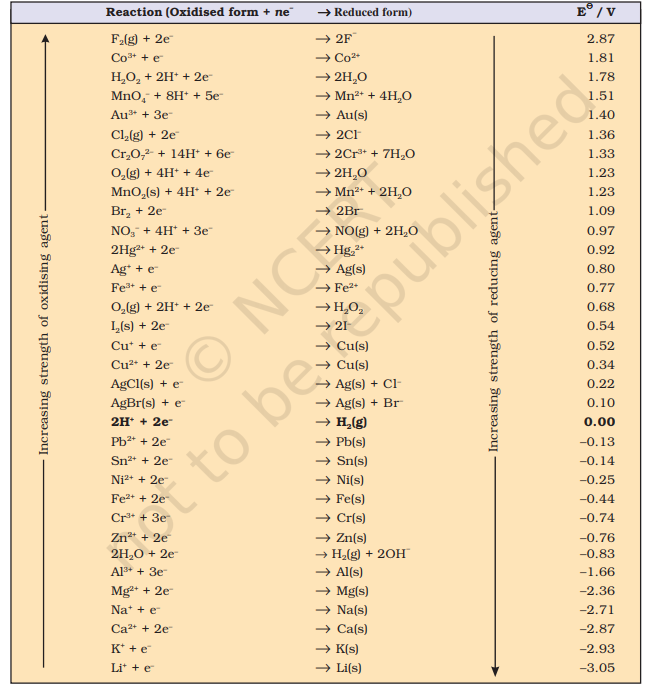
Br2(aq) and Fe2+(aq).

Answer

The possible reaction between Br2(aq) and Fe2+(aq) is given by,

$\text{Br}_{2(\text{s})}+2\text{Fe}^{2+}_{(\text{aq})}\rightarrow2\text{Br}^-_{(\text{aq})}+2\text{Fe}^{3+}_{(\text{aq})}$

$\text{Oxidation half equation:}\ \ \ \ \ \ \ \text{Fe}^{2+}_{(\text{aq})}\xrightarrow{\ \ \ \ \ \ }\text{Fe}^{3+}_{(\text{aq})}+\text{e}^-]\times2\ \ ;\text{E}^\circ=-0.77\text{V}\\\text{Reduction half equation:}\ \ \text{Br}^{}_{2(\text{aq})}+2\text{e}^-\xrightarrow{\ \ \ \ \ }2\text{Br}^{-}_{(\text{aq})}\ \ \ \ \ \ \ \ \ ; \text{E}^\circ=+1.09\text{V}\\\overline{\ \ \ \ \ \ \ \ \ \ \ \ \ \ \ \ \ \ \ \ \ \ \ \ \ \ \ \ \ \ \ \ \ \ \ \ \ \ \ \ \ \ \ \ \ \ \ \ \ \ \ \ \ \ \ \ \ \ \ \ \ \ \ \ \ \ \ \ \ \ \ \ \ \ \ \ \ \ \ \ \ \ \ \ \ \ \ \ \ \ \ \ \ \ \ \ \ \ \ \ \ \ \ \ \ \ \ \ \ \ \ \ \ \ \ \ \ \ \ \ \ }\\\ \ \ \ \ \ \ \ \ \ \ \ \ \ \ \ \ \ \ \ \ \ \ \ \ \ \text{Br}^{}_{2(\text{aq})}+2\text{Fe}^{2+}_{(\text{aq})}\xrightarrow{\ \ \ \ \ }2\text{Br}^{-}_{(\text{aq})}+2\text{Fe}^{3+}_{(\text{aq})}\ \ \ \ \ ;\text{E}^\circ=-0.32\text{V}$

Here, E° for the overall reaction is positive. Hence, the reaction between Br2(aq) and Fe2+(aq) is feasible.

Need a full question paper?

Generate a complete, print-ready paper with questions like this in minutes — across 16+ boards, with answer keys.

Start Generating Free

Similar questions

How will you calculate work done on an ideal gas in a compression, when the change in pressure is carried out in infinite steps?
Consider the reactions:

O3(g) + H2O2(l) → H2O(l) + 2O2(g)

Why it is more appropriate to write these reactions as:

O3(g) + H2O2(l) → H2O(l) + O2(g) + O2(g)

Also suggest a technique to investigate the path of the above redox reactions.

If Kw = 49 × 10-14, what will be neutral pH of H2O?
PbO and $PbO _2$ react with HCl according to the following chemical equations:
$
\begin{aligned}
& 2 PbO+4 HCl \rightarrow 2 PbCl_2+2 H_2 O \\
& PbO_2+4 HCl \rightarrow PbCl_2+Cl_2+2 H_2 O
\end{aligned}
$
Why do these compounds differ in their reactivity?
How will you calculate work done on an ideal gas in a compression, when change in pressure is carried out in infinite steps?
In a reaction
$A + B _2 \rightarrow AB _2$
Identify the limiting reagent, if any, in the following reaction mixtures.
(i) 300 atoms of A + 200 molecules of B
(ii) 2 mol A + 3 mol B
(iii) 100 atoms of A + 100 molecules of B
(iv) 5 mol A + 2.5 mol B
(v) 2.5 mol A + 5 mol B
An alkyl halide (X) of formula C3H13Cl on treatment with alcoholic KOH or potassium tert-butoxide gives two isomeric alkenes Yand Z(C6H12). Both alkenes on hydrogenation give 2, 3-dimethylbutane. Predict the structure of X, Y and Z.
1. Two litres of an ideal gas at a pressure of 10 atm expands isothermally at $25^{\circ} C$ into a vacuum until itstotal volume is 10 litres. How much heat is absorbed and how much work is done in the expansion against a constant external pressure of 1 atm?
2. What is free energy in terms of thermodynamics?
3. Define a system.
How do atomic radius vary in a period and in a group? How do you explain the variation?
The Ksp values of two slightly soluble salts AB and PQ2 are each equal to 4.0 × 10⁻¹⁸. Which salt is more soluble?